“The first anatomically modern humans (Homo sapiens) evolved in Africa around 300,000 years ago. By then, successive waves of upright apes, including Homo erectus and the ancestors of the Neanderthals, had been making their way into Europe from Africa for nearly two million years. Our species was destined to follow in their footsteps. By about 180,000 years ago Homo sapiens had pushed as far north as present-day Israel, where they may have hybridised with Neanderthals. But for reasons that remain unclear, these first African expatriates did not reach Europe. It was not until about 60,000 years ago, when humans again emerged out of Africa, that our species spread.”
From “Europe The first 100 Million Years” by Tim Flannery.
Severe ice ages were a hallmark of our planet for hundreds of millions of years. Caused by climatic variances and lasting for up to 100,000 years these ice ages impacted the survival and extinction of much flora and fauna on a massive scale. Adaption and migration to the warmer regions of southern Spain, Italy and Greece enabled survival for some fauna – however more than half of Europe’s mammal species disappeared with the arrival of the most recent ice ages.
Two factors enabled the Homo sapiens to survive and thrive the most recent and less severe ice age (40,000 to 10,000 years ago): fire and language.
The control and use of fire enabled warmth, protection and cooked food.
Language enabled the sharing of new technology (tools and weapons) and knowledge of their environment through generational story telling between nearest bands of hunters and gatherers.
These two advancements made possible the collection of immeasurable amounts of information about the seasons, edible plants, animal migrations and weather patterns. Communication and cooperation was enhanced by music, dance and art which has been preserved on sheltered rock overhangs and inside caves.
Prehistoric cave art is a vital window into the cognitive and cultural evolution of early humans. It shows that our ancestors possessed complex symbolic thought, language, and probable spiritual beliefs, showing that early human existence was defined by more than just basic survival. This art, often including symbols and representational animal figures indicates the development of externalized language and graphic communication long before writing.
More than 400 caves with prehistoric art have been found across Europe, Asia, Australia, Africa and the Americas. The true significance of cave art remains debated, particularly as recent discoveries and advanced dating methodology continue to push out the actual time frame it may have begun.
Was it initially what we could classify as graffiti?
Do the animals, handprints, and abstract symbols give insight into probable ancient symbolic and ritualistic practices?
Many scholars believe caves functioned as sacred spaces. Detailed drawings of formidable, now-extinct megafauna (such as mammoths, cave hyenas, cave bears, cave lions, and woolly rhinoceroses) provide a visual record of Ice Age biodiversity and animal behaviour. The level of coordination required to prepare pigments and paint deep underground implies highly communal, cooperative societies rather than isolated individuals. Perhaps it signifies hunting magic or is it the simple recording of environmental observations.
Our ancestors would also have had to compete with some of these animals for possession of the caves; factors which the advanced tool & hunting weapons and language cooperation would lead them to be the dominant species in a relatively short time. Consider that this “short time” may have be many thousands of years.
Artists utilized pigments like charcoal, chalk, and iron oxides (hematite/red clay).
Painters utilized natural rock contours to give figures a 3-dimensional appearance and employed shading, stumping, and spraying to execute their works.
Reaching Australia from Asia is widely considered to have involved the first planned, long-distance sea crossing undertaken by our species. The earliest intentional ocean voyages over shorter distances took place when Homo sapiens spread beyond the extreme eastern edge of Asia (Sunda).
WHERE IS THE OLDEST EVIDENCE OF CAVE ART?
Currently, the oldest cave art, dated as 67,800 years ago, has been found inside the Liang Metanduno, a limestone cave on Muna island, Southeast Sulawesi, Indonesia. It comprises a hand stencil – pigment in liquid form sprayed over a hand against the wall of the cave. The discovery supports the northern maritime route of early human migration from Sunda (Asia) to Sahul (Australia-New Guinea) and suggests that early homo sapiens possessed complex symbolic and artistic abilities. The cave contains more than 300 newer paintings of humans, horses, deer, pigs, suns and boats. These later paintings, dated as 64,800 years old were painted over the hand stencils. Wikipedia says that there is some scepticism about the validity of the dates of the hand stencils.
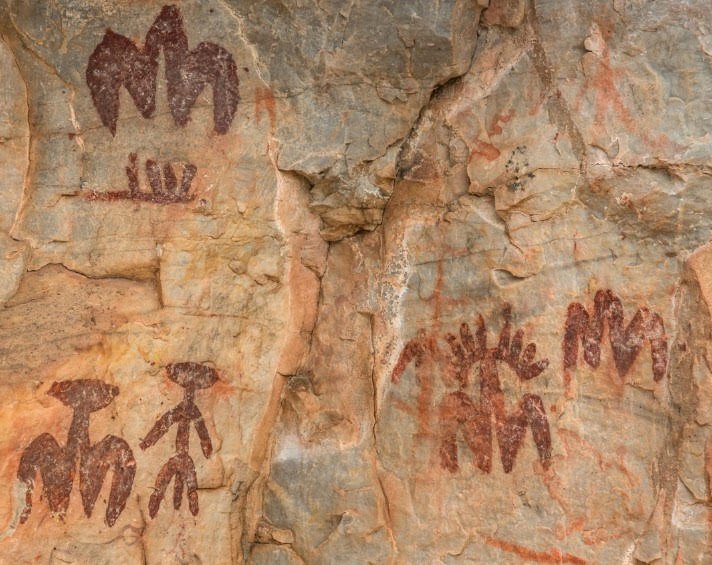
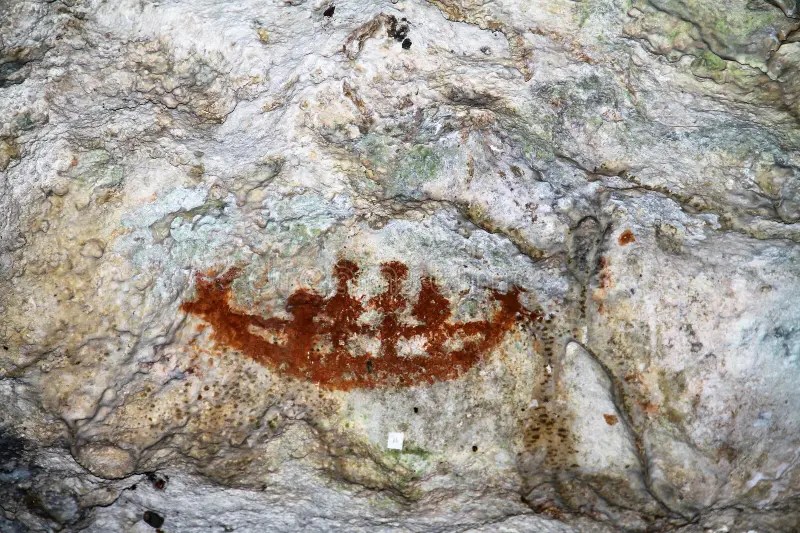
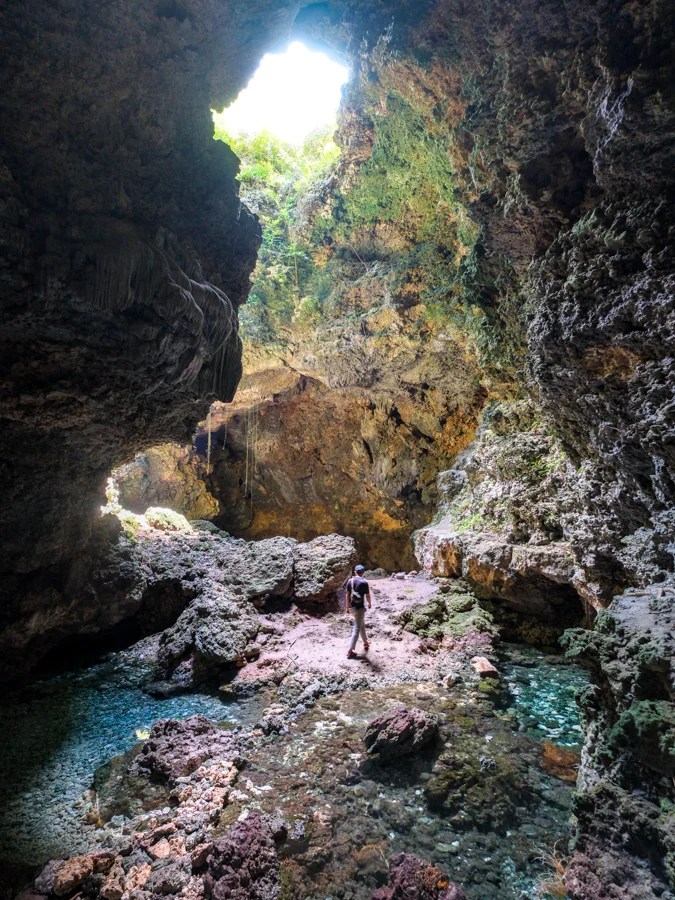
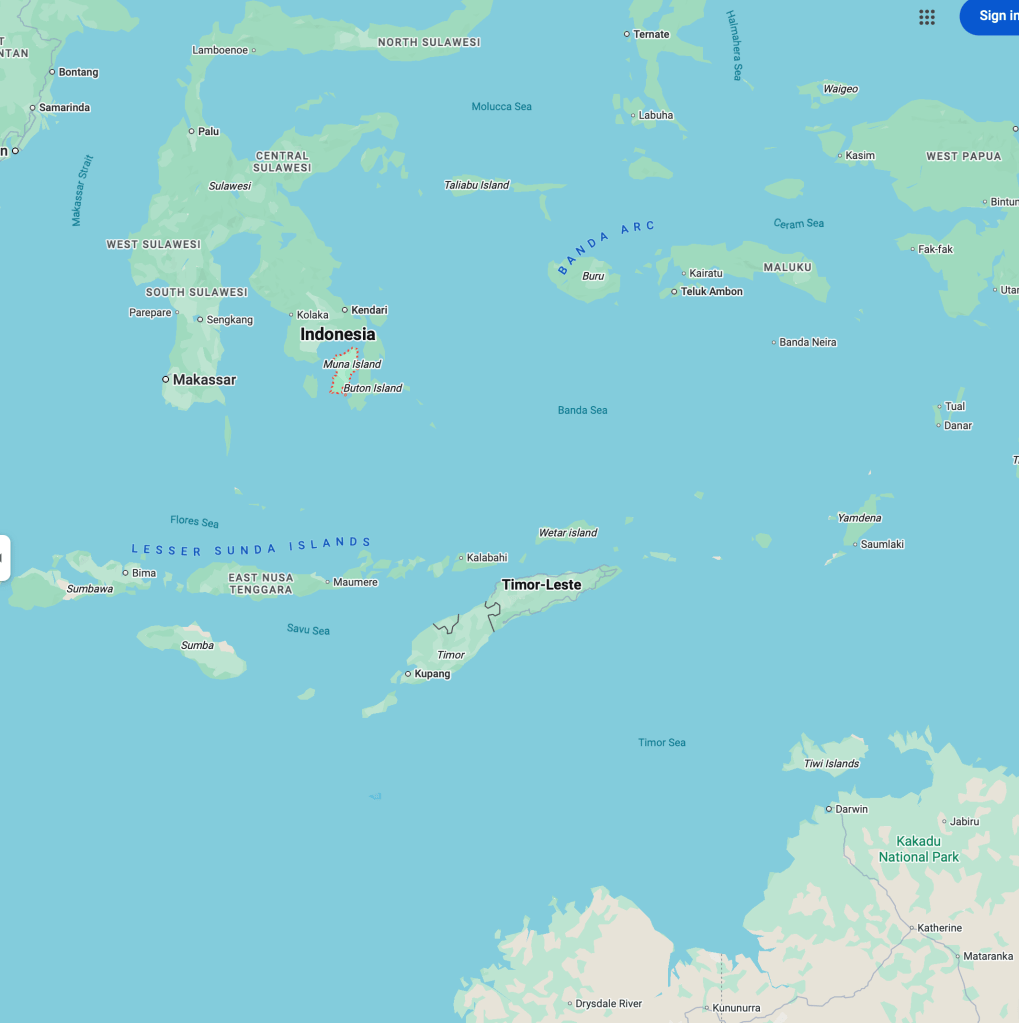
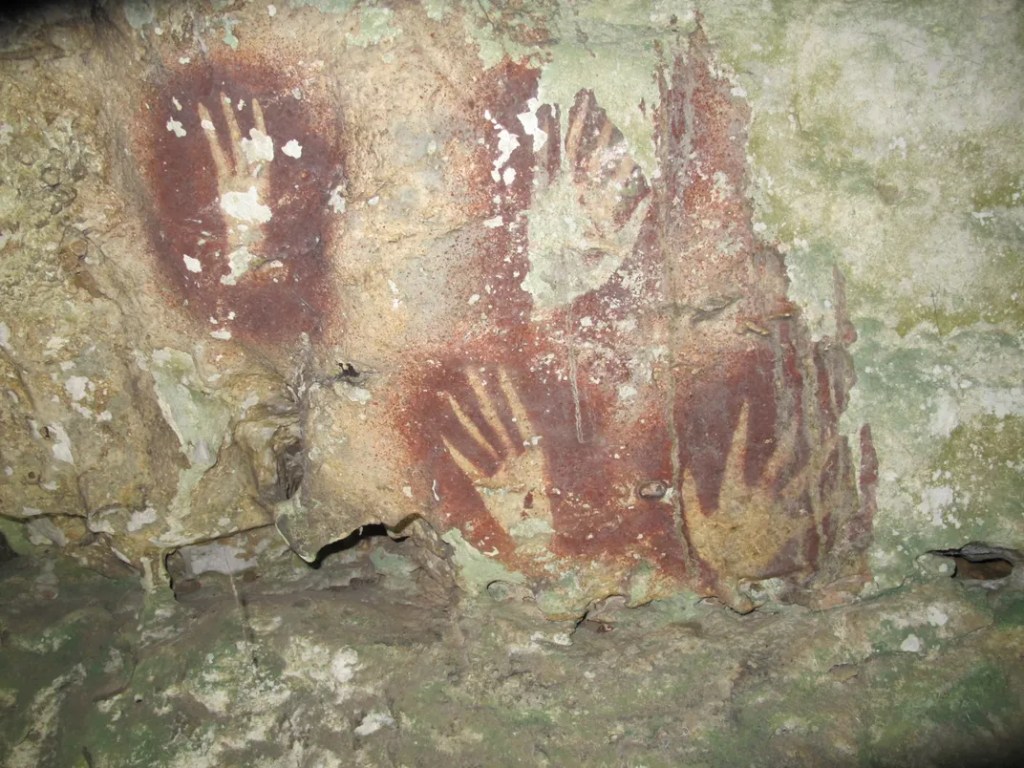
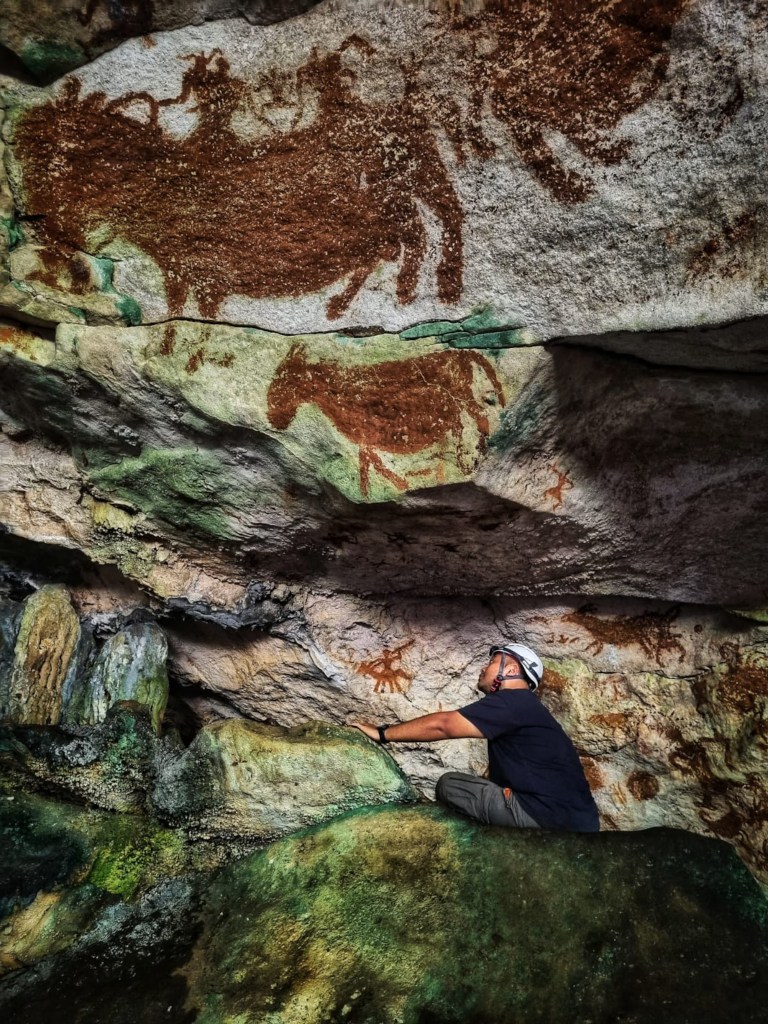
“Researchers don’t know for sure which species made the newly discovered hand stencil on Muna Island. However, based on the fact that the artist appears to have retouched the work, they suspect it may have been Homo sapiens. If so, the individual may have been an ancestor of the first modern humans to reach Australia some 60,000 years ago. The discovery on Muna Island, then, hints at a possible route humans might have taken to reach the continent, though scientists say more research is needed to prove that theory. If true, it could mean these groups “weren’t just surviving; they were creating art, crossing oceans and carrying complex symbolic traditions,” Chris Clarkson, an archaeologist at Griffith University in Australia who wasn’t involved in the study.
Until now, the world’s oldest known rock art was a 66,700-year-old Neanderthal hand stencil in northern Spain. If the researchers’ conclusions are correct, then the Muna Island hand stencil is 1,100 years older.
Both the Neanderthal and the Muna Island handprints appear to have been created using a similar technique: probably by spraying mouthfuls of ochre mixed with water over a flattened hand. “But then the modern human did something different,” study co-author Adam Brumm, an archaeologist at Griffith University, tells New Scientist’s James Woodford. “They deliberately altered the outlined fingers of the stencil to artificially narrow the digits and make the tips more ‘pointy.’”
This adds an element of playfulness to the artwork. The Muna Island piece shows signs of “creative imagination and abstract thinking” that are largely absent from the Neanderthal work, he says.
However, it’s also possible that the artist modified the handprint accidentally. Additionally, the researchers cannot definitively rule out the possibility that some other species made the masterpiece.
“To call this complex is rather over-interpreting the hand stencil,” says Paul Pettitt, an archaeologist at Durham University in England who was not involved with the new research, to the Guardian’s Ian Sample. “In any case, Neanderthals were modifying hand stencils, so why should this be a behaviour restricted to Homo sapiens?”
The hand stencil adds to the growing catalogue of prehistoric art found in Sulawesi. Here, researchers have also identified a 51,200-year-old pig depicted alongside several human-like figures. They’ve also discovered other hand stencils, as well as figurative paintings of animals and “anthropomorphs,” or figures with human-like qualities.
On its own, the cave on Muna Island appears to have been a major hotbed for art until about 20,000 years ago, according to a statement from Griffith University. Evidence suggests human ancestors were producing paintings there repeatedly for at least 35,000 years.” Smithsonian magazine: January 23, 2026.
Art, language, oral storytelling, sharing information and cooperation.
All in evidence about 40,000 years ago? Maybe 50,000?
I’m happy to claim them as my ancestors!
This book by Tim Flannery was my primary source and has been a favourite of mine for quite a few years. I think I’ve purchased and distributed it to more than a dozen people all who have expressed interest in his work. Highly recommended!

~ ~ ~ ~ ~ ~ ~
WHERE DID ALL THIS INFORMATION COME FROM?
Encyclopaedia Britanica
https://www.britannica.com/science
Natural History Museum
The Leakey Foundation
The Bradshaw Foundation
https://www.bradshawfoundation.com
The Cosquer Cave
https://www.grotte-cosquer.com/en/homepage
Nature
Wikipedia
https://en.wikipedia.org/wiki/Liang_Metanduno
The Megalithic Portal
Smithsonian National Museum of Natural History
“Europe The First 100 Million Years” Tim Flannery
“Origin Story A Big History of Everything” David Christian
“A Little History of Archaeology” Brian Fagan
“Archaeology The Whole Story” Paul Bahn – General Editor
“Atlas of the Invisible” James Cheshire & Oliver Uberti
“Death as told by a Sapiens to a Neanderthal” Juan Jose Millas & Juan Luis Arsuaga
“Maps of Time” David Christian
“Sapiens A Brief History of Humankind” Yuval Noah Harari
“Aerial Atlas of Ancient Britain” David R Abram
“Homo Deus” Yuval Noah Harari
“The Dawn of Everything” David Graeber and David Wengrow
“The Silk Roads A New History of the World” Peter Frankopan
“The Earth Transformed an Untold History” Peter Frankopan

