Quite simply, where did we come from and what happened on the way.
An origin story is a foundational narrative that explains how something or someone came into existence. It’s important to recognize that many different types of origin stories exist.
Some are thousands of years old and some are newer. They come from varying cultures and religions, but one theme runs through all of them: It seems that all humans are interested in understanding their origin to some degree. Creation stories can have many versions, passed down by word of mouth from generation to generation. Some of these oral stories have been written down by settlers from other places; some have been written down after writing was in existence; some have been set in stone (hieroglyphics).
A broad range of Origin Stories include Chinese, Judeo-Christian, Greek, Zulu, Efik (Nigerian), Mayan, Iroquois, Maori, Hebrew, Norse, Aztec, Australian Indigenous, Egyptian and Celtic. The concept of creation and/or genesis is a very common thread.
To understand “the beginning” of our planet and then what subsequent markers, or thresholds we can utilise to explain a probable and evolutionary timeline is both simple and complex. Big Bang, the origin of our universe, is currently approximated as occurring 13.8 billion years ago. That number is immense and requires a complex explanation of what happened during that timeline.
I’m going to use David Christian’s book, “Origin Story” to put this huge number – 13.8 billion years into an acceptable account of the steps or thresholds that bring us to now, the year 2026, the first quarter of 21st century where elsewhere in this blog I have been able to relay smaller stories of individual ancestors within Vicki and Roger’s family history. The overall time scale is huge, almost incomprehensible.
“Today, a new framework for understanding is emerging in our globalised world. It is being built, developed and propagated collectively by thousands of people from multiple scholarly fields and in numerous countries. Linking these insights can help us see things that we cannot see from within the boundaries of a particular discipline; it lets us view the world from a mountaintop instead of from the ground. We can see the links connecting the various scholarly landscapes, so we can think more deeply about broad themes such as the nature of complexity, the nature of life, even the nature of our own species! After all, at present we study humans through many different disciplinary lenses (anthropology, biology, physiology, primatology, psychology, linguistics, history, sociology), but specialization makes it difficult to stand back far enough to see humanity as a whole.” David Christian “Origin Story”
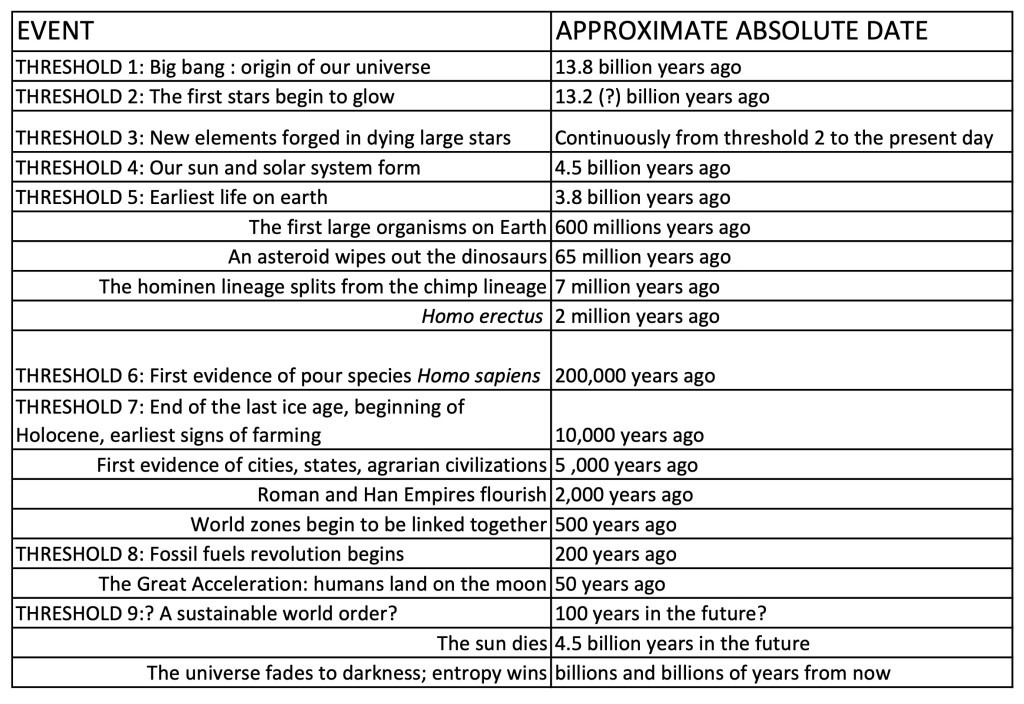
I will “rush” through David Christian’s Origin Story by simply including the table above. I’ll pick it up at a point about 50,000 years ago when cave or rock art is first evidenced. And from there, I’ll have a good look at a time frame roughly between 7,000 and 4500 hundred years ago, when vast megalithic monuments began to rise across Europe. These massive stone structures, often used as collective burial chambers, are a testament not only to strong local traditions but also hint at potential cultural exchanges between distant communities; something that became possible at the end of the last ice age as we humans developed farming, phasing out hunting and gathering.
The aspect that boggles my mind is the time scale of human evolution and the thresholds that evidence change, however slow it might be. How different and similar were these ancestors to us, now living in the luxury and anxiety of our current capitalistic world?
Let’s briefly look at one of the most dramatic historical events – the dinosaurs and their “sudden” demise.
Dinosaurs lived during the Mesozoic Era, a period spanning from about 245 million years ago to 65 million years ago. This massive timeframe is divided into three geological periods: the Triassic, Jurassic, and Cretaceous. All non-bird dinosaurs went extinct 65 million years ago, though their descendants (modern birds) are still with us today.
The dinosaur timeline spans nearly 180 million years and is broken down into three distinct geological chapters which most experts agree is probable, and are happy with the labels (thresholds):
- Triassic Period (approx. 252 to 201 million years ago): Dinosaurs first evolved during this time, starting as small, agile reptiles on the supercontinent Pangaea.
- Jurassic Period (approx. 201 to 145 million years ago): The supercontinent began to break apart, and the climate became more humid. This allowed dinosaurs to grow to massive sizes and diversify greatly, leading to iconic giants like the Brachiosaurus and Stegosaurus.
- Cretaceous Period (approx. 145 to 65 million years ago): Dinosaurs peaked in variety, including legendary predators like Tyrannosaurus rex. This period ended abruptly 65 million years ago with the Chicxulub asteroid impact.
Mammals/marsupials survived the asteroid either by their good fortune of living in water, living underground or being small and readily adaptive to sudden change.
The evolution of monkeys and apes started about 30 million years ago and it would take a brave soul to deny that the next 35 million years saw the evolution of homo sapiens.
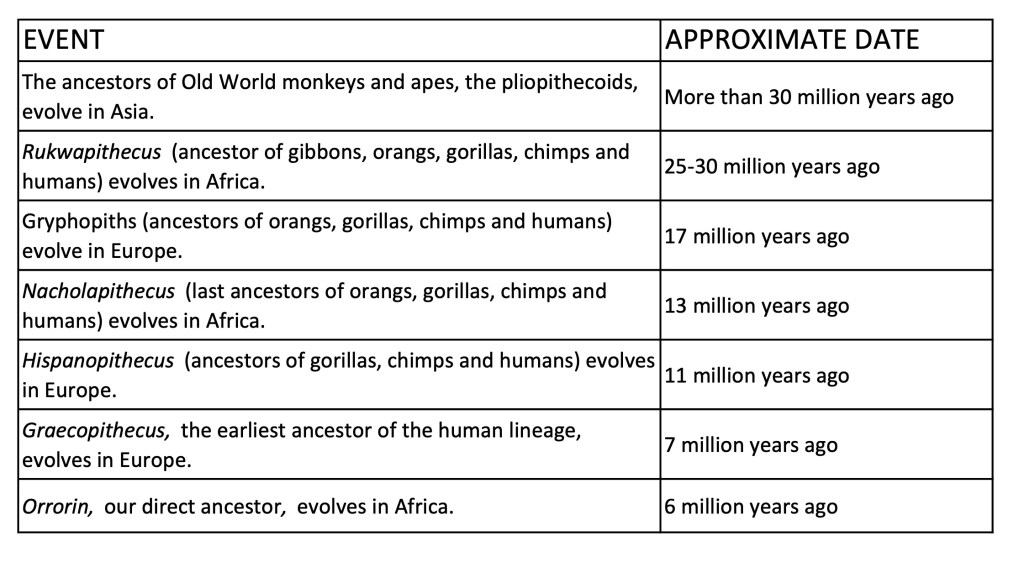
Once the homo sapiens has come down from the trees and is now walking upright over the plains our time between discoveries and adaptation “quickens”.
All experts seem to agree that the following timeline and associated labels ( thresholds) is probably correct – to an approximated few hundreds (or thousands) of years!
The Stone Age (Prehistory)
This vast period is characterized by the reliance on stone for tool-making and spans from about 3.3 million years ago until the discovery of metallurgy. It is divided into three distinct phases:
- Paleolithic Era (c. 2.5 million – 10,000 BCE): The “Old Stone Age.” Early humans lived as nomadic hunter-gatherers, used primitive tools, mastered fire, and created the earliest cave art.
- Mesolithic Era (c. 10,000 – 8,000 BCE): The “Middle Stone Age.” A transitional phase where humans crafted smaller, more sophisticated tools (microliths) and began to settle into more permanent coastal or river communities.
- Neolithic Era (c. 10,000 – 2,000 BCE): The “New Stone Age.” Marked by the dawn of farming, pottery, weaving, and the construction of permanent villages.
The Metal Ages
As early humans developed the ability to smelt metals, tool-making, trade, and weaponry underwent a revolution.
- Chalcolithic Period (c. 5,000 – 3,000 BCE): Also known as the Copper Age, this was a transitional period where early copper metallurgy began to appear alongside traditional stone tools.
- Bronze Age (c. 3,000 – 1,200 BCE): People learned to alloy copper with tin to create bronze, which was much harder and more durable. This era gave rise to the first writing systems, early city-states, and organized governance.
- Iron Age (c. 1,200 – 500 BCE): The discovery of techniques to forge iron revolutionized agriculture and warfare. Iron was more abundant and stronger than bronze, leading to widespread empires and advanced early city planning.
Historical Eras
With the invention of writing, the prehistoric period concluded, opening up the timeline of recorded human history.
- Ancient Era: Includes early civilizations in Mesopotamia, Egypt, and the Classical Era (Greece and Rome).
- Post-Classical & Modern Eras: Encompasses the Middle Ages, the Renaissance, and the modern world.
A quick summary:
The Big Bang was about 13.8 billion years ago.
Dinosaurs were on our planet for about 180 million years until they were wiped out 65 million years ago.
Apes and monkeys in some form emerged about 30 million years ago.
The first upright human ancestor appeared about 2 million years ago
The first evidence of our species, homo sapiens, dates back to 200,000 years ago.
The first evidence of rock art dates back to about 50,000 years ago
The end of the last ice age was about 10,000 years ago.
Stonehenge’s construction started about 4,500 years ago and took more than 1,500 years to complete.
Most of Roger and Vicki’s ancestors came to Terra Australis from Great Britain about 150-200 years ago.
Some were convicts, all were brave.
Some of them have ancestral roots from Scandinavia, Asia, Africa and Eastern Europe.
All of them have evolved from fish.
That’s it; this simple intro to my Origin Story is complete. Very short and sweet.
If you are at all interested or intrigued by this scant post go to the web and do your own research. There is a bibliography, I can highly recommend visiting and/or perusing these references.
The problem with time is that we don’t know how much we have.
~ ~ ~ ~ ~ ~ ~
WHERE DID ALL THIS INFORMATION COME FROM?
Encyclopaedia Britanica
https://www.britannica.com/science
Natural History Museum
The Leakey Foundation
The Bradshaw Foundation
https://www.bradshawfoundation.com
The Cosquer Cave
https://www.grotte-cosquer.com/en/homepage
“Europe The First 100 Million Years” Tim Flannery
“Origin Story A Big History of Everything” David Christian
“A Little History of Archaeology” Brian Fagan
“Archaeology The Whole Story” Paul Bahn – General Editor
“Atlas of the Invisible” James Cheshire & Oliver Uberti
“Death as told by a Sapiens to a Neanderthal” Juan Jose Millas & Juan Luis Arsuaga
“Maps of Time” David Christian
“Sapiens A Brief History of Humankind” Yuval Noah Harari
“Aerial Atlas of Ancient Britain” David R Abram
“Homo Deus” Yuval Noah Harari
“The Dawn of Everything” David Graeber and David Wengrow
“The Silk Roads A New History of the World” Peter Frankopan
“The Earth Transformed an Untold History” Peter Frankopan
 miles of irvings