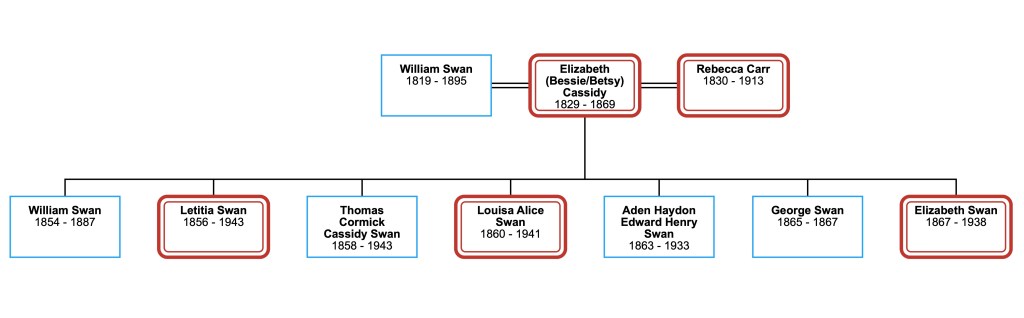
Louisa Alice Swan was born in West Maitland on the 2nd of July 1860, the fourth child & second daughter to William Swan (1819-1895) and Betsy (Cassidy/Cain) Swan. Louisa was also the last of William & Betsy’s seven children to be born in West Maitland; the youngest three, Haydon/Edward, George and Elizabeth were all born in Sydney. Louisa married a radical, militant and socialist Sicilian, Francesco Sceusa, in Sydney on June the 5th 1878 and she died in Orange, New South Wales in 1941. Francesco and Louisa did not have children.
Louisa’s story is very sad. She was seventeen when she married Francesco at the Sydney Registry Office, just a few weeks before her eighteenth birthday. The marriage document shows that her father, William Swan, signed his permission for her to marry Francesco. For the entirety of their married life Louisa played a quiet, supportive role to her obsessive and politically driven Sicilian husband.
The nature of Francesco’s total involvement in all political aspects of socialism saw Louisa become extremely anxious about Francesco and very concerned with his safety. At one stage, Francesco armed himself with a revolver as a consequence of threats from political enemies.
In Sydney, after an alarming medical diagnosis of Francesco she attempted suicide. Family lore suggests that Louisa was forced to watch her husband being tortured, an incident that greatly attributed to her fragile state of mental health.
She and Francesco were living in Sicily in 1919 when he died and she was left isolated with little support, no employment and didn’t fully understand Italian, especially the Sicilian dialect. Her life was devoted to her husband’s wellbeing and support, both in a physical, practical sense and also with encouragement and blind belief in Francesco’s political philosophy.
In essence, Louisa played a very distant second fiddle to the driven global socialist that she married.
All my efforts to research the life of Louisa Swan were swamped by the volume of stories about her husband, Francesco Sceusa. As noted earlier, Louisa was the almost invisible supporter of Francesco during their marriage of just more than forty years. Francesco was a very active and driven revolutionary socialist, representing Australia on a world stage and constantly battling the conservative elements of politics in both Italy and Australia. He was an extremely energetic and pugnacious man who had been exiled from Italy. He wrote incessantly, promoting the causes of the working class, through newspapers, journals, essays, articles, pamphlets and letters, constantly striving to play a prominent role in establishing the meaningful foundations of socialism.
Much of what has been written about Francesco is in Italian. My entry in this blog about my youthful belief that I was a direct descendant of Julius Caesar (ARRIVEDERCI ITALIANO ASCENDENZA!) unfortunately did not equip me with any real translation skills. I have relied on ever changing digital apps in an attempt to provide a semblance of accuracy in translating the many documents found online in Italian. There are also many articles that I found that were written in English. Please accept my apologies if any serious errors emerge as a result of my rudimentary language competency. And please, feel free to offer your services in this regard!
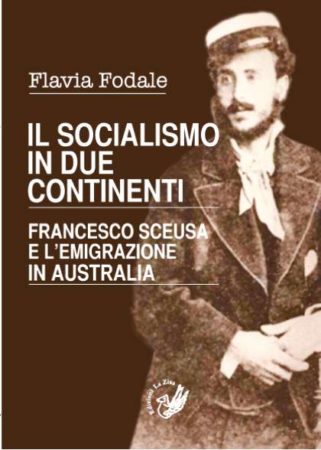
I did find a small book on Francesco written by Flavia Fodale which included a 3-page chapter on Louisa, addressing some of the difficulties she faced during their marriage as the “foreign” wife of a dynamic, forceful and confrontational political agitator who could and would act in a communistic and anarchistic manner if he felt any situation demanded it.
The following article is a short sketch of Francesco’s life from the Australian Dictionary of Biography, Volume II,written by the Australian historian, Gianfranco Cresciani which shows the dynamism of Francesco Sceusa and the difficulty Louisa Swan would have had in assimilating into his sensitive and highly strung life.
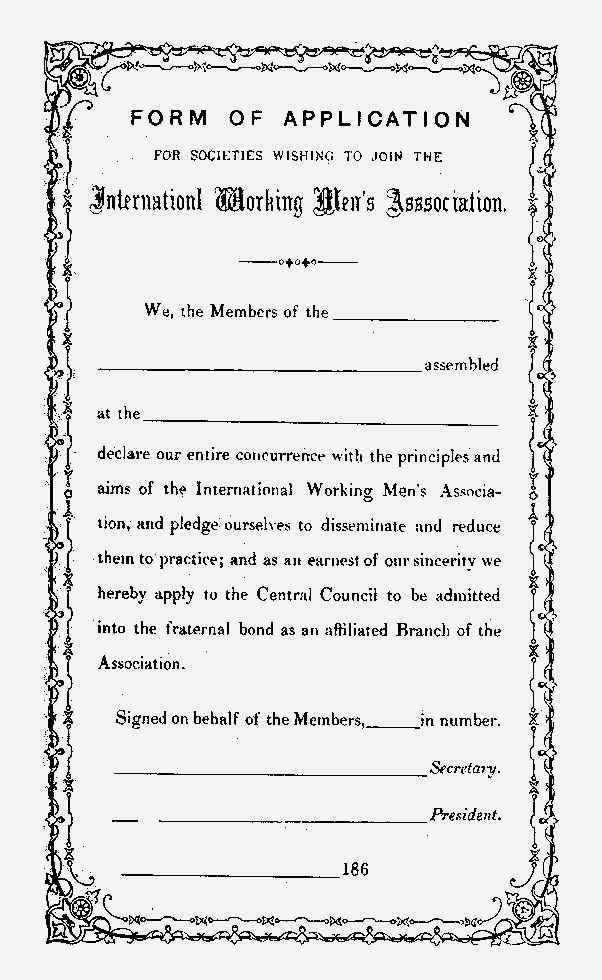
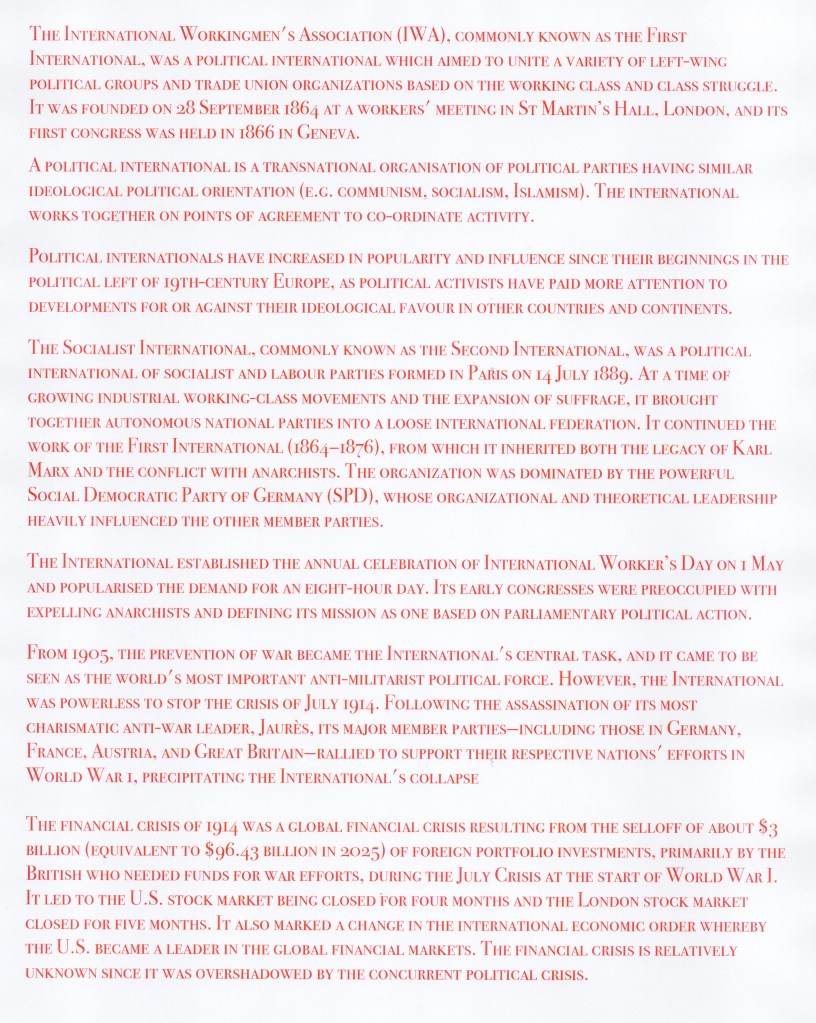
“Francesco Sceusa (1851-1919), socialist, was born on 21 November 1851 at Trapani, Sicily, son of Giuseppe Sceusa, grocer, and his wife Concetta, née Cavasino. As a boy he witnessed the events of the Risorgimento and later recalled the church bells being taken down in Sicily in 1861 to make cannons for Garibaldi’s army. He studied at the local technical institute, marine engineering at the Nautical College, Palermo, and architecture and civil engineering at the University of Naples, where he was involved with the republican and anarchist movements and joined Karl Marx’s International Working Men’s Association (the Internationale). Sceusa’s participation in the 1874 riots ruined his professional career. Returning to Trapani next year, he published a socialist journal, Lo Scarafaggio (the Scarab). In September 1876 he was ‘admonished’ by the police magistrate as an ‘agitator’ and next March was discredited when accused in parliament of belonging to the Mafia.
Forced to leave Sicily, Sceusa sailed for Batavia (Djakarta). He travelled in India, Singapore, South China, North Queensland and eventually reached Sydney on 5 December 1877, where on 15 June 1878 he married Louisa Swan; they were childless. He became a Freemason and in May 1879 joined the survey branch of the Department of Lands, working in Sydney, Orange and Bathurst as a draughtsman. In 1883 he was a foundation member of the (Royal) Geographical Society of Australasia and in 1892 was naturalized.
Sceusa directed his political activities towards assisting Italian immigrants. He promoted an Italian benevolent society in 1881 and later the Italian Working Men’s Benefit Society of which he was president. He aided the Italian victims of the Marquis de Rays‘ expedition, who eventually settled on the Richmond River. On 17 June 1882 he organized a commemoration of Garibaldi’s death, attended by over 10,000 people. He waged campaigns to prevent the exploitation of Italians’ labour on the cane-fields of North Queensland and of their children as beggars and organ-grinders in Sydney and Melbourne, and fought the conservatism of the local Italian establishment. In January 1885 he founded the first Italian newspaper in Australia, the Italo-Australiano, but it ceased publication when he was transferred to Orange in July. He was also Australian correspondent for several newspapers in Italy. He had ‘a dapper, spare figure, with moustache, upstanding black hair … Although mild-mannered, he was touchy and excitable’.
A founder of the Australian Socialist League in 1890, Sceusa as secretary of the Social Democratic Federation represented Australian socialists at the Socialist International’s congress at Zurich, Switzerland, in April 1893. He refused to be classified as part of the English delegation and secured an independent vote for Australia. On the way home, many thousands welcomed him and his wife at Trapani; sixty mandolin players serenaded them. His involvement with the Australian labour movement was ambivalent. While recognizing (and admiring) the social and political achievements of trade unions through the ballot box, he bitterly resented the hostility of Labor leaders towards foreign migrants and to immigration in general. He also criticized their parochial views on international solidarity and the class struggle, complaining in 1890 that ‘Australia is too free and satisfied to need the services of a reformer’.
After repeated suicide attempts, his wife was admitted to a mental asylum in 1903. In poor health, Sceusa retired from the Lands Department next year. Tom Mann visited ‘the grand old battler’ at his Annandale home before Sceusa left for Sicily in January 1908. At Trapani Sceusa continued his political struggle; in 1912 he joined the Reformist Socialist Party, abandoning his radical beliefs, but was defeated at the elections of June 1913. His strenuous campaigns in Australia in defence of Italian immigrants and ‘the good name and national prestige’ of Italy undoubtedly contributed to his peculiar strand of socialism: he advocated a strong national government and an aggressive colonial policy, and in June 1915 appealed to Italian workers to support Italy’s entry into World War I.
Sceusa died at Casasanta, Trapani, on 21 June 1919, leaving a vast quantity of letters, pamphlets, essays and articles.”
Gianfranco Cresciani
NOTE: I have underlined the phrase “repeated suicide attempts” in Cresciani’s article because I could only find and verify one such incident.
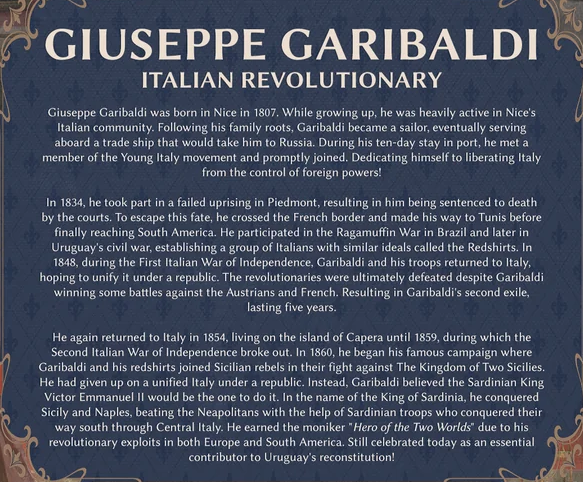
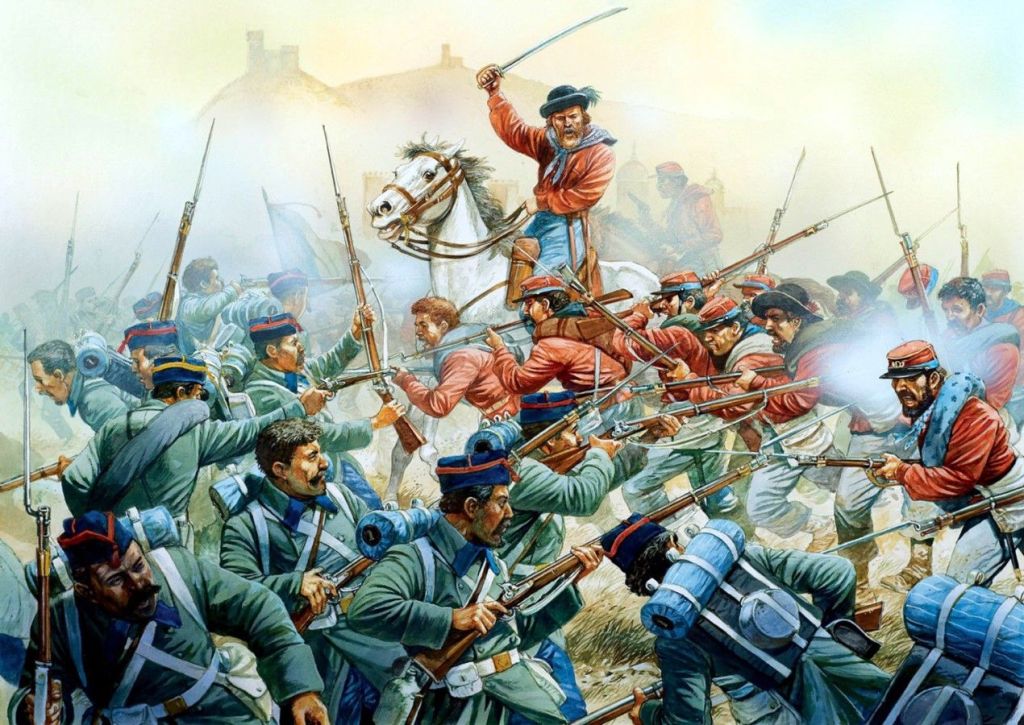
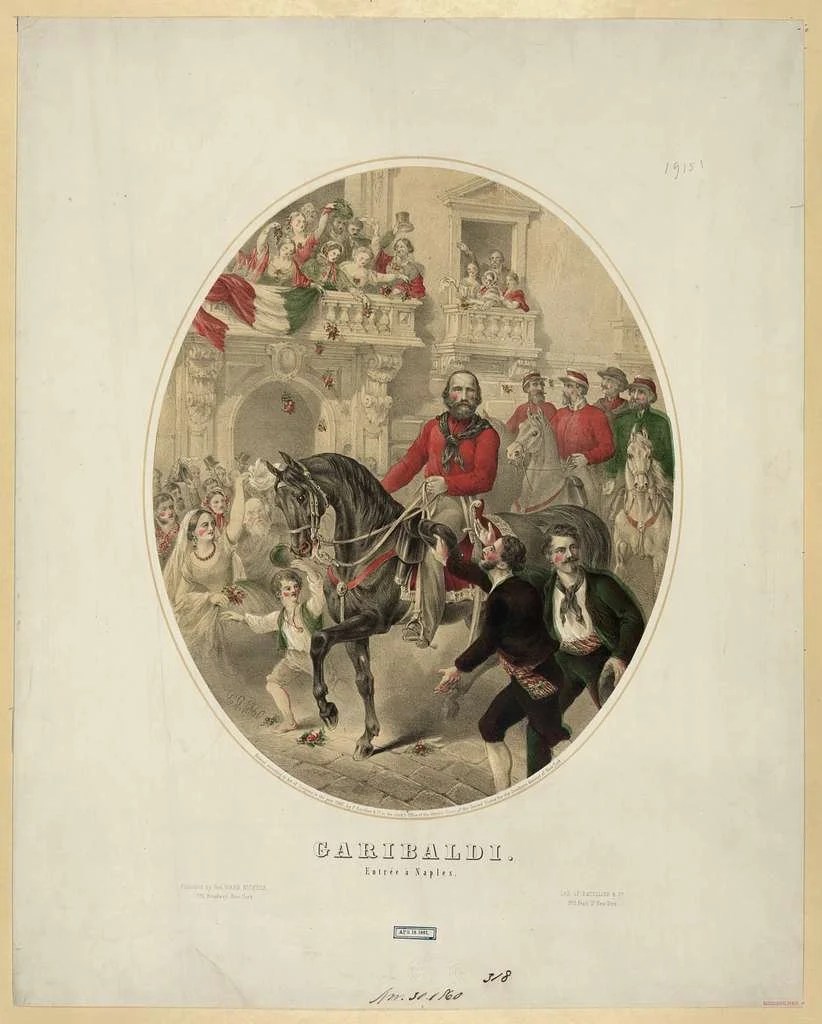
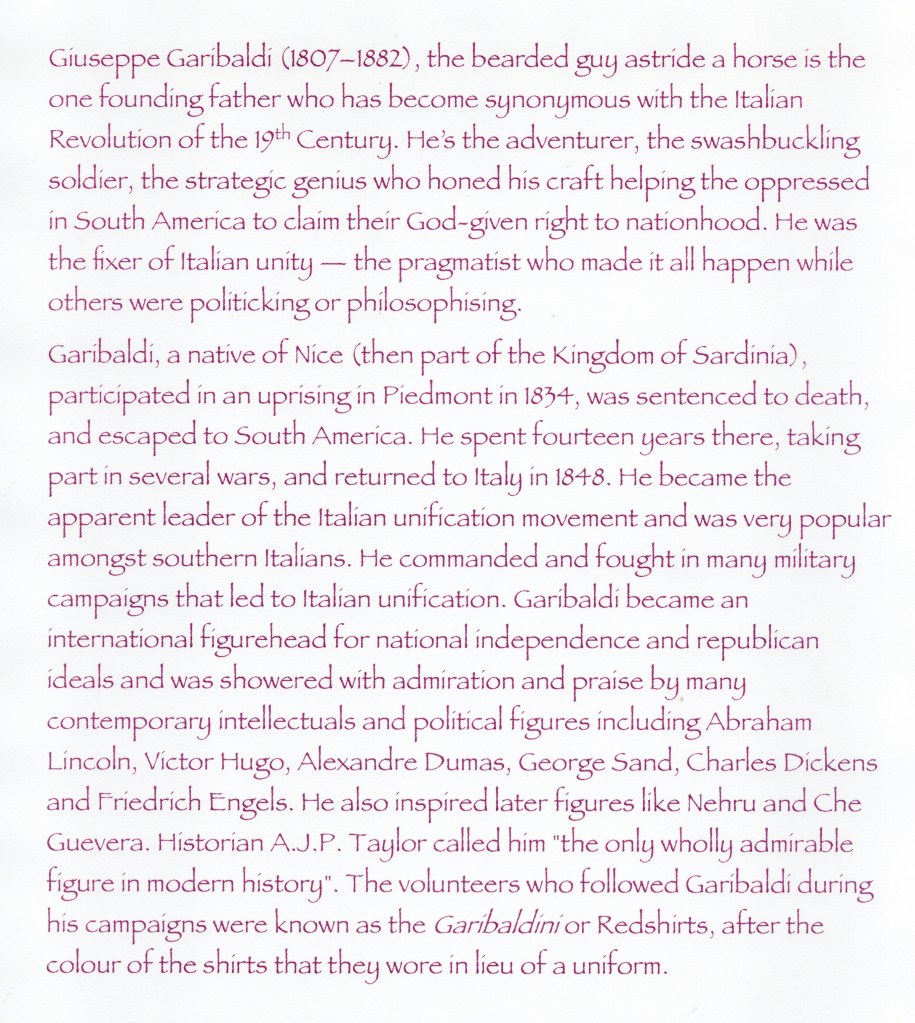
From an early age, Francesco Sceusa, born in Trapani, Sicily 1851, was a voracious reader of literature on socialist issues during a period of great social and political upheaval throughout Italy. Central to this upheaval was a swashbuckling magnetic leader – Giuseppe Garibaldi (1807–1882) a general who is widely recognised as one of the “fathers of the fatherland” during the unification of Italy (Risorgimento). Garibaldi’s landing in the Sicilian port of Marsala in May 1860 with more than 1000 volunteers is the piece of history most Italians can remember from school; La Spedizione dei mille, the Expedition of the Thousand, is modern Italy’s First Fleet. It was during the battle of Calatafimi, in Sicily, that Garibaldi was said to have dropped the quote that would guarantee him a place in the Risorgimento’s pantheon: “Here we either make Italy, or we die.” He could have left it there and we’d still know his name. But he kept going, crossing the Strait of Messina and weaving his way up the mainland, fighting battles against the troops of the Kingdom of the Two Sicilies and cutting short the reign of the last Bourbon king of Naples, Francis II. I have no doubt that Garibaldi was an early hero of Francesco’s. A broader view of Garibaldi is here.
As noted in the short sketch of Francesco’s life written by the Australian historian, Gianfranco Cresciani, the notion of church bells throughout Sicily being taken down in Sicily in 1861 to make cannons for Garibaldi’s army is the stuff of legend and obviously made a great impression on the young Francesco Sceusa.
Francesco was greatly influenced by Benoit Malon, a Communist who in August 1873 settled in Palermo, and was employed as a proofreader for the socialist newspaper “Il Povero”. In 1874 when Francesco finished his studies at the Technical Institute of Trapani, he enrolled at the Faculty of Architecture of the University of Naples, where he came into contact with the anarchists who were preparing riots in Benevento. Francesco participated in their meetings and maintained regular correspondence with many influential politicians, agitators and revolutionaries. He also initiated the formation of a social studies club at the University.
In 1875 after returning to Trapani, he founded the newspaper “Lo Scarafaggio” (either the Scarab or the Cockroach, depending on translation!). Authorities closed the newspaper on September 23rd 1876 after sixteen issues, some of which had been seized because they incited civil war and the destruction of state institutions. From these heady University days, it seems that Francesco was no shrinking violet and had fully committed himself to the socialist cause. The newspaper also advocated the principles of The International, praised famous Communists and rejected any suggestion of accommodation with the bourgeoisie.
Another initiative undertaken by Sceusa in July 1876 was to found a Company Casino for workers in Trapani, a place where the interests of the workers and their relations with the masters were discussed. There was conversation, and debate on all questions of politics, religion, socialism, science and art; newspapers and brochures were read and public conferences were held. What most alarmed the authorities, however, was the publication in September, 1876 by Sceusa of the statute of an International Workers’ Association, Italian Federation, Sicula Region, Trapani Mixed Section, and the foundation of a local section of The International, with Sceusa its president.
The predictable government reaction was the adoption of repressive measures that saw the closure of the Company Casino at the end of 1876. On January 8, 1877, Francesco Sceusa received a formal warning from Domenico Bardari, Prefect of Trapani, ―not to give further reason for suspicion of himself for his public conduct to the Public Security authorities. In addition, he was ordered ―”not to be armed, not to be part of associations, not to try to disturb public order by making propaganda both by voice and through writings or the press: not to incite hatred among the various social classes and finally, not to take part in any assembly that could in any way disturb public tranquillity”. Sceusa protested against the deprivation of his civil rights, and the Hon. Giovanni Bovio went to Parliament in his defence. This representation to Parliament was in vain. On February 16, 1877, Francesco Sceusa was issued with a second warning and on April 20th the dissolution of the section of the Trapani International. His house was searched and his papers seized. Effectively reduced to silence, political inactivity and isolation from the two warnings, Sceusa decided to resume his studies in Naples, where he went in April 1877, under police escort. He was eager to take revenge on his detractors and persecutors, having always fought his political enemies with dialectics, but also physically. On February 1, 1876, in Naples, he had faced a sabre duel with the son-in-law of the late Prefect of Trapani, Cotta Ramusino, in which he was injured in the right wrist. The sequel was a second duel the following month, this time with pistols, in Trapani, between Sceusa and Gaetano Pagano, a friend of the Prefect. Once the first shots failed, the opponents shook hands and the dispute was ended. Even in Naples Sceusa was guarded by the police, who seem to have heard him say in a cafe in the city ”if I find the necessary physical courage to do so, I will avenge, as a good Sicilian, the outrage that the Minister brought to my name”. These events forced him to take the decision to emigrate to Australia.
Francesco, 26-years-old, arrived in Sydney on the 5th December 1877 aboard the SS Bowen from Hong Kong after travelling to Batavia, India, Singapore, South China and North Queensland.
His Italian political experience and cultural awareness distinguished him from the few Italian notables and merchants of Sydney. He was young, proud and impetuous, intellectual, grumpy and therefore not able to easily make friends. However, he soon attracted the respect, if not the sympathy of the prominent exponents of the small Italian community of Sydney. He immediately tried to fit into the circle of Australians who counted by his enrolment in Freemasonry.
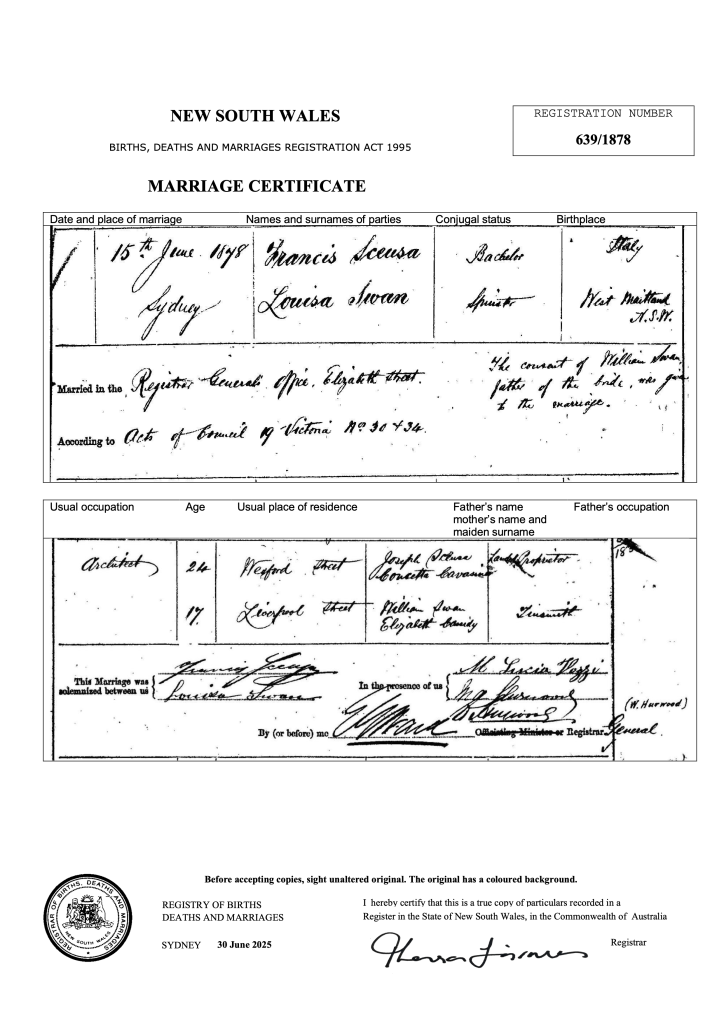
A short six months later he was married to the seventeen-year-old Louisa Alicia Swan.
The Swan family, Sydney and its comparatively recent establishment of social structure, must have been a dramatic contrast to Francesco’s life as a pugnacious and driven socialist revolutionary in Sicily and Naples!
I have no clue as to where and how they met, nor what the attraction between them was. The marriage notice says that Francesco was from Wexford Street (now Wentworth Avenue) and Louisa from Liverpool Street, (probably living with her father), which meant that they could have been living very near to one another perhaps as close as three blocks!Louisa, a Catholic, did not learn Italian beyond a rudimentary level but would prove herself to be a faithful companion to Francesco who was an avowed anticlerical socialist until his death. Louisa shared his anguish and supported him in every way possible, especially moments of political adversity. Sceusa always had words of affection and concern for the future of Louisa, who obviously did not have the same intellectual stature as him. In a letter of 1886 to Vincenzo Curatolo, his socialist companion from Trapani, he confided that
“my wife – my only consolatory angel – urges me to hope, not to deject myself. But her voice can’t calm me down, make my existence more tolerable. And yes, I should dedicate all my care, my thoughts to making her happy, to ensuring the future of this young woman who, by marrying me, did not seen that my heart was already committed to the human cause, to a distant land.”
After a year and a half without permanent employment, on May 5, 1879 Sceusa was hired by the Department of Lands, Survey Office of the Government of New South Wales as a surveyor, thus acquiring that economic security that would allow him to operate politically without financial problems for the next 25 years, as well as to give generous sums to countless socialist causes. However, he was unable to buy his “little house”, like many Australian workers of the time, and was forced, probably due to economic constraints and his financial commitments in the political field, to change residence a dozen times, in some suburbs to multiple locations: Woollahra, Orange, Balmain, Newtown, Woolloomooloo, Paddington, Rozelle, Annandale and St. Peters.
Thanks to his experience as an anarcho-socialist militant, acquired at a hard price in Sicily, Sceusa had from the beginning, a very clear mindset as to the political strategy to be pursued in Australia to promote the internationalist cause. It was organised in five directions. The first strategy, in the total absence in Sydney of Italian associations that promoted socialist ideas at that time, was to create such structures within the Italian community. These vehicles of political propaganda would have sensitised immigrant workers to the socialist cause and would have given them an effective instrument of pressure for the conquest of their rights. In addition, they would have constituted a transmission belt, a vehicle between the Italian emigrated proletariat and the Australian working class with regard to the demands, aspirations and problems of the former. Secondly, in compliance with the dictates of The International, it was necessary to form, together with emigrants from other countries and Australians, clubs, leagues and workers’ unions whose purpose was the victory of socialism in Australia. In this regard, Sceusa is historically important, because he was the first to spread and promote in Sydney, Orange and Bathurst, as it had already been in Trapani, the ideals of The International. Thirdly, he soon realised the need to create social assistance institutions for the Italian community, which was in pitiful conditions of indigence and unemployment. These organisations would also have had the task of defending the Italian working community from the racist and xenophobic attacks of certain Australian press, as well as from the exploitation by some Italian employers and immigration agents who favoured the use of Italian labour under conditions of “crumiraggio” – essentially scab labour. The fourth strategy was to spread socialism through its own press as opposed to the bourgeois press. The creation of socialist newspapers was therefore an essential necessity. Finally, it was essential to maintain stable contacts with socialist organisations in Italy, to inform them about the progress made by the Australian labour movement, about the working conditions that had to be adhered to, agreed by the Australian unions, as well as the dangers of Italian emigration to Australia in times of severe economic recession, in order to avoid the exploitation of emigrated workers.
From the end of 1877 until January 1908, the year in which Sceusa made a definitive return to Trapani, he held himself faithful to these principles and worked tirelessly for their realisation. However, his political thinking matured over the years, as a consequence of contact with an Australian socialism and Labourism profoundly different from his European experience. His initial radicalism, the anarchist propensity for revolution faded, to disappear completely in comparison with Australian pragmatism.
Sceusa had understood that the Australian situation was diametrically opposed to the Italian situation from the beginning; when the SS Bowen was docking in Sydney on December 5, 1877, observing the Australian port workers, and remembering the daily meal of the Trapani worker, which consisted of two pennies of bread and a pilchard, he was stunned to attend the breakfast of the Australian worker.
“I was left speechless when, while the steamer was approaching the dock, I saw a girl spread a napkin over a bale of merchandise, at the ends of which sat two port porters, and put there a pan of eggs and ham, cold meat, large slices of burrato bread and a bowl of tea. From this I learned that I had reached the antipodes”.
In 1881 Sceusa began to implement his strategy. On April 7 of that year, 200 Venetians arrived in Sydney with the SS James Patterson, survivors of the unfortunate expedition organised by the Marquis of Rays, a handyman who had convinced the naive peasants to sell everything and move to an island in the Pacific, promising them easy and quick wealth. Instead, they had found only desolation and death. As many as 50 had died of hunger and hardship during this tragic odyssey.
On April 12th, 1881, Sceusa became a promoter of an Italian Relief Committee and was appointed President. The Committee, which included several Italian merchants, collected considerable funds that were donated to the refugees. Sceusa then published a volume on the events of the surviving Venetians, entitled “The expedition of the Marquis of Rays and its victims”, which caused a sensation in Italy and France and contributed to the conviction of the Marquis and his acolytes. This incident demonstrated his inflexibility and obstinacy to proceed even alone against those who had perpetrated this scam. With a footnote at the bottom of his papers, he testified that
“I wrote this brochure, at least a good half of it, in bed sick … the Italian Committee on whose behalf I wrote it, however, alarmed by the audacity of my language and by the overt accusation of fraud raised by me against the Marquis de Rays & Co., fearing a law of the Agent of said Marquis … sent me, just published, a letter signed by Secretary Ferrari, declining any responsibility. I was left alone, and I had to pay my part (lire 175) of the total expenditure (lire 700) of publication that the Committee had undertaken to pay.”
Following the vicissitudes of the refugees of the Marquis of Rays, on July 7, 1881, it was decided to found an Italian Benevolent Society, in charge of assisting the needy Italians of the Colony. A committee was formed with the chairmanship of the Vice-Consul of Sydney, Vincenzo Marano. Sceusa was elected Secretary. In the political field, two initiatives of great significance were those taken by Sceusa in 1882.
“There was an attempt”, he later wrote, “for the establishment of a branch of the International in Sydney. It was made by the Italian refugees and the French Communists who, after the amnesty, came from New Caledonia. It happened little by little and no social issue then arose in the Workers’ Paradise. The International Club was the first attempt at socialist propaganda, founded by me in Sydney, as soon as I learned English, but the result was disappointing, if not nil.”
An attempt to create a section of The International in Australia had previously been made in February 1872, when the Democratic Association of Victoria was founded in Melbourne. During its short life of only ten months, the Association published a weekly, “The Internationalist”, and a magazine, “The Australian International Monthly.”
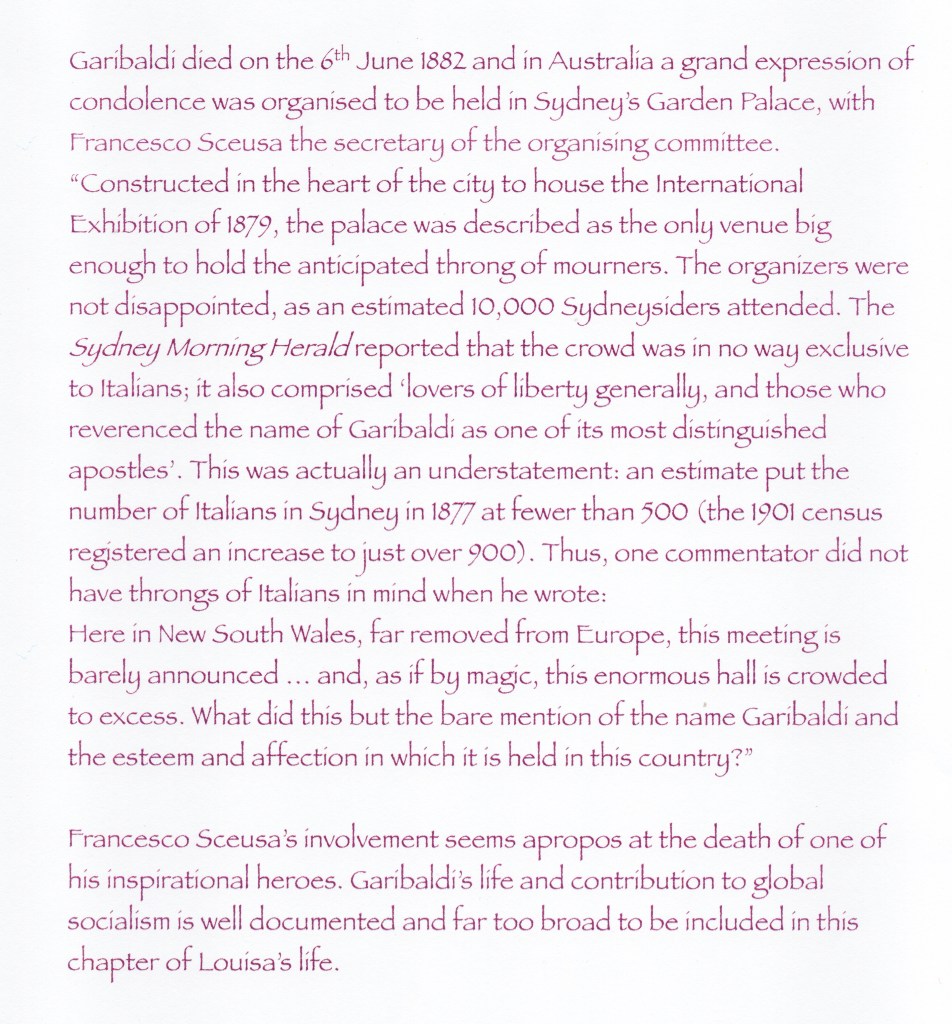
On June 6th, 1882, the greatly revered international revolutionary Giuseppe Garibaldi died on his farm on the Sardinian island of Caprer. On June 17, 1882, a commemoration of his life and death was held at the Garden Palace in Sydney. For the occasion Francesco Sceusa designed the decoration of the hall and a huge two-ton Garibaldi bust that the sculptor Tommaso Sani modelled in papier mâché. Sceusa, Secretary of the organising committee, sat on the stage of honour, together with the Italian Vice-Consul, Marano, the mayor of Sydney H. G. Reid, J. Farnell, representing the Great East of Australian Freemasonry and Sir Alfred Stephen, Lieutenant- Governor of the Colony. Ten thousand people took part in the ceremony.
Knowing his strategic aims, it comes as no surprise that Sceusa was the co-founder and editor of the first Italian newspaper to be published in Australia – L’Italo-Australiano. On January 12, 1885, the first issue appeared in Sydney.
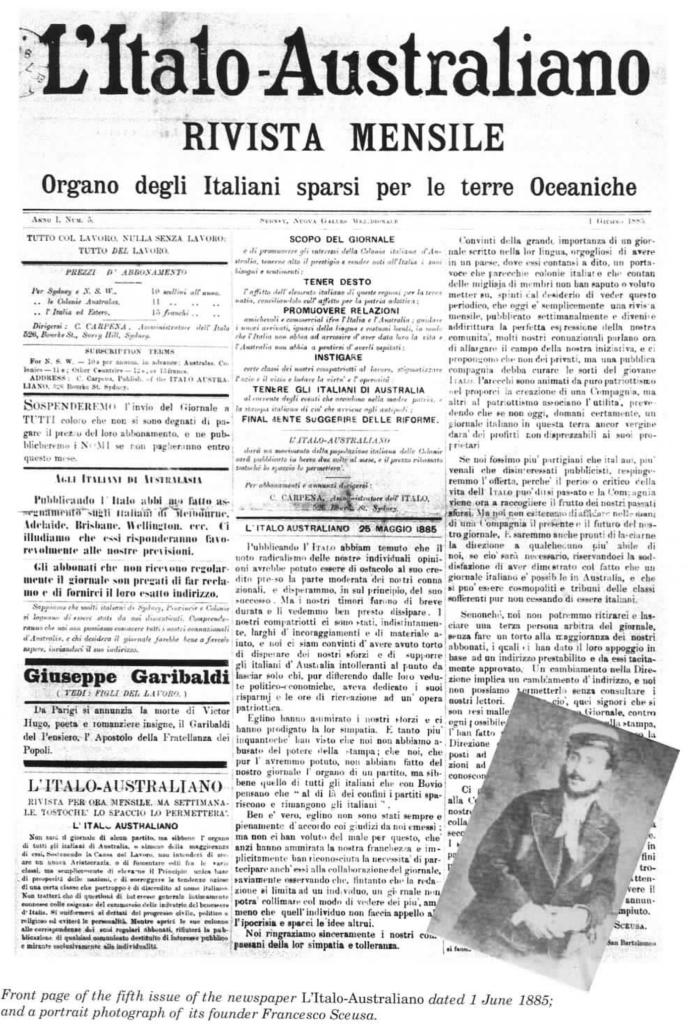
The appearance of L’Italo-Australiano did not endear Sceusa to his political opponents. In addition to the persistent lobbying of the Italian ruling class seeking his destruction, Sceusa could not count on many friends in the workplace. The Department of Lands decided to transfer him in July 1885 to the office in Orange, a town 261 kilometres from Sydney, which shackled his ability to continue the promotion of his political agenda. The transfer resulted in the end of Sceusa’s newspaper. After six issues and a supplement, the L’Italo-Australiano ceased publications after the last issue of July 1, 1885
The absence of Sceusa from Sydney between 1885 and 1890 coincided with the emergence of strong socialist organisations in major Australian centres. This was not accidental. This period was in fact characterised by the beginning of the severe economic depression that devastated Australia until the end of the century.
In this dramatic scenario of economic, trade union, political and ideological upheaval, Francesco Sceusa returned to Sydney in July 1890, a re-location approved by the Department of Lands due to his precarious health conditions.
Back in Sydney, Sceusa started a campaign to reform living and working conditions of Italian migrants. Many of them lived in abysmal conditions in what the Australian press disparagingly called Macaroni Row, a cluster of 36 putrid and miserable houses in Castlereagh Street. They earned their living by selling ‘hokey-pokey’ (ice cream), fruit and flowers, or as street musicians and organ grinders, begging in the streets with the inevitable monkey on their shoulders.
“There are approximately 100 Sicilians here in Sydney’, reported Sceusa, eighty of whom are fruit sellers. Of the same number of Neapolitans in the colony, more than half are street musicians. Of the 40 Tuscans, 20 are figurine-makers, producing, with some effort if you wish, but without taking their pipe from their mouth, a number of Madonnas and Venuses which are useless and which Australia does not need.”
They not only gave the Italians a bad name he stated
“but were also attracting the poisonous rays of a certain Australian press, which found in the appearance of these organ grinders on the streets of Sydney a validation, if there was a need, of their anti-Italian prejudices.”
In spite of the opposition encountered, in August 1891 Sceusa was head of a delegation that met with the Prime Minister of New South Wales, Sir Henry Parkes, urging government intervention, and on September 3 he was received by the Trades Hall Council of Melbourne to make its members fully aware of the problem of the exploitation of Italian workers and minors.
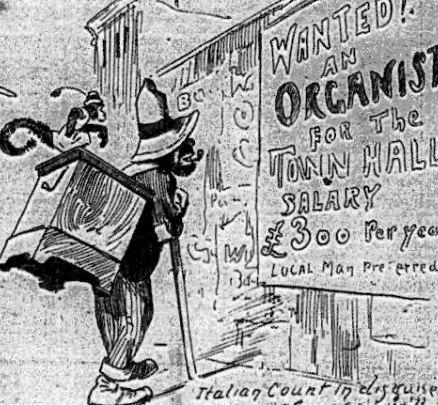
The Bulletin of Sydney published on July 12, 1890, this caricature of doubtful taste.
Sceusa also openly clashed with a prominent conservative, Thomas Henry Fiaschi (1853 – 1927) who was an Italian-Australian surgeon and landowner. Their differences were a classic case of revolution vs conservatism with Sceusa very agitated by worker exploitation. Fiaschi served with both Italian and Australian armed forces, seeing active service as a military surgeon in the First Italo-Ethiopian War, the Second Boer War, and World War I. Sceusa challenged the Florentine doctor to a duel; and in the following weeks he published a brochure on the conflict, to which Fiaschi responded with another brochure, accusing Sceusa of spreading the full shadow of Communism. The duel, which was to be held in Noumea, New Caledonia, because it was illegal in Australia, did not take place. As Sceusa later said
“I was summoned to his office by a senior officer of the Lands Department and threatened to be fired if I gave to my warlike intentions”.
The police officers present at the interview confirmed that Sceusa would be arrested if the duel in Noumea went ahead.
The relations between Sceusa and the supporters of conservatism had become so intense that he confided to friends that he had relentless enemies:
“the players and other street vendors threatened me, intimidated me, and since I am very weak physically, I don’t I leave the house without the company of a reliable revolver.”
The prominence of Sceusa in the Australian socialist circles was constantly increasing. In December 1891 he took part in a meeting of the Trades and Labour Council in Sydney, pointing out that the Italian conservative circles of Sydney had informed the conservative newspapers of Rome, Milan and Naples that the associations Sceusa chaired were anti-patriotic, anarchic and at the service of Australian trade unions, which fomented disorder and rebellion. It was also suggested that Sceusa was lying when he claimed that Italian emigrants were abused in Australia. The Secretary of the Council, John Christian Watson, who in 1904 would become Prime Minister (the first case in the world of the conquest of power by a Labour party) thanked Sceusa, who pointed out that both had the interests of two countries to keep in mind, beyond nationalist and racial prejudices.
In 1891, the arrival, to which Sceusa was opposed, of 335 Piedmontese emigrants to Northern Queensland to work under contract in sugar cane plantations, produced an immediate reaction by the Australian trade union movement. The Secretary of the Trade Unions Council of Victoria, David Bennett, wrote to Sceusa that
“if on the one hand we find nothing to object to the Italians who, going to Australia in search of work, conform to the customs, tariffs, needs and local laws, we are strongly against the imports of workers bound by contracts, and we strongly protest against the infamous system of Italian emigration as it was inaugurated in Queensland in order to ruin wages, considering it essentially pernicious to the interests and well-being of the producing classes of Australia.”
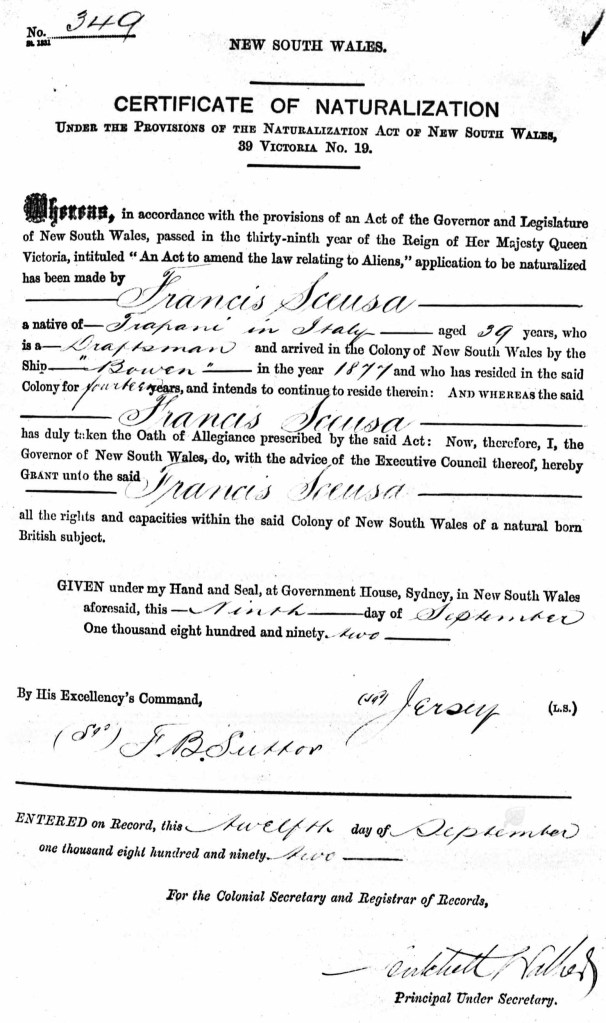
At the same time the Truth news-sheet of Sydney, accused Sceusa of being a foreigner, of not having acquired the British subject, stating that no man can honestly serve two countries as different as Australia and Italy. He must be a traitor to one or the other. Sceusa, aware that his political activities in Australia could give rise to a request for deportation by the Italian Government, applied for a Certificate of Naturalisation, which was granted to him on September 9, 1892.
On December 27-28, 1892, delegates from Victoria, Queensland, South Australia, and New South Wales met in Sydney, and founded the Social Democratic Federation of Australasia. Sceusa was elected Secretary General and commissioned to draft the Manifesto, which he published on May 1, 1893. In it, the Federation declared that it wanted to change the then prevailing system of production and distribution from its foundations, to overthrow the reign of Capitalism and the land monopoly, encourage all workers to enrol in the Socialist Party and to send representatives of their own class to Parliament. In addition, the Australian Socialist League of Sydney, the Social Democratic Federation of Queensland, the Social Democratic League of Victoria, the South Australian Allgemeiner Deutscher Verein Deutscher and the Verein Vorwarts of Melbourne (all members of the Social Democratic Federation of Australasia), delegated Francesco Sceusa to represent the Federation at the International Congress Socialist that would be held in Zurich on August 6-13, 1893.
This must have pleased Francesco immensely. The International was the global instrument for recognition of the various left-wing parties and policies that were mooted and amended on a continual basis. His election to Secretary General and commission to draft the Manifesto was respectful recognition of his skills, knowledge, strategy and overall suitability for the role.
At the end of June 1893 Sceusa, accompanied by Louisa, embarked on the French steamer Polynesien for Marseilles. The Federation had offered him to pay the travel expenses, but Sceusa had refused, accepting only a contribution for the printing of the advertising material. Before continuing to Zurich, Sceusa passed through Milan, for talks with the socialist exponents Filippo Turati and Camillo Prampolini, also delegates to the Congress. To Prampolini who, amazed to be in front of the old internationalist, anarchist sympathiser, asked him if he had changed his mind, Sceusa replied:
“In Italy, maybe, and without maybe, I would still be an anarchist. But how could I be in Australia? Against whom and why should I preach the use of violent means in a country where we, like everyone else, can meet whenever we want, hold conferences in the squares and streets, make as many associations as we like, print everything we like? There I realised that the real enemy, the great obstacle that must be overcome for the implementation of our ideals is not the tyrant government, it is not even the will of the capitalists, but it is above all the people, who do not understand us and do not follow us: I have understood that our victory cannot be the work of a day, but it will be the result of a long, patient, tireless propaganda and a series of progressive reforms.”
In Zurich, Sceusa took an active part in the work of the Congress, intervening in the discussion on the working day of the eight hours and on the anniversary of May Day. In his speech, on August 8, he also praised Australian socialism, prophetically saying that:
“Australia and New Zealand are much more at the forefront of any other country in the world in the field of Labour parliamentary representation and, therefore, Labour legislation … and it will also be the first nation in the world to achieve the emancipation of the working classes.”
At the end of the Zurich Congress, Sceusa and Louisa decided to visit Trapani before their return to Australia. Upon their arrival, on September 2, a crowd of ten thousand people welcomed the exile, now in his 40’s and no longer the firebrand who agitated for social reform almost twenty years earlier. An orchestra of sixty mandolins and guitars honoured the guests with a night serenade, while the Prefect put the troop on alert in the event of a popular riot.
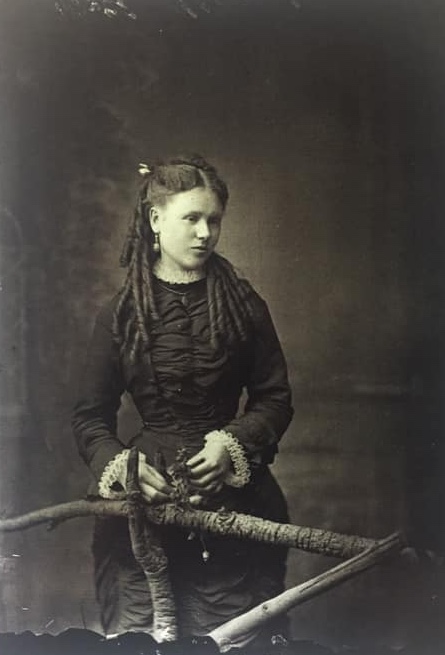
This image of Louisa is from the NSW State Library.
The Trapani newspaper, Il Mare demonstrated an awkward, then enthusiastic coverage of the visit. The word “wife” was not used, only “companion” and “lady“.
The coverage went from an “almost frightened” Louisa at the time of her arrival at the Trapani station; then to “attentive tourist” on a trip among the natural rural beauty of Erice; and finally a “moved, affectionate and familiar woman of the people who lets herself go in handshakes, greetings and thanks in Italian – a language that we know she has never learned – towards the Sicilian workers.”
“his affectionate companion Louisa Swan, is greatly impressed, she is almost frightened of the crazy joy of the people. “
“visiting the land that had given birth to her husband”
“On Sunday our friend visited Mount San Giuliano, making his loving companion Louisa observe the ancient castles, today owned by Count Agostino Pepoli, and all the ruins of ancient art”.
“She is barely on the sidelines in a carriage, attentive and interested during the trip to Erice, then Monte San Giuliano”
“Leaving from Trapani to continue the journey to the province, the Trapani crowd no longer only cheered Sceusa and Socialism, but to the sound of “Long live Lady of Sceusa” the workers also greeted “Mrs. Louisa”
“Mrs. Louisa, worthy companion of our friend moved by the affectionate greetings, went down into the atrium to shake hands with the workers, who also greeted Australia in her. Thank you, she said, socialist brothers, thank you!”.
“The lady of the Sceusa, moved to tears by those festive receptions, did not know how to thank everyone and how to respond to those greetings, to those hooray”
Francesco and Louisa arrived in Sicily at the time when the peasants were rebelling and organising against the landowners. The authorities reacted to this upheaval by ordering the troops to shoot against those who had occupied the lands. In Caltavuturo, on January 20, 1893, 13 farmers were killed, and another in Catenanuova in May. Between December 10, 1893, and January 2, 1894, the army killed another 50 demonstrators. The exasperation of the Sicilian agricultural proletariat had reached such a level as to lead to open rebellion. Socialist propaganda had taken hold of the masses.
Sceusa and Louisa left Marseille aboard the SS Armand Behic, heading back to Sydney, where they arrived on November 7, 1893. A few days later, the Executive Committee of the Australian Socialist League and the President of the Trades and Labour Council, J. C. Watson, celebrated Sceusa at Leigh House, in the presence of Labour MPs George Black and W. F. Shey. The President of the League, W. A. Holman, declared that everyone agreed that Sceusa had fully deserved the recognition of all Australians and the Australian Socialist League, and gave him a pipe as a gift.
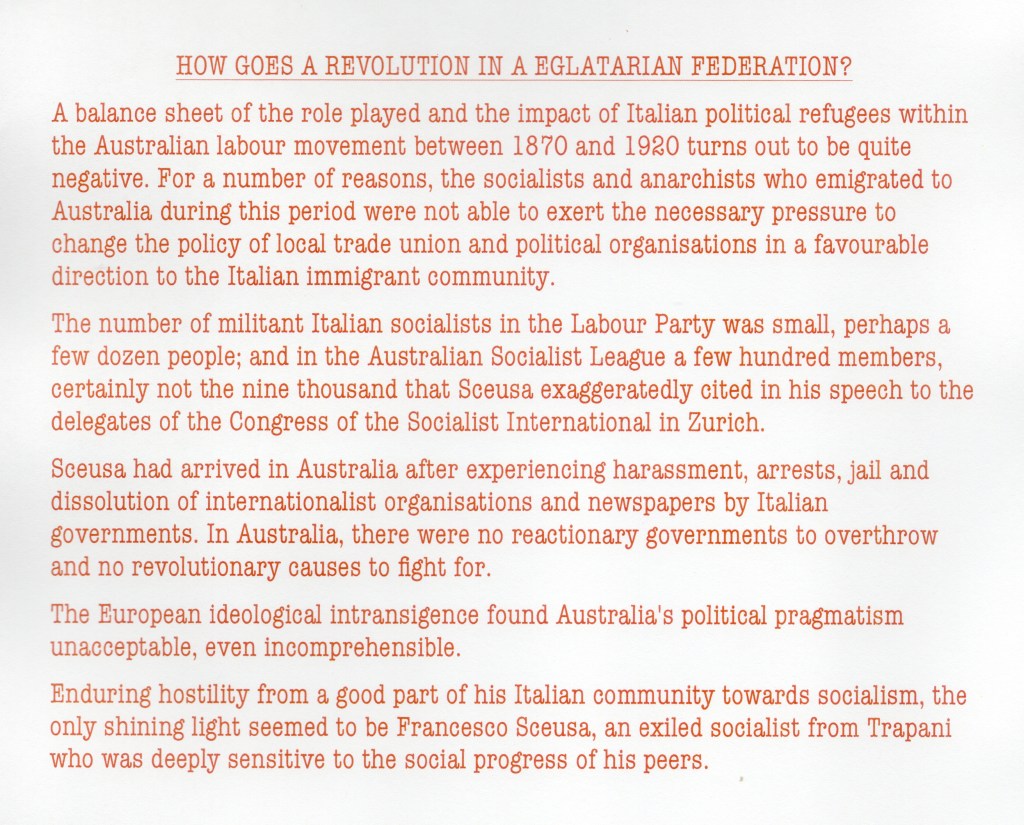
The position publicly taken by Sceusa gave him yet another headache with his superiors at the Department of Lands. In October the news sheet Avanti! reported that procedures were made to obtain the expulsion of Sceusa from the office of surveying and engineering where he was employed. It seems that for various reasons, including the imminent Federal elections and the support that Sceusa would have in this case from the Workers’ Party, nothing was done. The revolutionary push of Italian political refugees had been exhausted in the face of a series of difficult situations, obstacles and unforeseen events. First, as the Labor Party increased its influence and increased its electoral weight, it reduced its commitment to the cause of socialism. The Australian Socialist League, from 1895 to 1898, worked in vain to counter the progressive watering down of the principles of socialism in the Labor Party program. In 1898, the League distanced itself from the party and founded the Australian Socialist Labor Party.
Other events that took place between 1903 and 1904 contributed to the end of the involvement of Italian refugees in the Australian labour movement. The life and activities of Francesco Sceusa also changed drastically, which led to a reduction of his role as leader of the Italian socialist movement in Australia.
On December 4, 1903, Louisa Sceusa, who had been ill with depression for years, attempted suicide by throwing herself into the harbour from Sydney’s Iron Cove Bridge. Saved by a passerby, she was taken to the Balmain hospital.
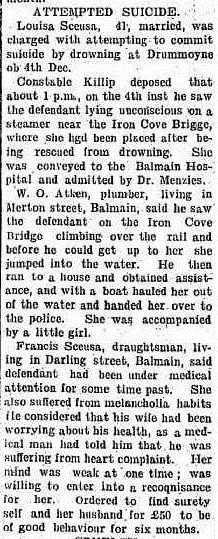
Louisa had seen her husband’s health deteriorate and for a long time she had considered herself a burden to him. She believed that freed from her, Francesco could have found a person able to help him and restore his health. In an attempt to take her life, she intended to facilitate her husband’s return to his homeland and thus put him in a position to fulfil the vow he made to dedicate himself to the good of the Italian working classes. Sceusa stated that the day before the suicide attempt, he had been examined by a doctor, who confirmed the existence in Francesco
“a certain illness in the heart and kidneys and that he considered Louisa to be suffering from “mental weakness at intervals”
Louisa was now forty-two years of age and had experienced almost a quarter of a century of continual concern and worry. Her primary role would have been domestic, as in house cleaning, shopping, meal preparation, washing and pressing clothing. She and Francesco relocated to at least dozen different housing situations in that period which would involve transporting furniture, personal belongings, and the ever-growing mountain of paperwork generated by Francesco’s political involvement. Louisa spoke very little Italian, probably read and wrote even less. The recent travel to Milan, Zurich and Sicily would have been exhausting – I can picture Francesco “delegating” all non-socialism responsibilities and subsequent organising to her. She obviously could not match his energy or drive and probably found herself in a totally “reactive” state rather than being able to be proactive. Louisa’s sense of worth was probably very low as well having to absorb Francesco’s conflicts, frustrations and disappointments. They married when she was only seventeen and I can only conjecture than she had no idea of what life would be with a complex and obsessed revolutionary trying to forge a path in a country far removed from where he grew up. Her awareness that Francesco at times carried a revolver as a defensive measure must have caused fearful concern and anguish.
I am sure that Louisa Alice Swan, my 3rd great aunt was suffering, and had been suffering for some time from mental anguish akin to PTSD.
Suicide then being a crime, Sceusa had to pay a bail of fifty pounds, a sum equivalent to more than two months of his salary, to guarantee the release of his wife, whose good behaviour he also had to guarantee. Louisa was hospitalised at the Gladesville psychiatric hospital on December 16. Sceusa pointed out that in the last eight- or nine-years Louisa’s mental state had gradually worsened, and she, “agitated, depressed and miserable, a malnourished woman, with a pale complexion, red hair and gray eyes, confirmed her persecution mania.”
Having apparently improved, she was discharged on April 6, 1904, four months from when she was admitted. In a letter to his friends in Italy the following year, Sceusa wrote that
“I had to lock her up in an asylum by magistrate’s injunction. When she had a serious illness, I had to bring her home, with very serious sorrows and regrets. These domestic misfortunes ended up ruining my poor health and making me unable to do my office work.”
And, of course, to continue his political campaigns.
The other event that deeply disturbed Sceusa was his dismissal, which occurred on May 5, 1904, from the Department of Lands.
“The bourgeois government of the time”, he said, “took the opportunity to make me pay dearly for my past participation in the labour and socialist movement and forced me to leave the service for poor health”. At the bottom of his cards, he noted many years later: “And so I lost a place that gave me more than 7000 Italian liras net per year!”
From this moment on, his health condition gradually worsened. Despite his infirmity and daily confrontation with Louisa’s depression, Sceusa continued to look for a job. In June 1904, the Federal Government, headed by his old friend since the Australian Socialist League, John C. Watson, offered him a position as immigration inspector and sent him to Western Australia to investigate the claimed foreign competition in mines, after the Australian miners had called for the expulsion of Italians from the gold mining camps. The fall of the Watson Government, on August 17, 1904, put an end to the use of Sceusa. He immediately found another job, as a draftsman in the Department of Lands of Western Australia, but his wife’s deteriorating health did not allow him to leave Sydney.
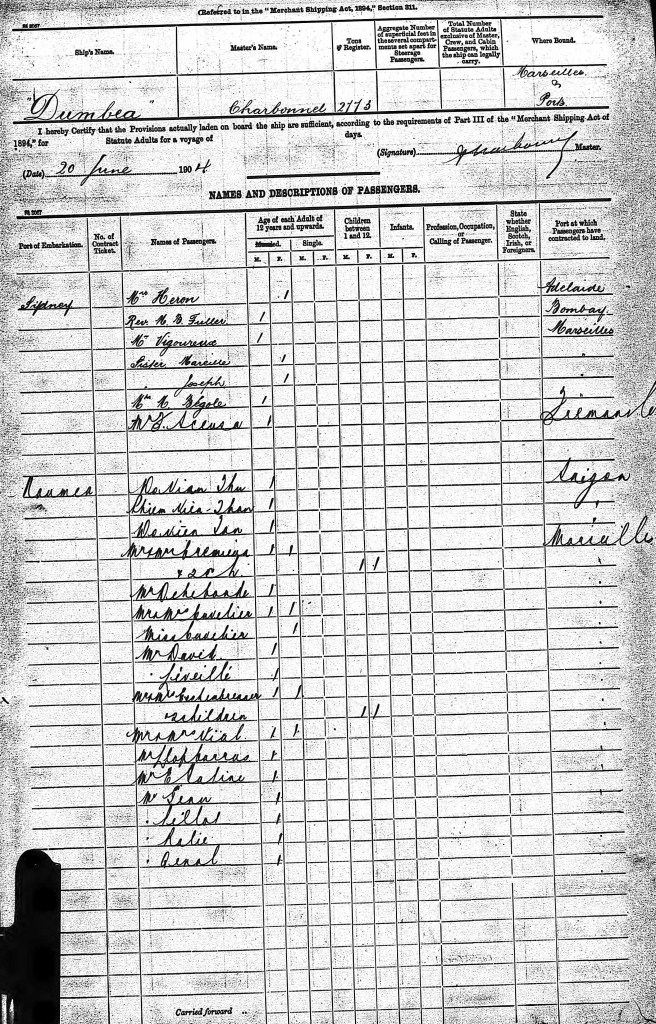
I can only find one trip west that Francesco could have made as part of his new job. He travelled by the ship “Dumbea“ from Sydney to Fremantle on the 20th of June 1904.
In addition to his health, his financial conditions were also precarious. In May 1905, he wrote to a friend from Trapani
“it is impossible for me to leave the house because I am always weak. This is heart weakness and arteriosclerosis with a good dose of the inevitable nephritis. I’ve spent a good part of my substances in recent months and if the deal continues, it will end badly. If you add a lot of speculations, it goes wrong for me, you will understand the conditions in which I am. My many friends have of course abandoned me; and, as for the scoundrels, whom I fought here with so much money, they are rejoicing with joy, knowing that I have prostrated myself.”
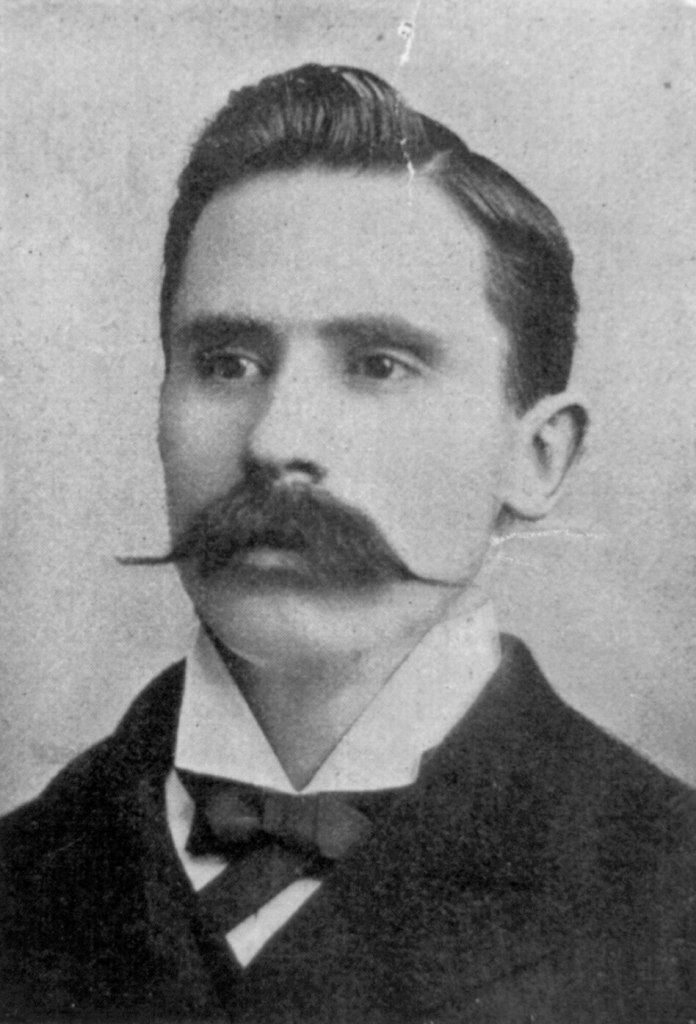
Tom Mann, English trade unionist.
In June 1907, the well-known English trade unionist Tom Mann, while in Sydney, went to visit Sceusa, accompanied by the Secretary of the International Socialist Club, P. J. O’Meara. He found Sceusa ―very busy with the pen, although looking very sick and barely able to drag himself from one point of the room to the other. His good friend and personal doctor, Quinto Ercole, went to visit him in November of that year and got a sad impression. “I found the friend and companion of better days,” he said, “lying on a sofa, in the small drawing room of which the most interesting furniture is represented by a table on which newspapers are stacked, half-written papers, notebooks full of notes, incomplete articles in various languages, songs from English and Italian newspapers, and two or three clewed dictionaries … for about 18 months Francesco Sceusa has spent his days in that room … he is sick, he is very sick … as a doctor, I advised Sceusa to return to his homeland.”
Francesco Sceusa accepted his friend’s suggestion and decided to return to Trapani, accompanied by his faithful wife Louisa. The Sydney Bulletin, which had often attacked him, wrote that he was the only avid socialist in the public administration of New South Wales. Even his Italian opponents, through the Italo-Australian, the paper which first appeared in Sydney in 1905, expressed their regret, recognising his merits; they organised a collection in his favour and published an affectionate farewell greeting on the Italo-Australian.
The socialist friends of Sydney organised a farewell party and presented him with a bag containing a few pounds of gold; a similar gift was given to him by the socialists of Melbourne, in the presence of Tom Mann and on behalf of the Garibaldi Club and the Socialist Party of Victoria, when the ship made a stopover in that city. Before leaving Sydney, Sceusa gave the newspaper Truth his manuscript, entitled “Autobiography of an altruist”, unfortunately also lost. In January 1908, the newspaper published some excerpts from this book.
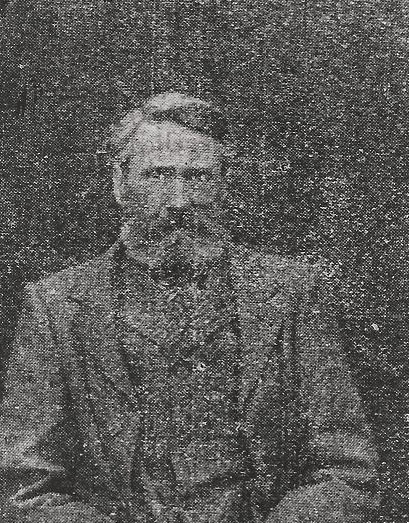
Francesco Sceusa 1851-1919
Francesco Sceusa and Louisa Swan left Sydney on January 10, 1908, on board the SS Oruba for Naples, where they re-embarked on a vessel, ironically bearing the name of Umberto I, to arrive in Trapani on February 22nd. They lived in a poor apartment in Via Argenteria (Contrada Casasanta), owned by Santo Buddua, a former leader of the peasant movement.
Two letters, from Francesco and Louisa, both to William Swan have survived. William was the older of the two sons of Thomas C.C. Swan and his wife, Esther. They were written in early August 1908 and indicate that Francesco had immediately involved himself in local politics, establishing a party to contest elections which does not seem to be successful.
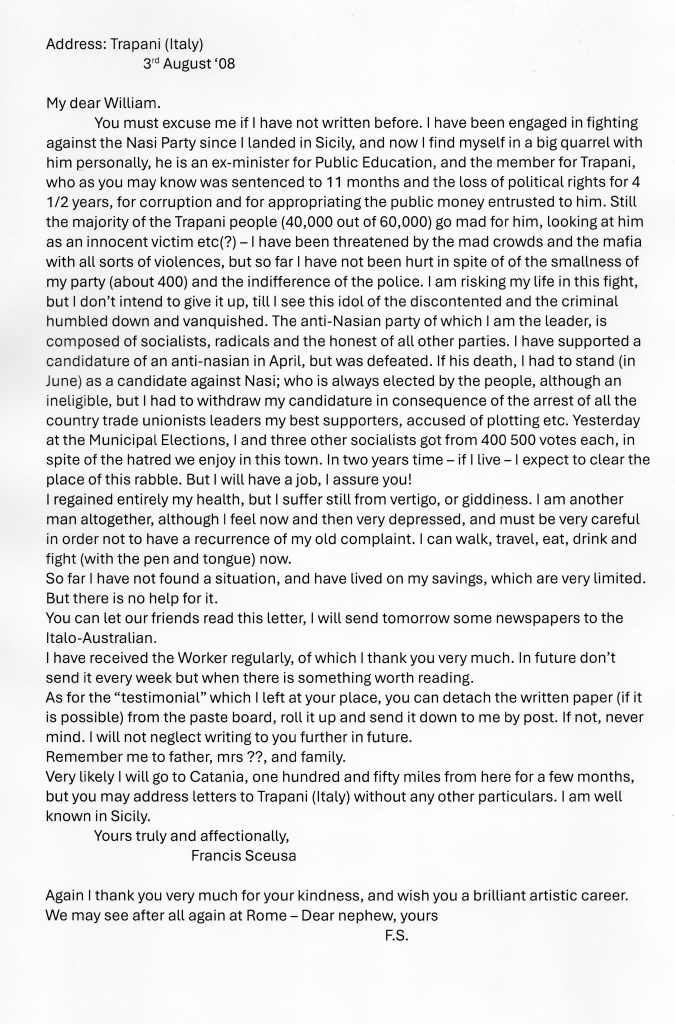
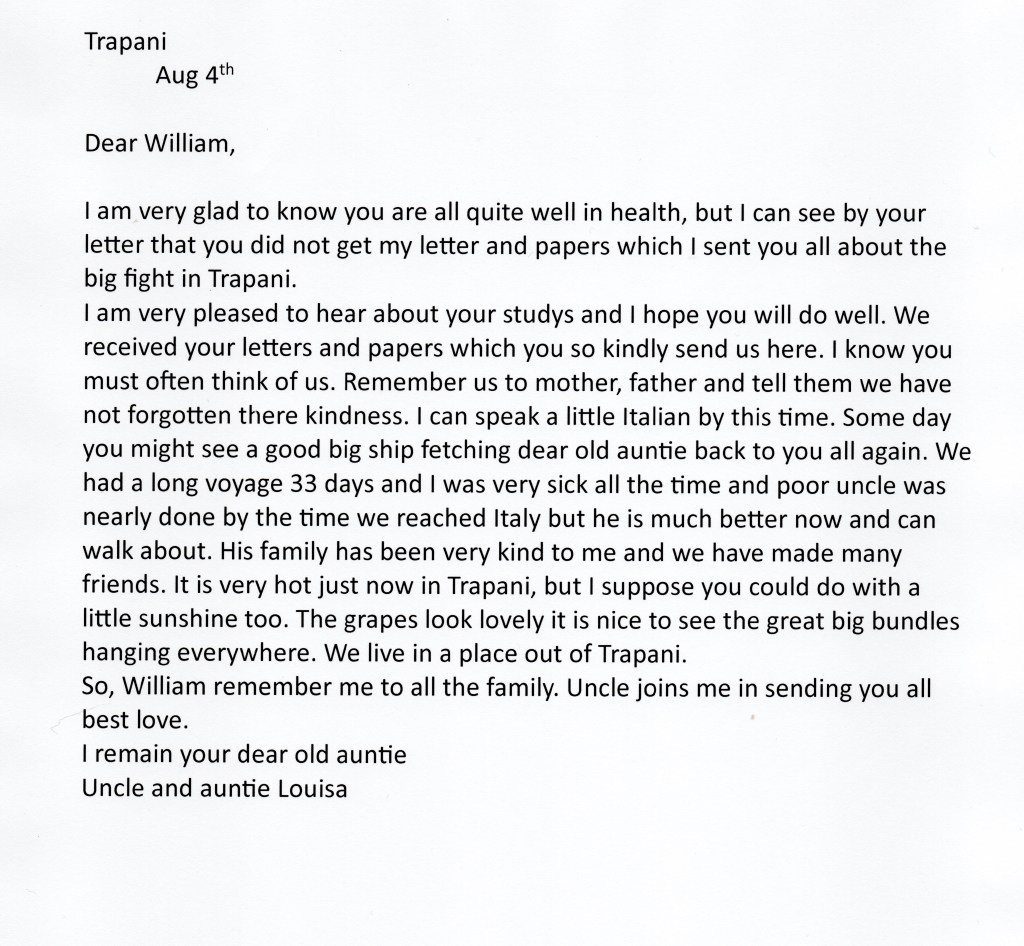
Francesco found paid work by giving private English lessons to young people. He continued his socialist battle against the mafia, corruption and bad government until his death, which occurred on June 21, 1919. In his last years he was in a state of acute poverty, so much so that the local Socialist Section paid him a monthly sum for his and his wife’s livelihood and paid the expenses of his funeral. Louisa who, as mentioned, not speaking a word of Italian could not get a job, at her husband’s death lived on the charity of her friends from Trapani, staying in a sleazy, small apartment.
In October 1919, an English pianist, Winifred Merrall, visiting Trapani, learned of Louisa’s conditions, and wrote to the Australian High Commissioner in London, urging her repatriation, also in consideration of the fact that the then Australian Prime Minister, William Morris Hughes, knew Sceusa well.
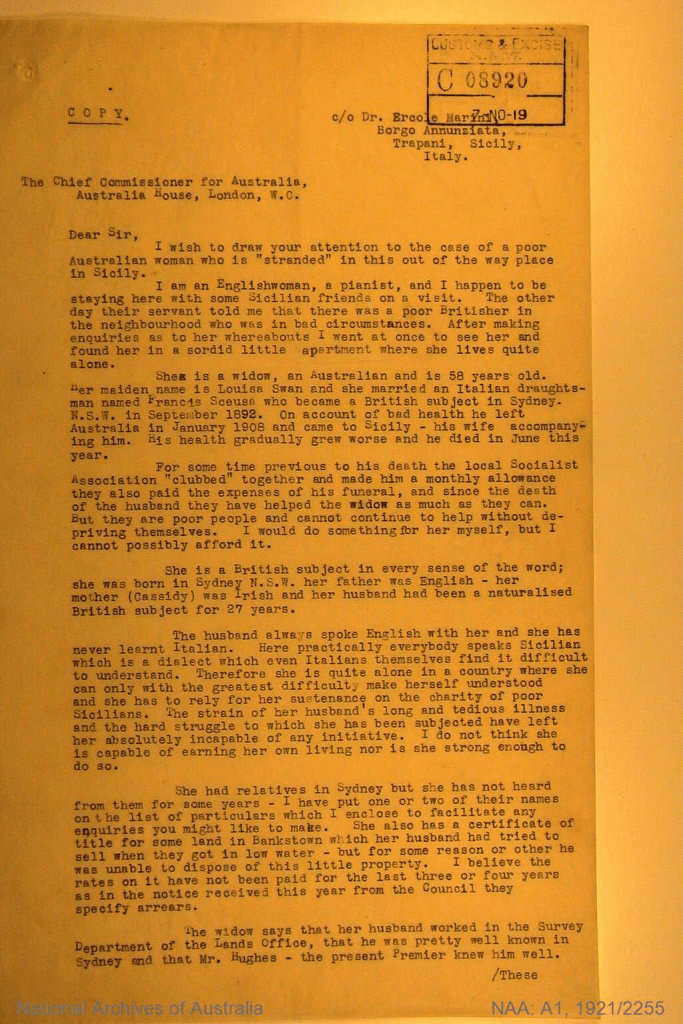
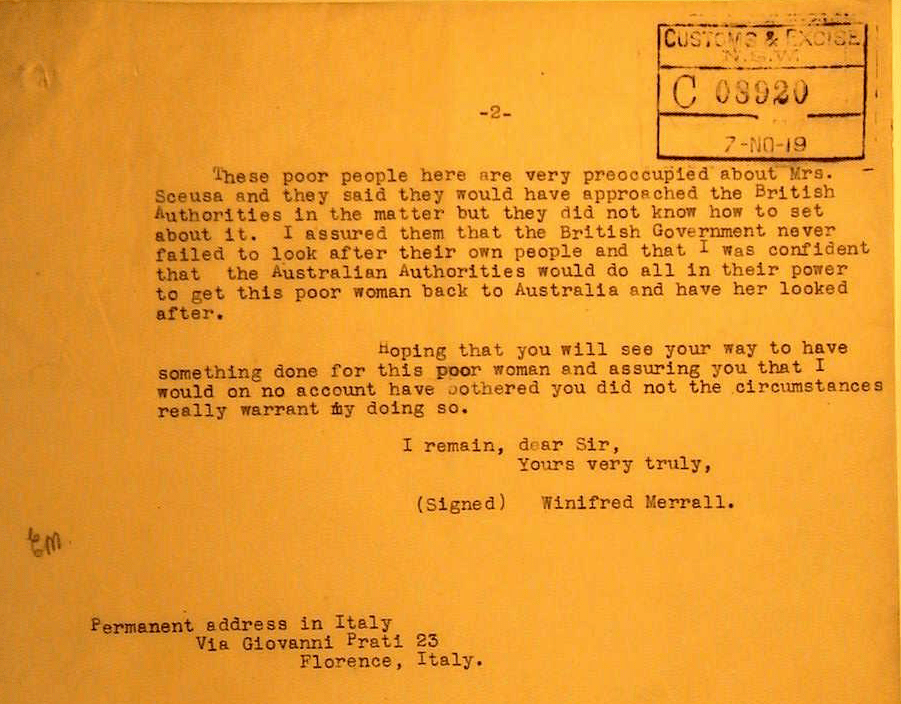
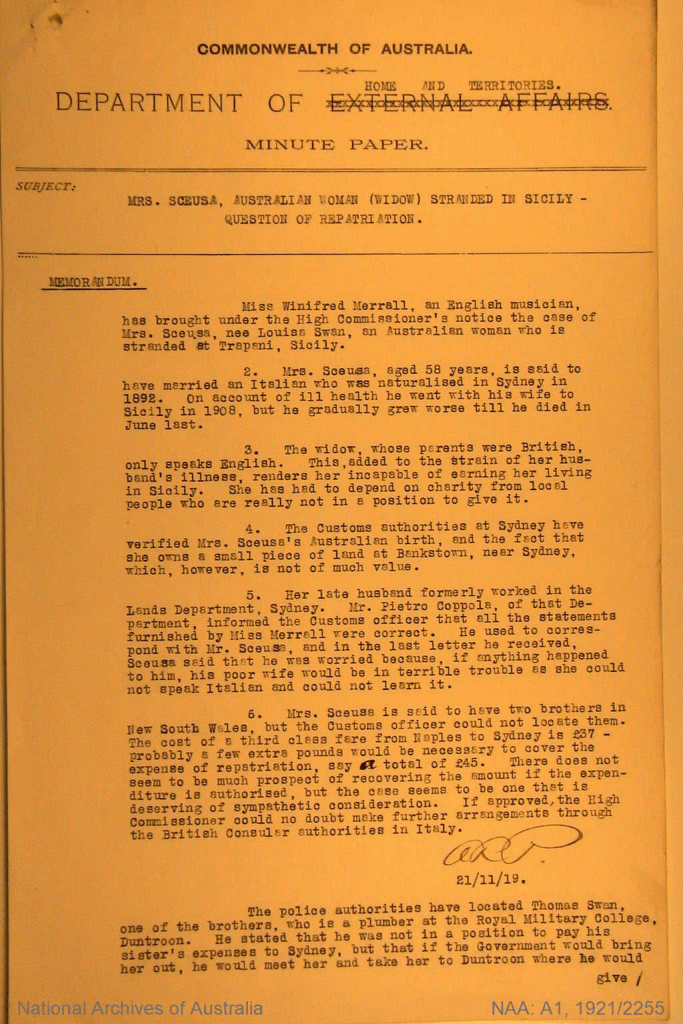
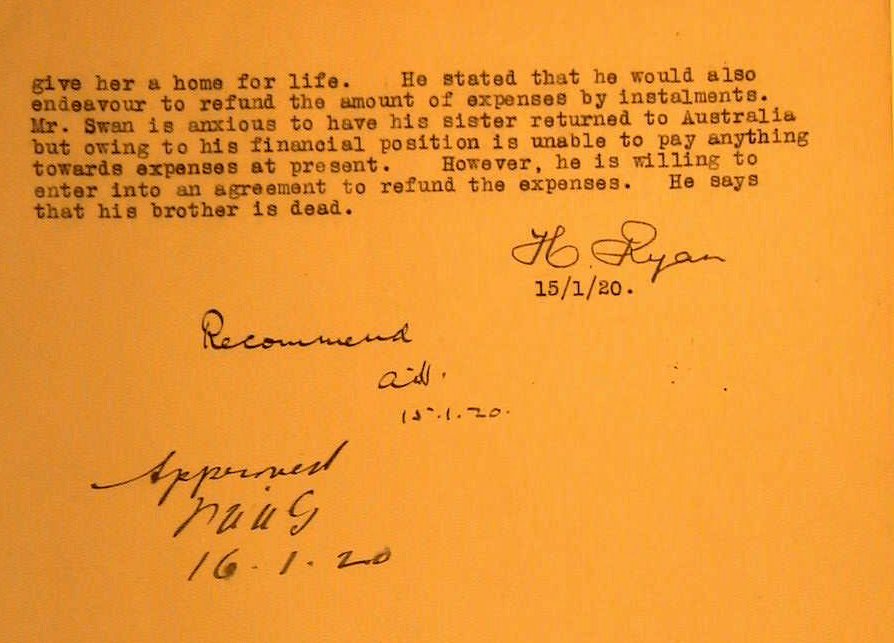
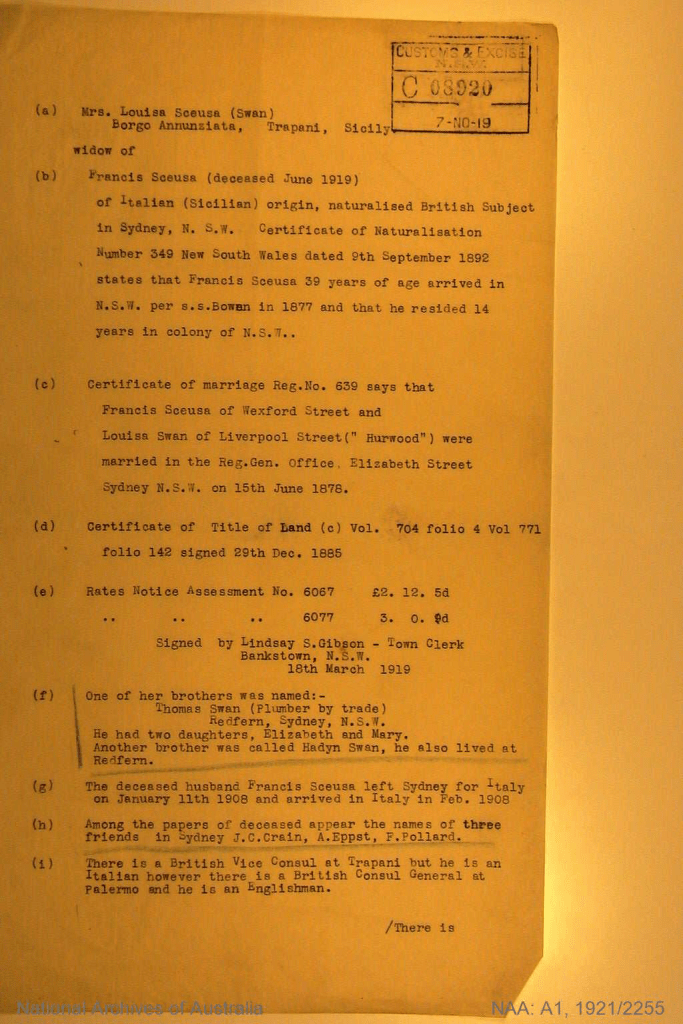
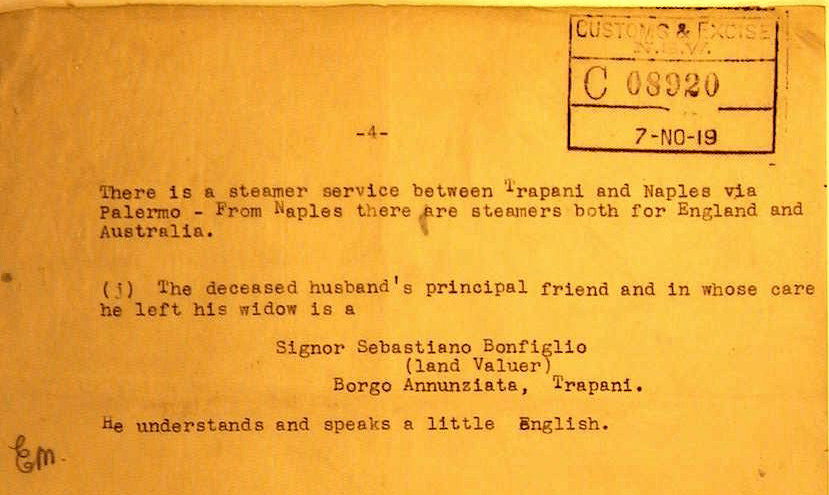
There are 46 pages of communication in the official Australian Government files regarding Louisas repatriation back to Sydney. They show that Louisa’s brothers, Thomas Swan and Hadyn Swan are identified and that Thomas, when contacted at Duntroon, Canberra, where he is working as a plumber, is very keen to have Louisa back in Australia where he would like to house and care for her. Thomas also states that his brother Hadyn is no longer alive. In his communication Thomas says that he would appreciate some financial assistance with the repatriation as he is unable to immediately settle the costs involved and that he would be pleased to enter into an agreement concerning the refund of his sister’s expenses. Communication between the various parties involved is at times disjointed with letters and memorandums not always in chronological sequence. This process is occurring between 1919 and 1920, a time without the benefit of current modern digital correspondence.
Eight months after Winifred Merrall’s letter to the Australian High Commission Louisa was repatriated to her family aboard the SS Osterley and arrived in Sydney on July 7, 1920. Initially there was some confusion about her whereabouts and her younger sister Elizabeth (Swan) Stephenson, who was living in Glebe had posted Louisa as “missing” in August 1920 on the Police Gazette. The Police Gazette reported in on 17th of November that Louisa had been found. On November 15, 1920, Louisa went to live with Thomas but soon left Duntroon and went to work in a convent near Campbelltown, where she stayed for 18 months. The travel expenses were paid by her brother Thomas Swan and officially finalised on the 4th February 1921.
The Swan family must have been distraught, upset and very concerned throughout the whole year that the repatriation process unfolded.
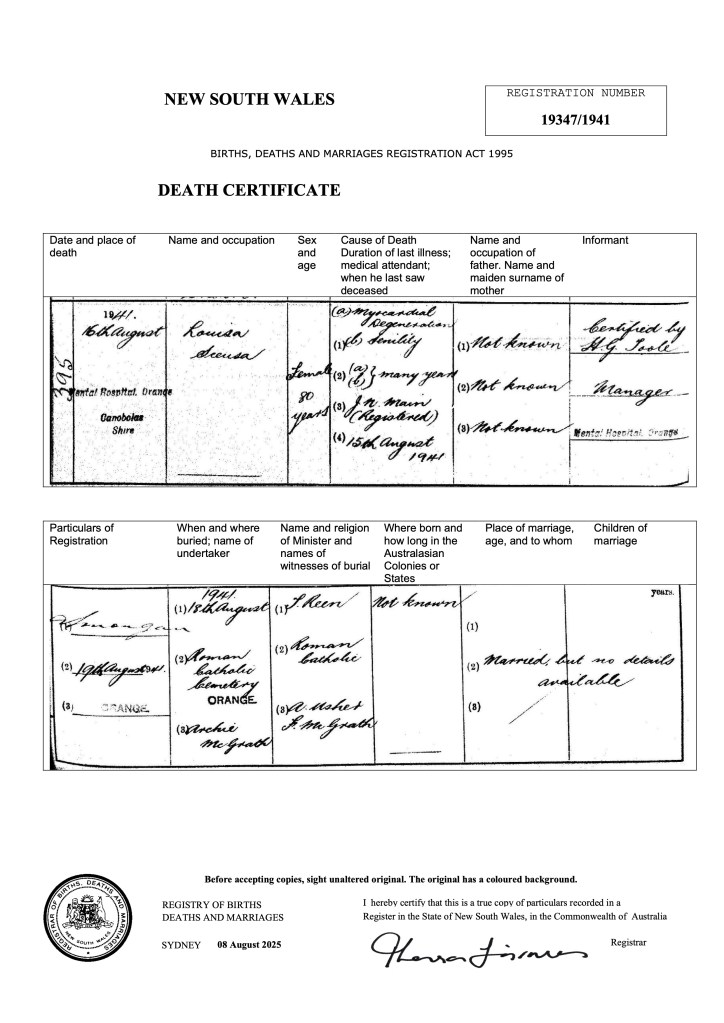
In 1923 Louisa was in Sydney, homeless, depressed and without adequate medical care. On May 7 of that year, she was hospitalised at the Rydalmere Psychiatric Hospital. To the doctors who treated her, she said that she had never attended school, but that she could read a little and could only write her name. She had never had children. On October 26, 1928, Louisa Sceusa was transferred to the progressive and caring Orange Mental Hospital, where she lived for twelve years. Louisa died on August 16, 1941. The hospital covered the funeral expenses and Louisa was buried in the Catholic section of the local cemetery.
Her brother Hadyn died in 1933, living a fugitive’s life in Orbost, Victoria. In Sydney, Louisa’s younger sister, Elizabeth died in 1938; her older sister, Letitia and her brother Thomas both died in 1943, also in Sydney. I have no knowledge of family members visiting Louisa in Orange and hope that she had a peaceful last decade of her life at the Hospital in Orange.
~ ~ ~ ~ ~
Where did all this information come from?
Cathy Shashkof, Cassidy Cousin extraordinaire. A sleuth of the highest order who always provides great ideas and unlimited support.
NSW State Library
Bill Swan for the letters to William Swan from Louisa and Francesco
Wikipedia for all sorts of detail and segues into strange places
Ancestry.com.au always has a big bunch of support documents
The NSW Police Gazettes
Gianfranco Cresciani who has researched and documented so much Italian-Australian history:
Fascism, Anti-Fascism and Italians in Australia 1922–1945, Australian National University Press, Canberra, 1980
The Italians in Australia, Cambridge University Press, Melbourne, 2003
‘Lo Spettro Della Quinta Colonna Italiana In Australia: 1939–1942’, Affari Sociali Internazionali, Year XIII, no 4, 1985, pp 45–61
‘Peasant Immigration in Australia. 1920–1940’, Spunti E Ricerche, vol 2, 1986
‘The Making of a New Society: Francesco Sceusa and the Italian Intellectual Reformers’, in John Hardy (ed), Stories of Australian Migration, University of New South Wales Press, Kensington, New South Wales, 1988
‘The Bogey of the Italian Fifth Column’, in Gaetano Rando and Michael Arrighi (eds), Italians in Australia: Historical and Social Perspectives, University of Wollongong, Wollongong, New South Wales,1993, pp 67–83
‘Refractory Migrants. Fascist Surveillance on Italians in Australia. 1922–1943’, Italian Historical Society Journal, vol 15, 2007, pp 9–58
‘A Not So Brutal Friendship. Italian Responses to National Socialism in Australia’, Altreitalie, 34, January–June 2007, pp 4–38
Australian Bureau of Statistics figures and Graeme Hugo, Atlas of the Australian People. New South Wales, Australian Government Publishing Service, Canberra, 1992, p 83
Garibaldi In Australia: Paul A. Pickering Research School of Humanities and the Arts, Australian National University, Canberra ACT 2601, Australia paul.pickering@anu.edu.au
Flavia Fodale: “Il Socialismo In Due Continenti” Francesco Sceusa E L’Emigrazione In Australia
National Archives Of Australia: NAA: A1, 1921/2255


Leave a Reply