
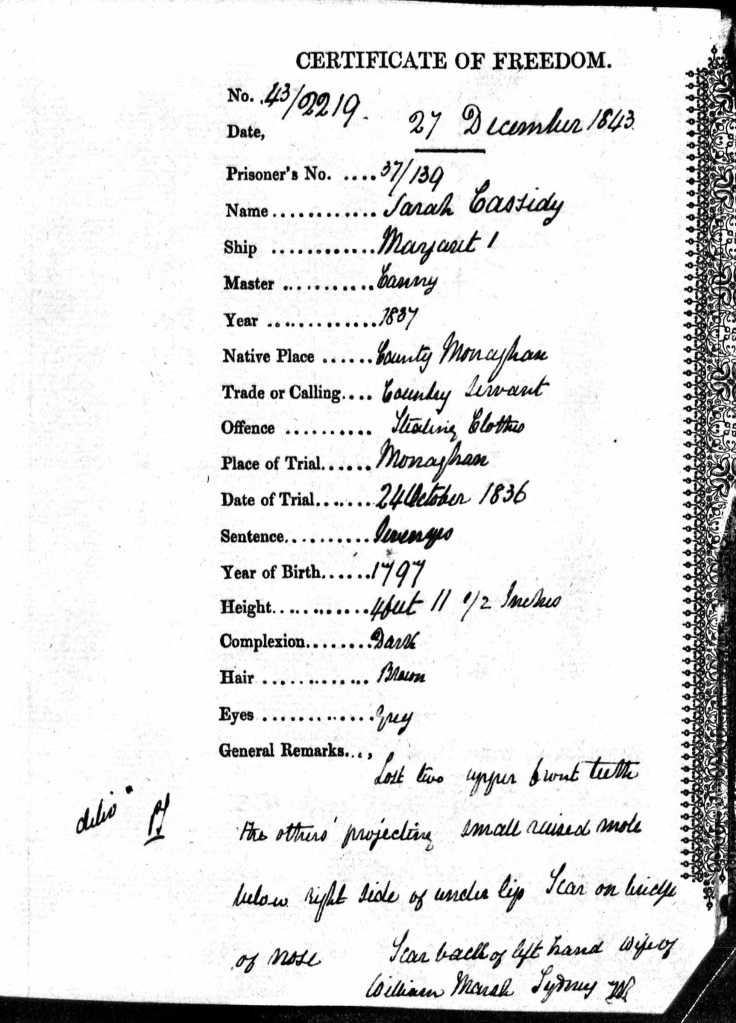
Sarah Murray, born about 1796, was an illiterate country servant from Monaghan Ireland whose husband, Cormic Cassidy, probably died about 1829. Sarah (Murray) Cassidy was convicted of a first offence, the theft of clothing on 24th October 1836 in Monaghan, Ireland and sentenced to seven years transportation. After sentencing, on the 15thNovember 1836 Sarah was sent to the Kilmainham Prison in Dublin. She was then transported on a female convict ship, the “Margaret” which departed Cork, Ireland on 24th January 1837 and arrived in Port Jackson on 30th May 1837, under the command of Edward Canny, with the Surgeon Superintendent a Henry Kelsall. On board were 153 female prisoners, 28 children of the prisoners and 35 free women and children – relatives of people already in the Colony. Sarah was listed as: Protestant, Widowed, 4 foot 11 ½ inches tall, Complexion: Dark sallow. Hair: Brown. Eyes: Grey. Two upper teeth missing, with the others protruding. A raised mole right side of upper lip. Scar back of left hand. Four daughters and one son. The two youngest children, both girls (Maryanne: 11yrs old; and Bessie: 8yrs old) were permitted to travel to New South Wales with her. Left behind was a third daughter, Catherine who was about 19 years old. Sarah had an older son, John who was an English soldier, a member of the 99th Foot Regiment.
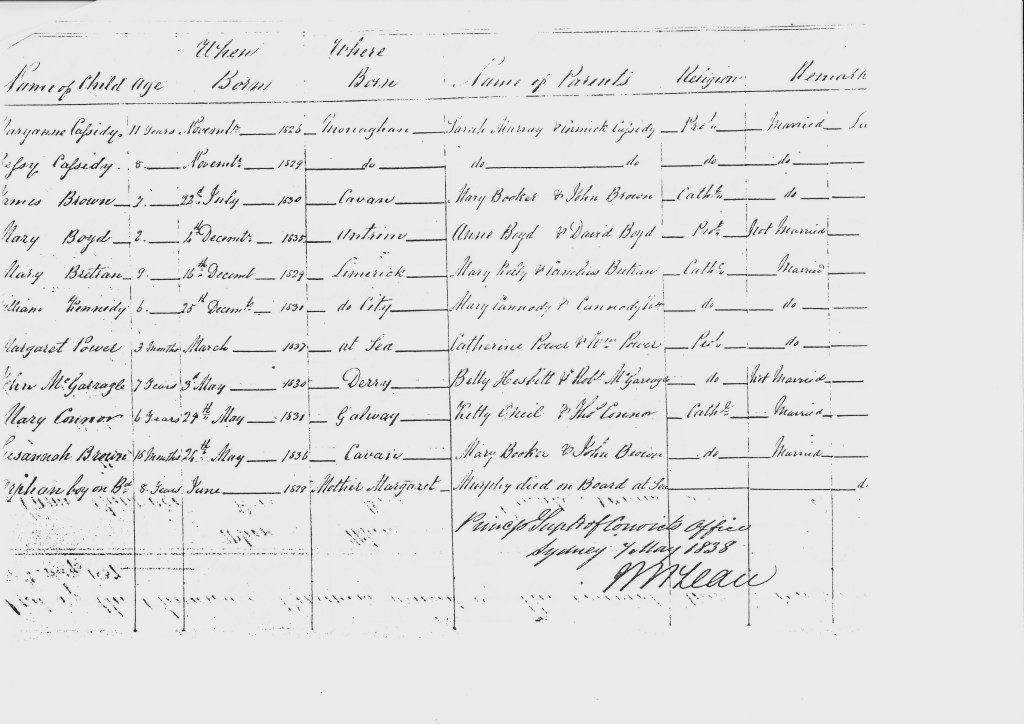
Surgeon Henry Kelsall remarked in his journal that the women were all sent on board the Margaret in a very filthy state from the Cork Penitentiary, with a small supply of spar clothing (linen). A great number were infected with psora as well as with influenza. Kelsall also mentioned that most of the convicts if permitted passed the whole of the day in bed and collected all kinds of rubbish about them. He was appalled with another filthy habit of the convict which he found difficult to stop – that of washing their linen in putrid urine which they would hang up to dry in the prison. He was no less scathing of the Irish free women and children of which he thought there were too many on the ship. Influenza was epidemic in both England and Ireland at the time and Surgeon Kelsall noted in his journal “fever of the bilious remittent character” made its appearance while sailing down the west coast of Africa. About 50 of the women had this fever, many of whom were bled when they first complained, “generally to good effect”. Two convicts and five of their infant children died on the voyage. Sarah (Murray) Cassidy was one of those affected, spending nearly four weeks hospitalised with the fever.
On arrival in the Colony, Sarah and her daughters were either kept on board the Margaret or transported to the Hyde Park Barracks for processing. Sarah was assigned almost immediately to a Mr. J Sheave of Sydney as a servant and the daughters, Maryanne and Bessie, were transferred to the Female Orphan School in Parramatta. It was typical for children over the age of four to be separated from their mother and placed in the Orphan School. Of the twenty mothers on the Margaret only three women were not assigned upon arrival.
To get some perspective at this point, we need to look at some statistics and a fellow “Cassidy Cousin” (there are a lot of us), Cathy Shaskof has published some wonderful material on female convicts in general and Sarah in particular. I am in awe of her research and her clear and thoughtful narratives and will shamelessly “borrow” her information and conclusions throughout this piece.
Sarah was one of over 150,000 convicts transported to Australia between 1788 and 1868. Only 16% of these convicts were women. Unlike many of her peers Sarah was allowed to bring her two youngest children, Maryanne and Elizabeth, with her. Sarah was sentenced to seven years transportation for stealing clothes in Monaghan, Ireland. More than half of the 6876 convict women who landed in New South Wales between 1826 and 1840 were Irish. Even though the majority of Irish female convicts were born in the rural areas, 80% committed their crime and were tried in urban centres. Sarah was atypical in that she committed her crime and was sentenced in her hometown. She was typical however of 66% of Irish convict mothers arriving with their children in New South Wales between 1837 and 1838. Sarah listed her occupation as a country servant. Farm and domestic servants made up 97% of transported Irish convict women. Sarah was one of only 16% arriving on the Margaret who stated their religion as Protestant.
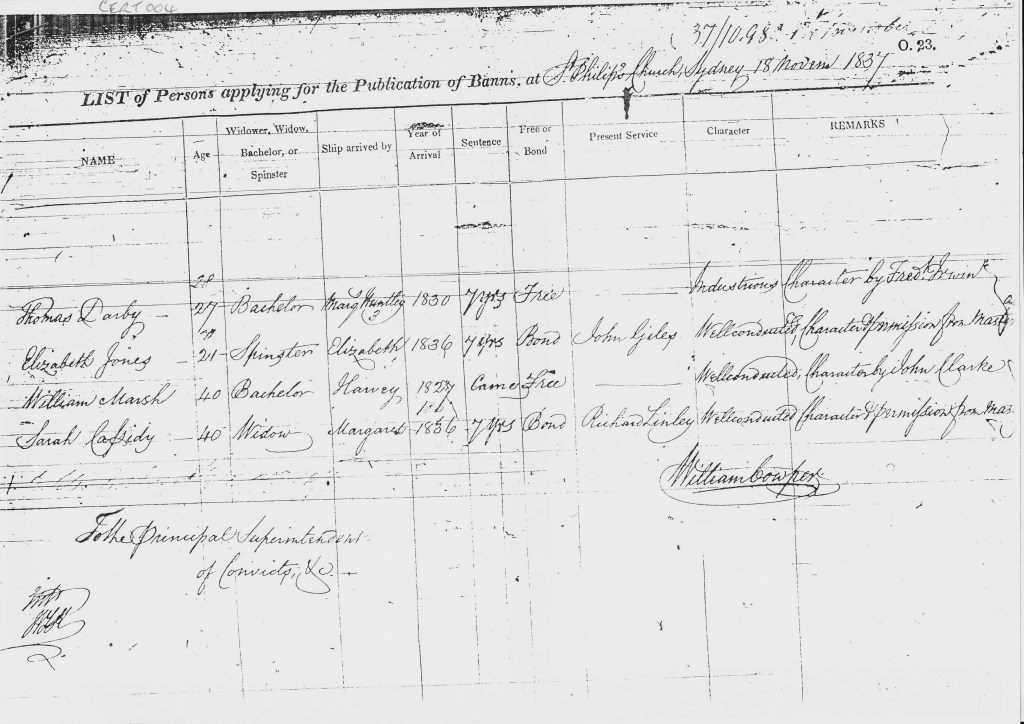
In September 1837 Sarah was reassigned to Richard Linley who gave his consent for her to marry when she applied to the Governor in November 1837. Banns were published at St. Phillips Church, Sydney on 18thNovember 1837 to marry William Marsh, an English free settler who had arrived in Port Jackson on the Harveyin 1827. Permission to marry was granted on 23rd November 1837 and they married on 26th December 1837 at St Phillips Church Sydney.
A third daughter, Catherine, at the age of 19, had also been convicted of stealing clothing in Monaghan on 20thMarch 1837, also sentenced to life imprisonment and also transported to New South Wales. She arrived in Port Jackson on the 25th December 1837, one day before Sarah married William Marsh. Catherine was assigned to the Maitland region, possibly to a Mr Lang. In December 1839 Catherine married a fellow convict, Robert Vincent in the Upper Hunter region north of Maitland.
On the 9th March 1842, Sarah’s son John Cassidy, serving with a detachment of about 30 soldiers escorting convicts aboard the convict ship Richard Webb sailed into Hobart Town, Van Diemen’s Land. John’s wife, Mary Ann and their two young children, Rose and James accompanied John on this voyage, which after disembarking the convicts in Hobart, sailed for Sydney, arriving on the 22nd March 1842. Around this time John was promoted to Corporal. Although there is no surviving evidence, we always assume that there was contact and communication between Sarah and her children. Later in 1842, John was stationed at Port Macquarie.
In December 1843 Sarah (Murray, Cassidy) Marsh gained her Certificate of Freedom (43/2219).
In 1844 John, now a Sergeant, was stationed back in Sydney where in December of the same year his youngest sister, Bessie, pregnant and only 15, married a member of his regiment, a private named Thomas Cain.
In 1845 Sarah’s daughter Maryanne married a former convict, John Lock in Hinton, just north of Maitland about two years after he was granted his Certificate of Freedom. They stayed in this region for the next 20 years, producing 14 children. Bessie and Thomas Cain also had children, a daughter in August 1845 and a son in 1847. During his period of service in Sydney John was stationed both at the Garrison and on Cockatoo Island.
In 1847 John was sent to Port Curtis in Queensland (now Gladstone) as part of a contingent surveying the area for a penal settlement.
Sometime in 1848 both John Cassidy and Thomas Cain were sent to the Norfolk Island Penal Colony as part of a contingent from the 99th Regiment. John’s wife died during childbirth in 1849; Bessie had a daughter in September 1849 and both families remained on Norfolk until 1851 when John was assigned to Hobart and Thomas Cain back to Sydney.
Catherine (Cassidy) Vincent, only 32 years old died in 1850.
In June 1853 Thomas Cain died and in July 1853 Bessie married a tin miner from Canada, William Swan, with whom she had 8 children.
John remained in Tasmania for the remainder of his life, remarried in 1855 and died in Hobart in 1879.
In 1861, at the age of 64, William Marsh died and 12 years later, on 14th February 1873
Sarah Murray/Cassidy/Marsh died. Sarah died in Hyde Park Asylum, at that time a home for infirm and destitute people, of thyroid cancer. Sarah is buried in an unmarked grave, with another women who died the same day, in the Catholic Section of Rookwood Cemetery in Sydney.
Roger is a descendant of Bessie Cassidy and her second husband, William Swan. Bessie died in 1869, only 40 of tuberculosis; and William in 1895 after self-administering himself with hydrochloric acid.
Selma McGoram and Pat Crook are both descendants of Bessie Cassidy and her first husband Thomas Cain.
Cathy Shaskof is a descendant of Maryanne Cassidy and John Lock. John died in 1883 and Maryanne in 1914.
Cathy Shaskof feels certain that the thefts committed by Sarah and her daughter Catherine were deliberate and strategic; designed to allow the family to grow and prosper in the penal colony, something impossible in Monaghan Ireland. Monaghan was a border town, always in conflict between Catholic and Protestant, Irish and English and in the 1830’s offered nothing but destitution and starvation to its poor and marginalised. Star of the Sea by Joseph O’Connor can provide ample description of conditions in both Ireland and Scotland at that time.
I’ll leave this piece with Cathy’s words:
“Between 1862 and 1886 the Barracks provided a temporary shelter for women unable to work due to illness, just under half the inmates who passed through were former convicts, more than half were Irish and the majority were widows. For many like Sarah, nearing eighty, it was their final home. She is buried at Rookwood Cemetery.
While the crime and punishment that made Sarah a convict was typical it was what she brought with her to the colony that made her experience atypical. The mothers like Sarah who were accompanied by their children not only brought the start of a kinship network compared to most convicts who suffered from the loss of family connection but also the skills and knowledge of bearing and rearing the next generation. They were older and more likely to come from rural areas with the associated skills needed in the colony. Sarah exhibited the resilience and constitution to survive the journey across, land and sea, from her home county with her children. “


 miles of irvings
Leave a reply to debbie bailey Cancel reply