On April 25th, 1854, the good ship “Marshall Bennett” carrying 180 persons, all assisted immigrants and their families, sailed from Southampton, the large port on the Solent in Hampshire, to Geelong, the major migrant port inside Port Philip Bay, Victoria. The trip took 109 days, landing on the 11th of August 1854.
One family on board the “Marshall Bennett” had come from the village of Priston, just outside Bath in Somerset. The journey to Southampton from Priston would have been by a horse drawn vehicle, a coach or perhaps a dray and it would have taken a full day and part of a night if the weather was kind, the vehicle sound and the horses strong. That family was Vicki’s 2nd Great Grandparents, Charles and Mary Miles and their five children. Charles Miles, an agricultural labourer, 40 years old, was the head of the family; his wife Mary, was 37 years of age; the eldest son, at 17 years old was William; two younger sons were George, 13 years old and Mark 9 years old; and then two young daughters, Ann, 6 years old and an infant, Elizabeth, who was only 3. Mary Miles was almost 6 months pregnant and knew that she might give birth before the ship landed in the Colony.
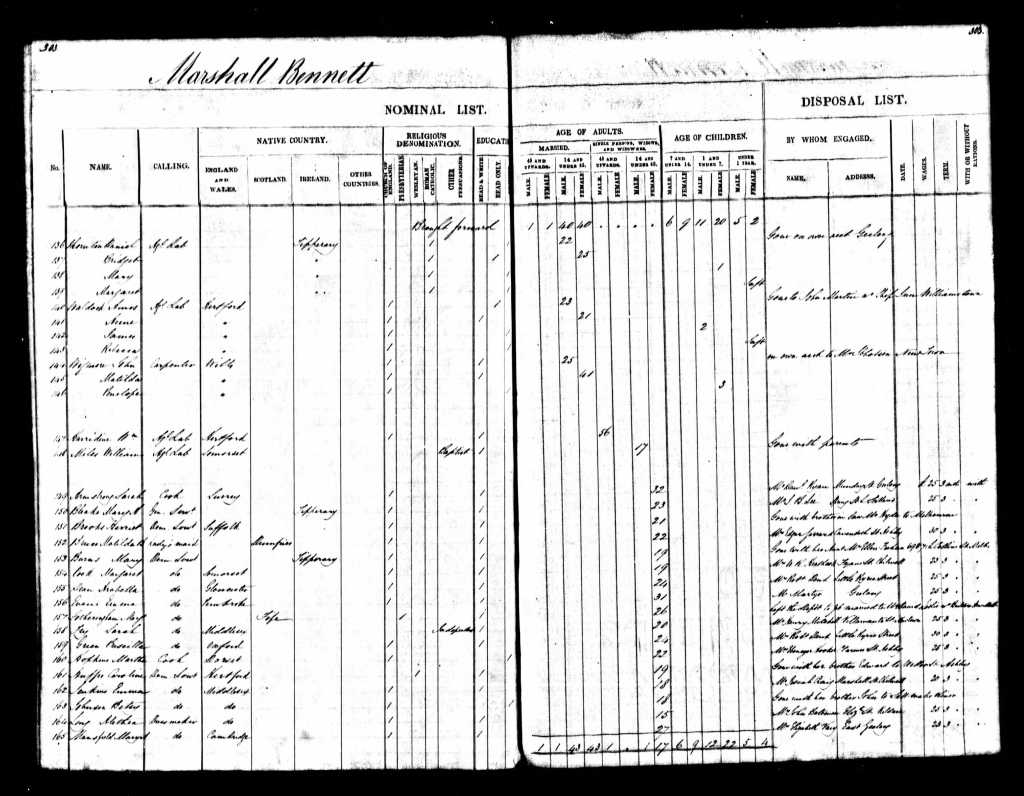
17-year-old William was, for immigration purposes, considered an adult, and so was housed with all other single males on board the “Marshall Bennett”. William was also the onlyperson in his family who could both read and write. The rest of the family could read. They were listed on the ships manifest as Baptists, presumably those of the Protestant faith who believed in full immersion when baptised rather than simply sprinkled with water, no matter how holy. Vicki’s parents and her siblings understood the family to be Methodist and Mary was particularly devout.
Any sailing voyage from England to Australia in the 1850’s would have been arduous, difficult and dangerous. On that particular voyage of the “Marshall Bennett” there were eight deaths – all children; six dying from measles, one from convulsions and one, Elizabeth Miles, the young infant daughter of Charles and Mary from whooping cough on July 30th, less than 2 weeks before the ship landed in Geelong. Mary had given birth only days before Elizabeth died, to a son John. This very difficult, upsetting and emotional situation was quite typical of what many immigrants to Australia experienced in making the journey to the other side of the world to start a new life. They certainly had firm resolve and a strong belief in themselves and their religion.
Although both the UK and the colonies were keen to encourage migration to Australia in the early and mid 1800s, North America was a more attractive destination, at the end of a shorter and less arduous voyage. To attract prospective settlers to Australia it was thought necessary to provide free or heavily subsidised travel with posters displayed to lure emigrants to Australia. Advertisements noted special provisions for steerage passages and stated that “Families will not be separated”. With ever-increasing networks of relatives from North America exerting a heavy influence on British and Irish workers to also migrate and join them during the nineteenth century, the provision of government assisted passages to Australia was deemed essential to support growth. From 1839 local officials in the NSW and Victorian colonies worked with British Government Officers to promote migration to Victoria and supervise the selection of applicants for both Government and privately sponsored immigration schemes. Overall, in the nineteenth century, 47% of all arrivals into Australia from the UK travelled with official assistance. The proportion of emigrants assisted by Australia’s colonial governments between 1831 and 1860 was 56%. Assisted immigration schemes developed in response to a high demand for labour for the rapidly growing Port Phillip District of Australia. The revenue from land sales funded two main types of assistance: migrant voyages organised directly by the government, and voyages operated by entrepreneurs, who were paid a subsidy or “bounty” for each immigrant on arrival.
The social engineering of the recruitment and selection of the assisted immigrants, with its careful balancing of married couples and of single men and women, was subverted in part by the self-funded immigrants, with many more single men than single women coming from England. This was also the case among the English immigrants to the United States in these same decades. In the social construction of respectability operating in nineteenth century Britain, women travelling alone were suspected of sexual immorality. Men could travel on their own with impunity, but women needed to emigrate in family groups, or under the quasi protection established on the well-run assisted immigrant ships or under some other chaperonage arrangements. For further reading on this aspect of social morality, read “Damned Whores and God’s Police” by Anne Summers.
Single men emigrated to build up their finances to enable them eventually to support a wife and a family in a manner acceptable to their class, or to achieve a higher status in the colonies than they could aspire to in England. Single women who emigrated also hoped to earn an income in the colonies prior to making a suitable marriage. Neither might necessarily realise this aim but it was a major motivator for both single males and single females. Families emigrated to improve their income and provide opportunities for their children in the new societies. Overwhelmingly the ethos among the English immigrants in New South Wales and Victoria was capitalist, accepting of a market economy and oriented towards acquiring more wealth than they believed they could in England, regardless of their class. They came bearing other values as well, but their dominant motivation was material success.
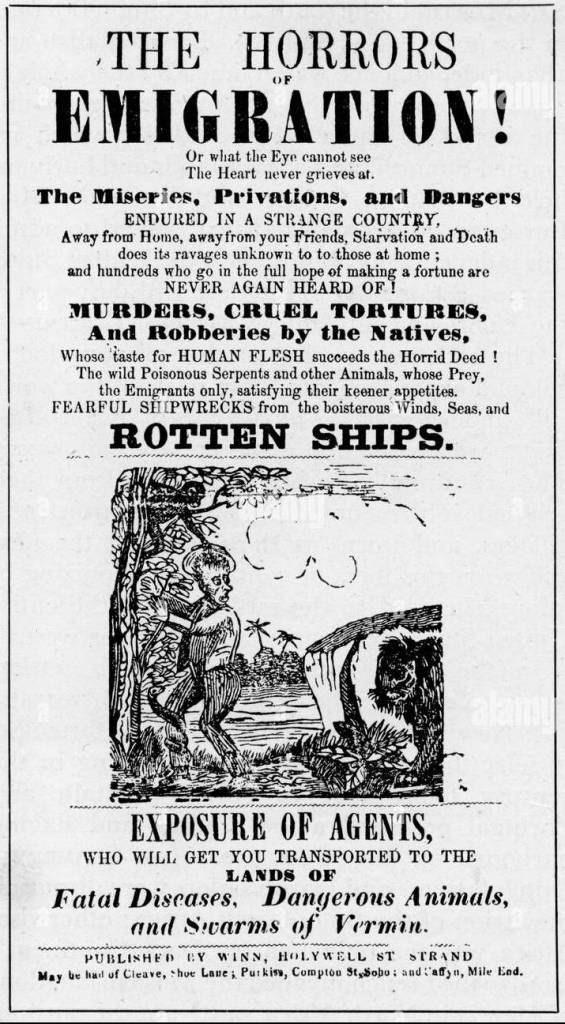
Assisted Passage also meant that the workforce coming from England, Ireland, Wales & Scotland were assigned to employers on pre-arranged pay and conditions. Around the world at the time Charles and Mary migrated to Australia, men, women, families and cooperatives were drawn by the lure of “striking it rich” at the Gold Rushes in both Victoria and California. Passage on ships was scarce, ships crews would desert and head for the gold fields; in many working environments men would simply down tools and head off, sometimes taking family, often just deserting them. Chinese “gangs” of labourers were organised and managed by powerful businessmen in their local districts and sent to pan and dig for gold.
England had serious problems in recruiting soldiers for the Crimea War because of the shortage of suitable young men – caused not only by the Gold Rush, but also by the large numbers of people who’d been affected by famines in the 1840’s and sent overseas, primarily to Canada and the United States. In farming communities such as Somerset where Charles and Mary Miles were living and working, agents would introduce and promote immigration to Australia where there was a drastic shortage of agricultural labour. Charles and Mary would have been aware of some young single men, women and families who had left for the promise of a better life that included the opportunity to actually own some farming land – an impossibility for them in England – the country they were living in.
This competition for what was becoming a scarce resource – experienced labour – saw American interests pitted against Australian entrepreneurs, established church bodies conducting wage wars with Governments, and as usual, different sides of politics pushing their own agendas.4
SOMERSET
Charles Miles and his wife Mary Weston grew up a few miles from one another in rural Somerset, a few miles between the two major market towns of the region – Frome and Bath. Their ancestors, family and neighbours were all people who were fundamental to the farming community of this region, all living in a small cluster of rural villages over an area of less than 50 square miles. It is a region of rich and varied history with Neolithic shrines dating back almost 6,000 years. It lies on one of the major Roman communication routes – the Fosse Way which went through the wonderfully preserved spa town of Bath. A large Anglo- Saxon community lived in this area during the 5th, 6th, and 7th Centuries A.D. During the Georgian period the city of Bath grew and prospered, contributing much to the architecture of the day. Coal had been mined in some of the small local towns as far back the 1300’s and this was expanded in the late 18th century as the Industrial Revolution became the driver for mechanical innovation and the expansion of the Victorian railway network.
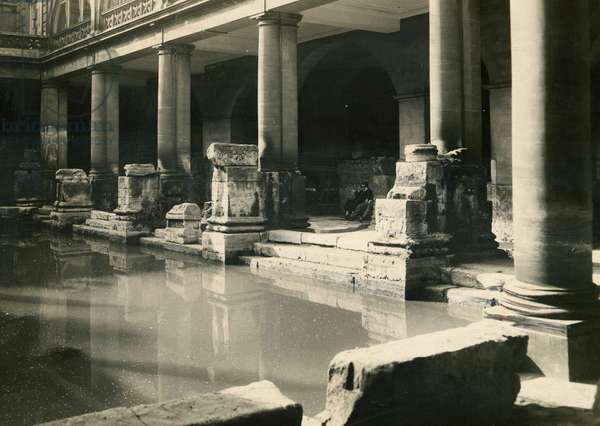
Today, most people would think of Somerset as the centre of rustic, traditional agriculture, with the vast countryside hosting dairy farming and the resulting Cheddar cheese and rows of apple trees producing cider. In the county’s northern reaches however, a prolific mining industry once had a hold of the land and even now, walking the comprehensive network of footpaths and cycle routes, some of this historic activity can be appreciated.
Their families and communities were close-knit, warm and supportive. It would have been emotionally difficult to leave a place that had been home to your ancestors for centuries, especially as the journey was known to be long and dangerous, the new land hot and inhospitable and more deeply, knowing that you probably would never see your friends and families ever again. Most of these folk did not read or write so communication would be sparse and delivered months, if not years, after any event. The overwhelming sense we have of our ancestors who came to Australia for a new life was how they were resilient and tough.
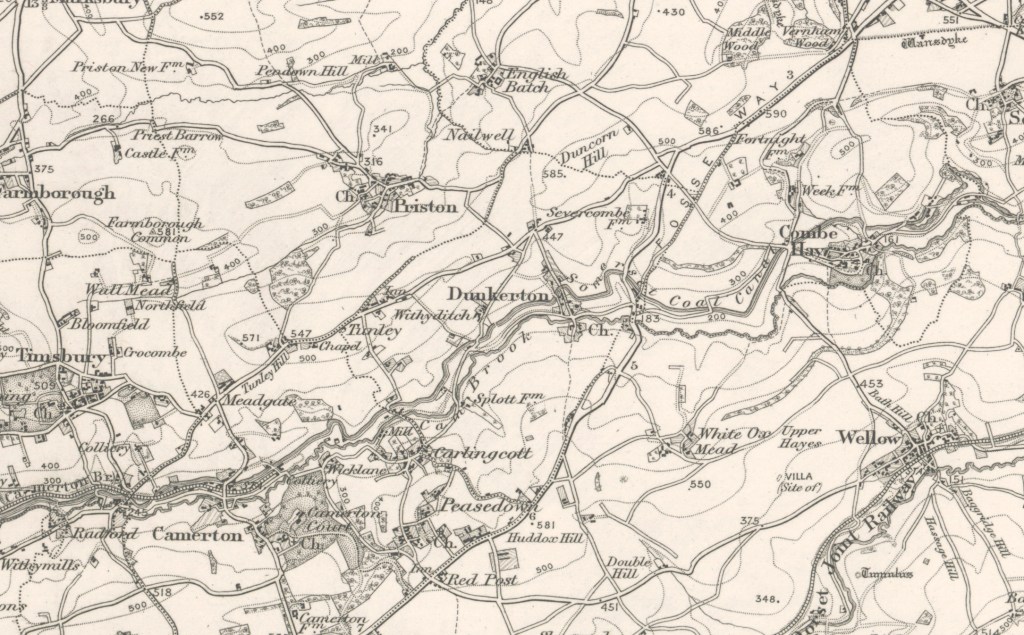
just above Englishbatch, out of the picture, is Englishcombe
Charles and Mary were descendant from the Miles, Weston, Heal, Cottle, Goford, Harris, Jeanes, Battel, Weeks, Whittock, Wilcox and Hinton families. Their ancestors lived in the farming hamlets and villages of Priston, Wellow, Englishcombe, Camerton, Dunkerton, Combe Hay, English Batch, Newton St. Loe, Hemington, Radstock, Timsbury, Tunley and Widcombe. The records we have utilised to create an accurate framework of these families can only take us back to the early 1700’s. There are no Kings, Queens or other famous historical figures in this background, however the countryside has not changed much since Charles and Mary’s youth – small farms and fields, separated with centuries old hedgerow, creating a vivid patchwork of various shades of green, intersected with small streams and rivulets.
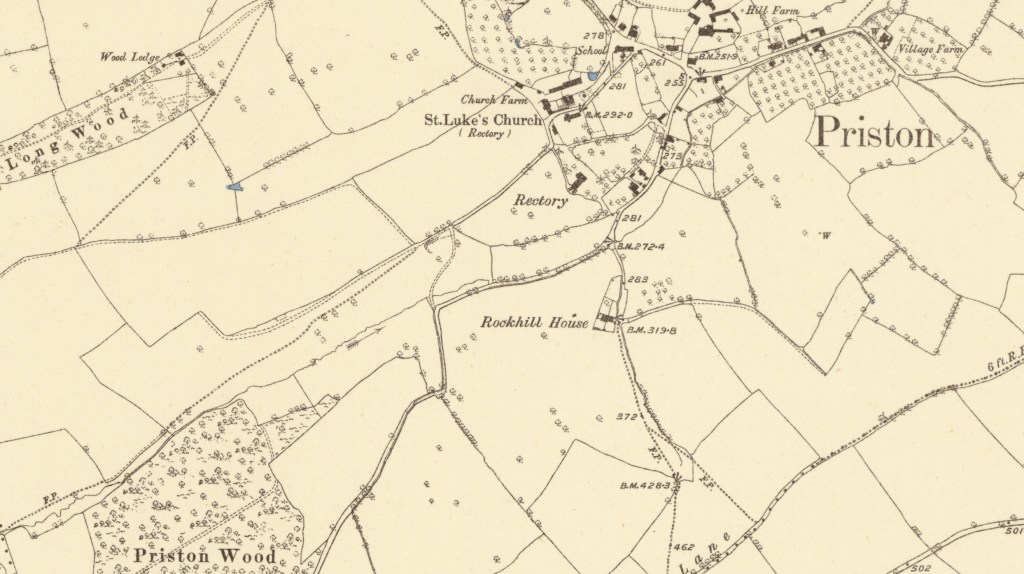
Charles was born in April 1813 in a small agricultural village, Priston, just a few miles from Bath. His mother Elizabeth Heal (1787-1828) was from Camerton, another rural village that was about 3 miles south of Priston. His father, John Miles (1795-1862) was from the village of Englishcombe, which was some 3 miles north of Priston. John Miles and Elizabeth Heal were married on Christmas Day 1809 in Dunkerton, perhaps a mile south of Priston; and yes, those dates are correct: John Miles was 15 years old, Elizabeth Heal 8 years older and pregnant with their first child, Abraham when they were married. They went on to have children, all born at Priston. Elizabeth died in 1828 giving birth to their last child, Richard, on Charles’ 15th birthday.
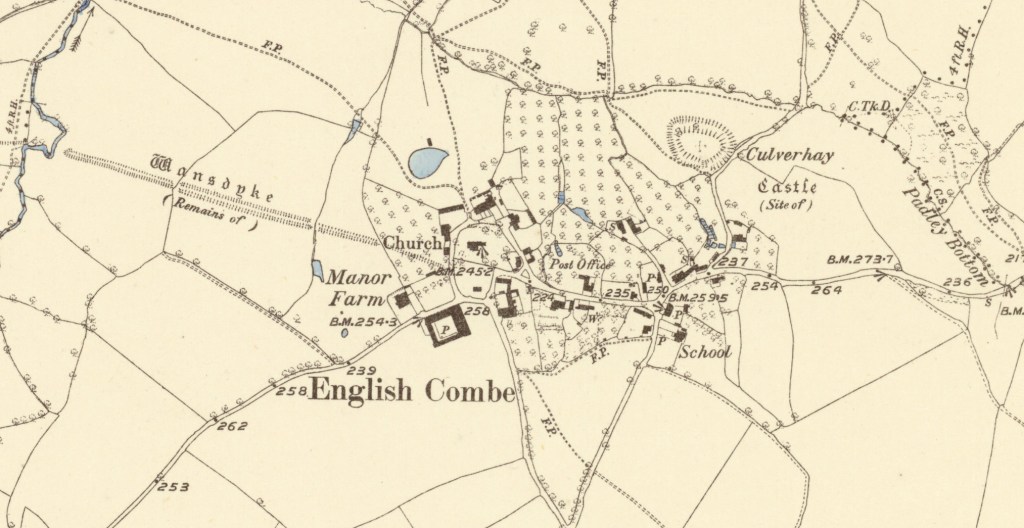
Mary was born 4 miles from Charles in the village of Wellow, her parents William Weston and Mary Goford also agricultural workers. Mary was born in October 1816 and had an older brother and sister, Thomas and Martha. Mary did not know her father as he died when she was only nine months old. Mary Weston married Charles Miles in Englishcombe, where they were probably both working on 21st June 1835. Later in that same year, John Miles, Charles’ father married again, to Johanna Bull, from Camerton. John Miles and Johanna married in Dunkerton and had 9 children. Tragically, Johanna, just like Elizabeth, John’s first wife, died as a result of birthing difficulties in February 1855.
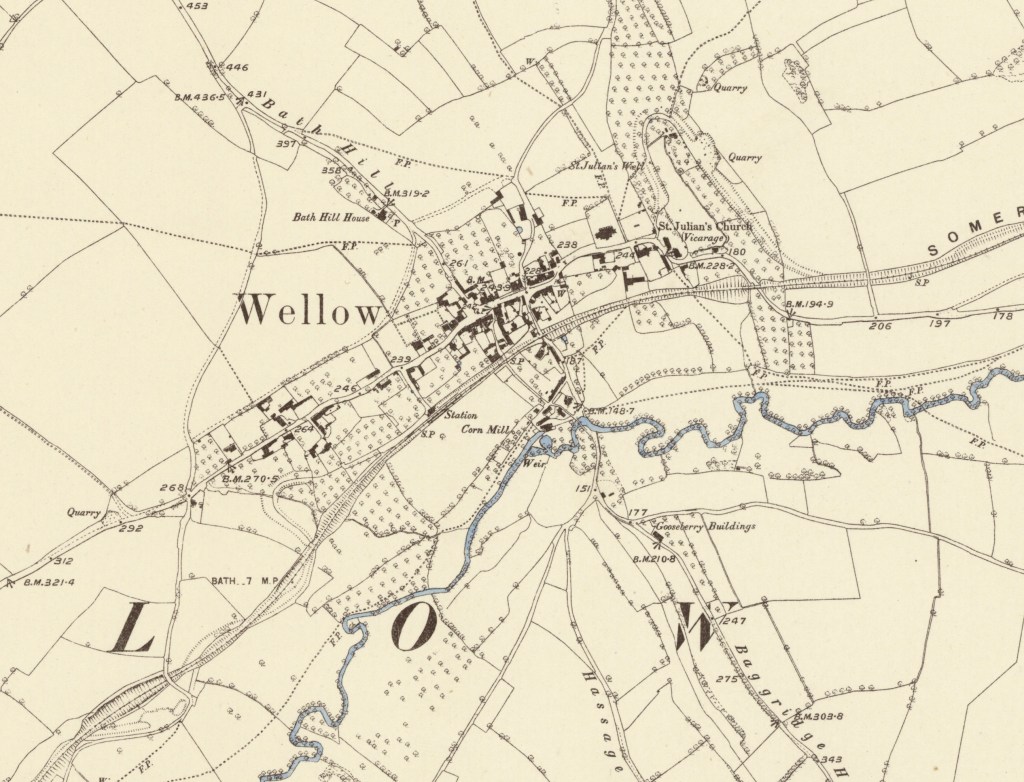
The 1841 Census shows Charles and Mary, with two young sons living in Englishcombe village, Charles listed as an agricultural labourer. Their daughter, Martha, named after Mary’s sister, died soon after birth, another reminder that life, especially for young children and their mothers could be short and precious.
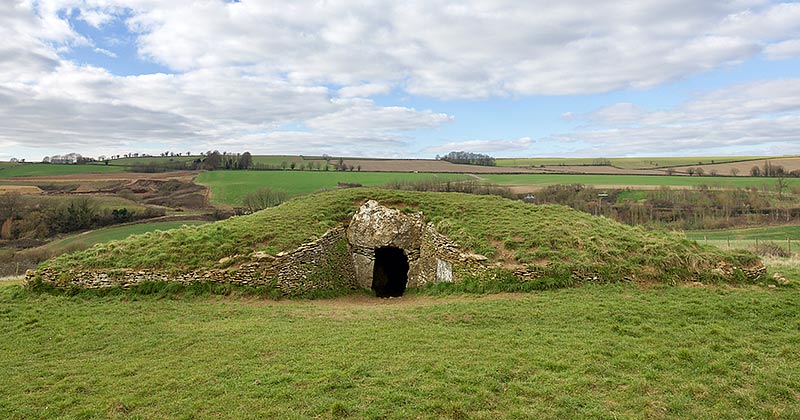
Stoney Littleton is one of the most easily accessible long barrows in Britain.
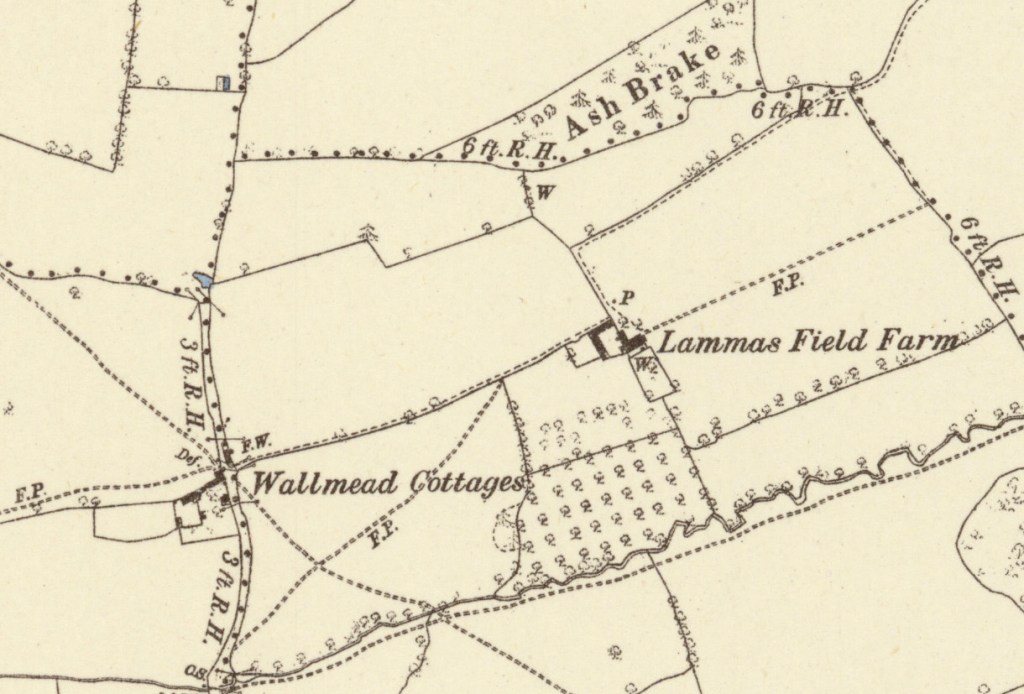
In 1851 the Census shows that Charles and Mary are living at Lammas Field Farm, a short distance from Priston and Camerton with their family of 5 children and Mary’s aunt, Hannah Hinton, a 79-year-old farmer’s widow. Hannah (Weston) Hinton had married a farmer from Combe Hay – William Hinton, who died in 1849. Hannah was the eldest aunt to Mary and her younger sister, also a Mary Weston, had married William Hinton’s younger brother, Richard Hinton. Neither of the aunts had children. An uncle to Mary from the same Weston family was Zebedee Weston who has gained infamy as the Reverend Stringer’s bag man.
Reverend John Skinner was the Rector of the parish Camerton from 1803 to 1834 and his diaries have been preserved in book form “Journal of a Somerset Rector”. An amateur archaeologist, Skinner is credited with the discovery and safeguarding of the famous chambered tumulus at Stoney Littleton, a mile and a half from Wellow. Zebedee Weston was employed by Skinner for much of the labour involved. Zebedee was Hannah and Mary (Weston) Hinton’s brother, and Mary (Weston) Miles’s uncle.
Charles and Mary would have had many discussions with close relatives about their possible future and their children’s future as part of an established agricultural industry where there was a drift of people seeking work from the fields to the larger townships. Their eldest, William at the age of 14 was listed as a stone worker in the 1851 Census – back breaking work in dangerous conditions, as was coal mining. Hannah would have added her perspective as the agricultural workforce were made aware of the opportunities for land selection that was available in Australia, as well as the passage for whole families paid for by farmers and/or governments in Australia, constantly seeking experienced agricultural labourers.
Mary’s sister, Martha had married a coach driver, Thomas Studds in 1843 and was living in London. Her brother Thomas is believed to have died about the same time, so there was probably few family ties to hold her to Somerset.
Charles and Mary came to Australian just as the Gold Rush had begun in earnest, however their aims were not to participate in this yellow fever but to establish themselves as farmers of their own land.
A NEW LAND
Charles Miles had been engaged by a Mr. William Walters at Barrabool Hills to work for him for 120 shillings and sixpence per year, which would include some labour from Mary and the children. The eldest son, William, seen as an independent worker not part of his father’s “family package” and possibly engaged separately. The manifest from the “Marshall Bennett” noted that William had “gone with his parents” but that 13-year-old George was engaged at Hampstead, Moolap for 20 shillings and threepence per year to a Mr William Hartley. Perhaps the entries for William and George were entered incorrectly. The property at Boorabool Hills was about 12 kms due west from Geelong and the Moolap property was about 6 kms east of Geelong. The family would have been limited in what clothes and possessions they could bring with them to Australia from Somerset, making the first few months of their employment in the Geelong region extremely difficult as they acclimatised
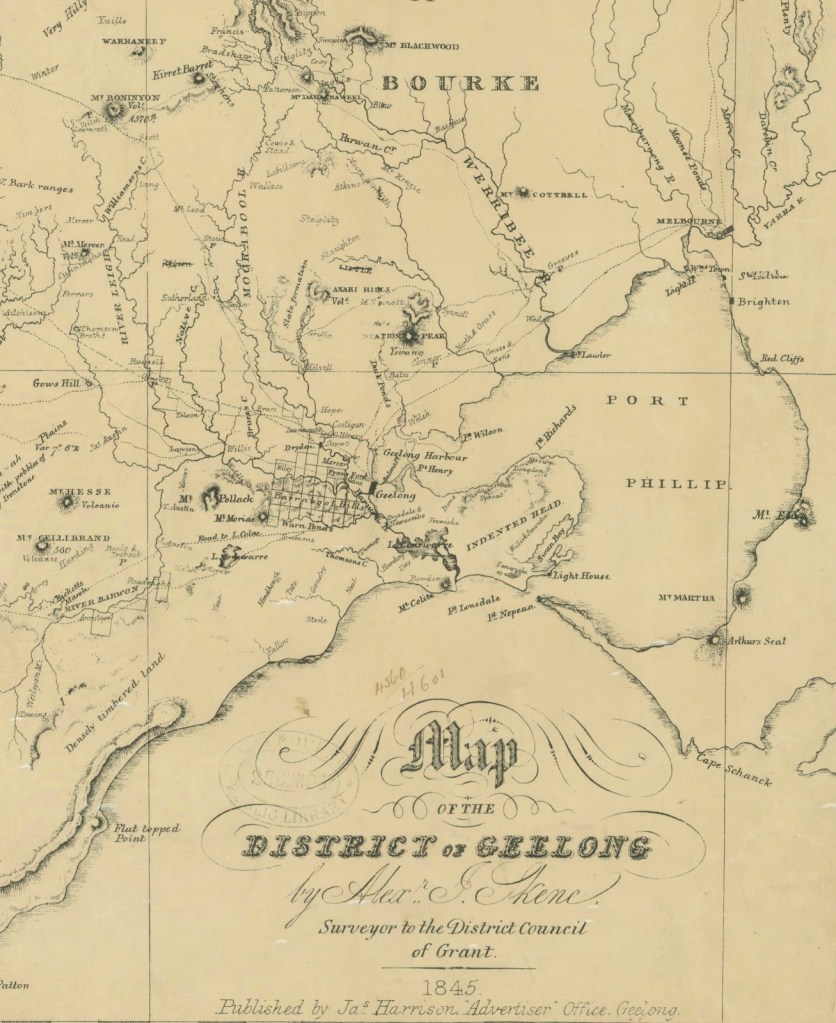
not only to a different, harsher world where farming was done differently; but also, to the grief of leaving their Somerset community behind. The death of young Elizabeth just before landfall would only add to their extreme disquiet and anxiousness.
In the early part of Victoria’s gold rush, the township of Geelong and its well protected harbour had a higher population than Melbourne. It was closer to Ballarat and Bendigo and had a much better port infrastructure. By the mid 1860’s Melbourne had overtaken Geelong in population, wealth, infrastructure and desirability both for private citizens and government bureaucracy. By the mid 1870’s Melbourne was considered one of the world’s most affluent cities.
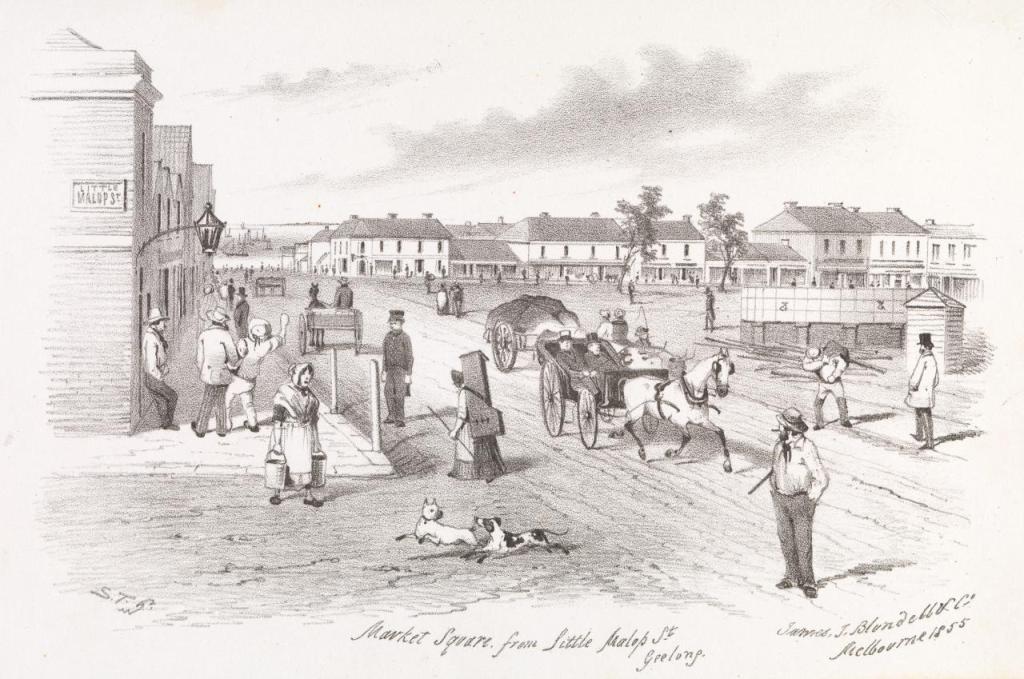
plate 23 from “The diggers and diggings of Victoria”
an 1852 series, published by James J. Blundell & Co., Melbourne, 1855
In January 1859 another child was born to Charles and Mary – a daughter, Sarah who was born at Barwon Heads. Charles had moved the family to another property for work at a place called Murradoc Hills, further east on the Bellarine peninsula, just past where William was working. Barwon Heads is on the ocean side of the Bellarine Peninsula, a very short distance from the opening of Port Philip Bay. Charles, nearing 50, now started to put his plan to secure his own land into place. The first step was to rent a farm so that he could make and use profit to secure some kind of selection of unimproved land. He took the family 130kms north, past the gold mining centre Ballarat, to a small place called Kingston, between Creswick and Daylesford.
The Gold Rush in Victoria, centred on the towns of Ballarat and Bendigo gave rise to very rapid growth and wealth. As mentioned earlier, men from intra and inter colony would simply drop tools and head for this part of Victoria, walking if no transport could be afforded. Some Colonial Governments, like South Australia, had to set up relief funds for families deserted by the husband who had walked out to make his fortune. Tens of thousands were afflicted by the hope of a lucky find; very, very few realised their dream – the search for gold has often been called a mug’s game. The Gold Rush phenomenon has been addressed in countless books and films and resulted in Melbourne, the city that all gold related commerce flowed through in Australia, becoming one of the wealthiest cities in the world by the early 1870’s. The little village of San Francisco in California suffered a similar fate.
Of greater interest is Charles and Mary Miles and their family.
It would appear that Charles and Mary had not remotely considered a gamble like gold prospecting when they left Somerset and the farming community of Priston, Dunkerton, Wellow and Englishcombe. Their plan was to secure raw land that they could improve, fence, raise pigs & cows and grow crops. Land that they could build a home and barns; land that they could break up so that their children could all have their own piece to follow suit.
A biblical vision, a promised land was their goal, not a yellow metal from the ground that caused all manner of ills in mankind.
In Kingston, sometime in the early 1860’s Charles rented a farm from a Mr. Thomas Bradley and went into business for himself. For the next decade he and the family lived and worked on the rented farm, able to secure enough profit to apply for land selection. The Land Act was a fluid, ever changing Government instrumentality, and, like all Government structures designed to ensure that the little battler did not get anything too easy or free. Old Charlie would have driven his family hard, knowing that he would have a very worthwhile result at the end of some arduous work and long hours.
LAND SELECTION
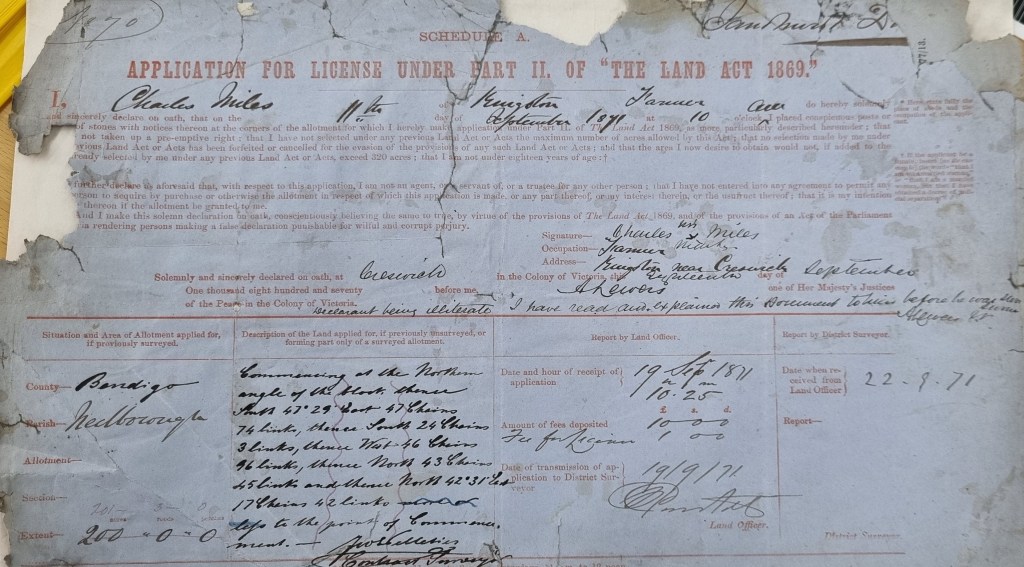
On the 11th September 1871 Charles applied for a licence to occupy an allotment in the Neilborough Shire of 320 acres. This meant the family had to move north again, another 120kms to their spot in the wilderness, past Bendigo and near Raywood; the region was called Summerfield. The Selection process, under the newly amended Land Act required the applicant to jump through all sorts of hoops, essentially improving the land from somewhat barren to liveable production.
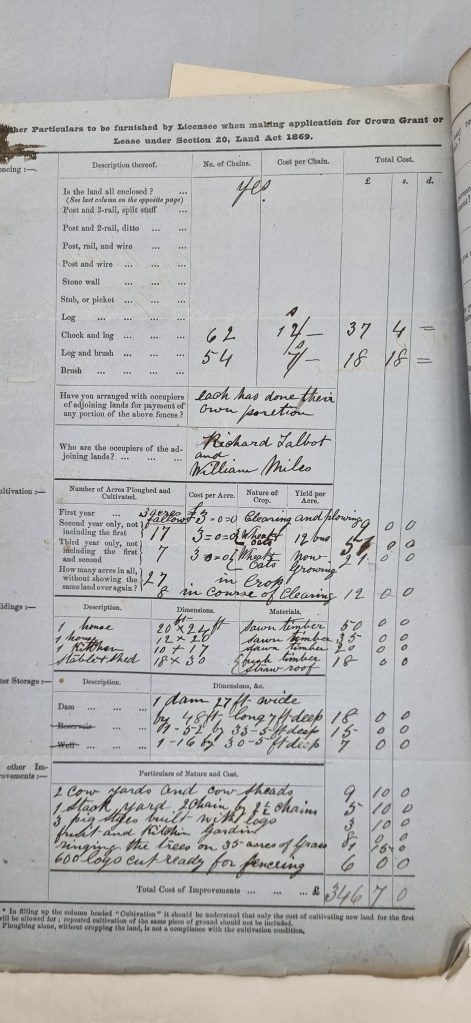
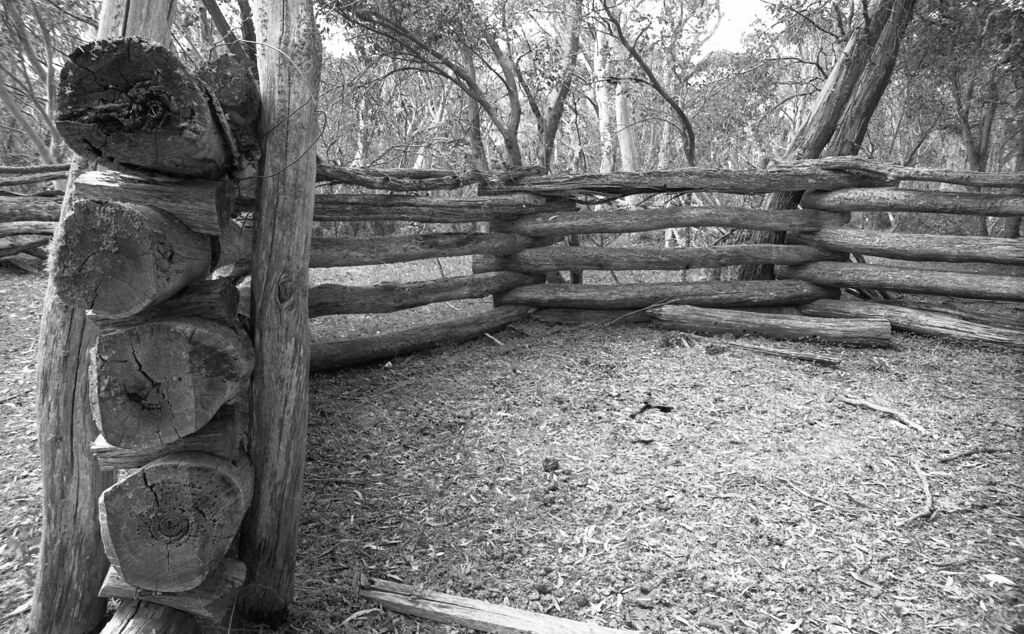
Over the next 15 or so years, Charles put in 62 chains of chock and log fencing, 54 chains of log and brush fencing, cleared and ploughed 27 acres for sowing wheat and oats, built a five-roomed house of sawn timber with a straw roof, and built two cow sheds & 3 pigsties.10
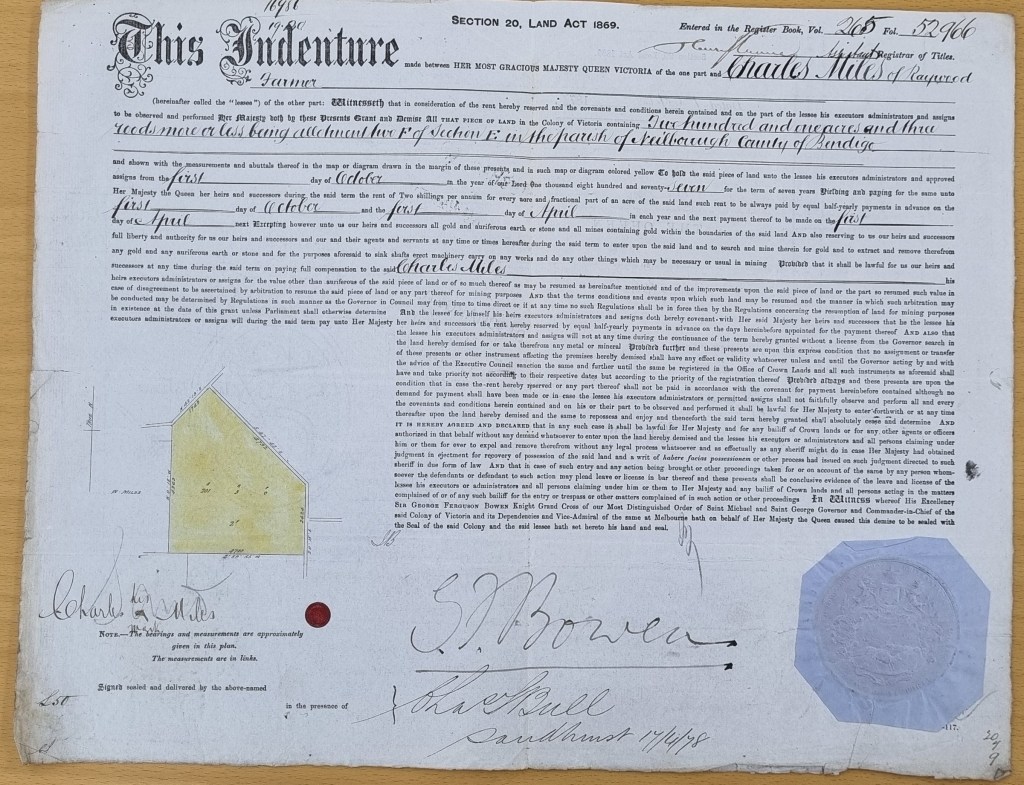
On the 12th of February 1888 less than two months before his 75th birthday, Charles Miles received his crown grant for the land, having satisfied the improvement requirements and completed the payment of purchase of 202 pounds.
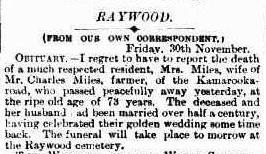
His wife, Mary (Weston) Miles passed away late in the same year at Raywood where their son, John was living with his family. Not everyone in the family came with Charles and Mary on their odyssey, but they did remain close and connected.
William, who was in a separate farming arrangement to his father, stayed in the Geelong area and was married there in 1864 to Jane Wiffen. However, he was the first of the family to move north and settle: his second child, a son Joseph, was born in Summerfield in 1867, a couple of years before Charles selected.
Ann married Thomas Lee in Creswick in July 1864 and remained there before settling near Glenrowan, Ned Kelly territory almost 300kms to the northeast.
George Miles married Jane Benbow Matthews in April 1868 in the small town of Dean, just 12kms south of Kingston. They eventually moved to Melbourne and then retired to Bairnsdale, more than 300kms on the east coast of Victoria, near Lake’s Entrance.
Mark Miles also married while the family were in the Creswick area, to Emma Wright in May 1866. After farming in this region for some years, Mark and Emma also moved to the Summerfield district in 1874, again farming. In 1880 they moved a few miles east to Kamarooka and opened a store and a farmer’s depot. Mark Miles was a very well-respected local preacher for more than fifty years.
John Miles who went with his parents to Summerfield, married Marion Hoatson in 1880 in nearby Raywood. Marion was the eldest daughter of an Independent Minister, George Hoatson from Raywood. Marion’s mother was Elizabeth Hendrickson, born in Adelaide in 1841 to Elizabeth (Armstrong) and John Hendrickson who had migrated to Adelaide from Newcastle-upon-Tyne in 1839.
Sarah Miles, the youngest, born at Barwon Heads before her father moved the family north was also married in Raywood. Sarah married William Ritchie in July 1879. William was a Scot who arrived in Geelong as a two-year-old with his parents in 1852.
There was another family wedding in nearby Creswick when Mary (Weston) Miles’s sister, Martha (Weston) Studds married Ellis Price in February 1872. There was always conjecture about communication between people migrating to Australia, particularly as so many did not read or write. Martha Weston, Mary’s older sister had married her first husband, Thomas Studds in London in 1843. Thomas, who was a cab driver (horse drawn of course), died in 1861 and a few years later, Martha sailed to Australia on board the “Zenobia”, arriving on 31st August 1869 with two children. The marriage, two years later to Ellis Price, in Creswick could not have been serendipity – there must have been some communication between the two sisters. We think that this was proven correct when it was discovered that one of the witnesses to Martha and Ellis’s wedding was Mark Miles’s wife, Emma Wright.
We have estimated that Charles and Mary Miles, married in 1835 in St. Peter’s Church, Englishcombe Somerset almost 200 years ago, now have in excess of 6,500 descendants, predominately spread throughout Australia. Some have estimated that number to be at least 25% higher. The exact number is of no consequence; but the total does reflect their determination, their drive and their courage in leaving their homes and travelling by ship to the other end of the world to restart their lives from scratch and make a new beginning.
This essay evolved from our desire to add further details to the lineage of Charles and Mary and their ancestors in Somerset England. That task has, in 2023, been made so much easier as parish and church records from every corner of Somerset have been transcribed and digitalised and are readily available online and through collaboration with some wonderful “new” cousins.
In the course of this collaboration, we have found that Charles and Mary were not the first of their families to sail to Australia, nor were they the last.
* * * * *
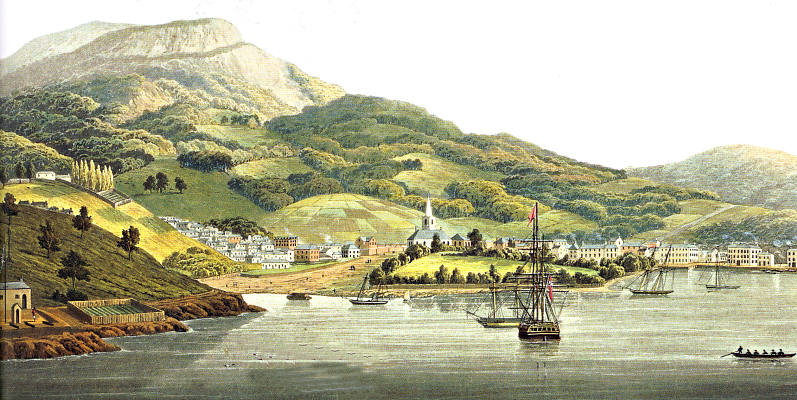
Two of Charles’s siblings arrived in Australia before Charles: his younger sister, Sarah (1824-1883) who arrived at Hobart, Van Diemen’s Land aboard the convict ship “Woodbridge” in 1834 has a tragic, yet fascinating story.
Charles’s younger brother, John Miles (1826-1903) also arrived in Hobart, aboard the convict ship, “Marion” in 1845.
And one of Charles’s first cousins, Sarah Miles (1839-1897) the second daughter of Francis Miles, arrived a few years later into Sydney in 1858 on board the “Peter Maxwell”.
There is no evidence to suggest that there was any contact in Australia between Charles and his siblings, Sarah and John, or between Charles and his cousin Sarah.
Their stories will be told in future Milestones.

 miles of irvings
Leave a comment