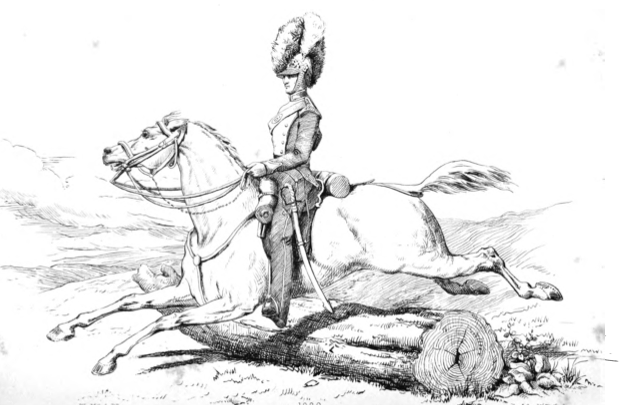
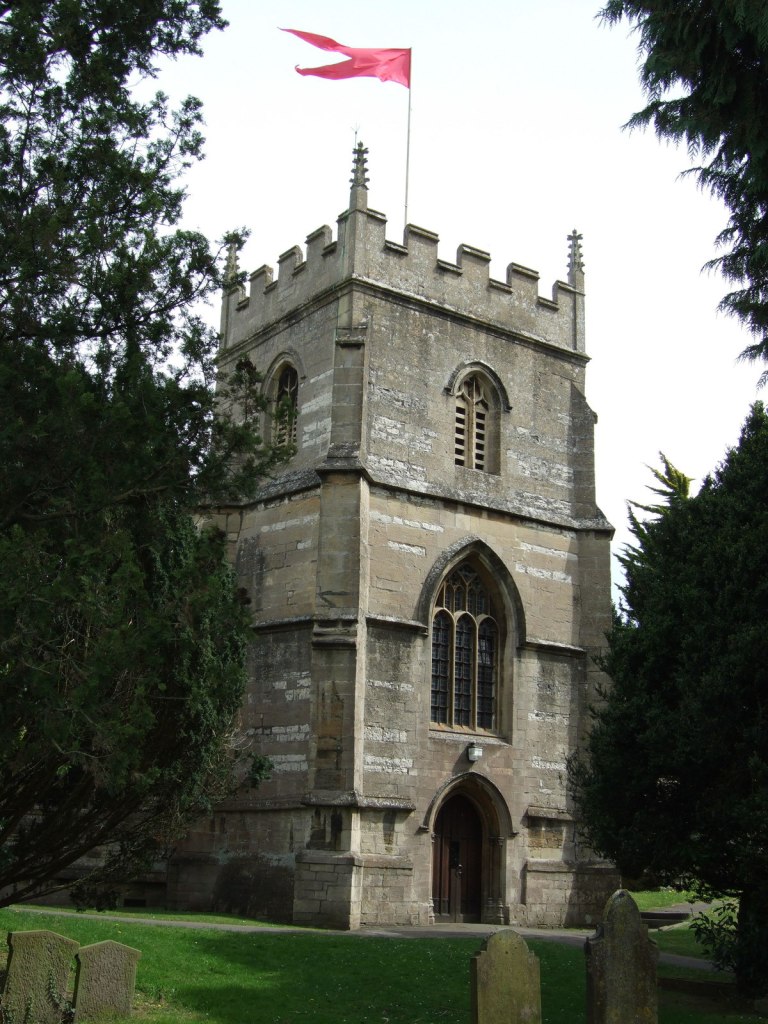
A story from the 20th September 1835 newspaper, The Bath Chronicle, reported a burial with military honours at Twerton commencing at 5 o’clock: “it is calculated upwards of 7,000 spectators were present.” The funeral, for Mr. Daniel Miles, of the Bath Troop of North Somerset Yeomanry Cavalry, started from the George Inn where Daniel had lived and finished at the local church. Seven thousand is a big number, particularly as the population of Bath at that time was probably just shy of 40,000 people. Irrespective, it was very intriguing when the cause of death was not published, yet the half-mile procession from the George Inn to the St. Michael and All Angels Church was described as “preceded by twelve of the Bath Troop, with their carbines reversed, and the Band of the Regiment, which continued playing the 104th psalm all the way to the church. The pall was borne by six of the troop, the helmet, sword, and pistol of the deceased being reversed on the coffin. – The horse immediately followed, with the boots and spurs also reversed in the stirrups. Next followed the chief mourners and the remainder of the Bath Troop, attended by their respected Captain, C. Wilkins esq. As soon as the corpse was lowered into the grave, twelve of the troop fired three volleys over the remains of their comrade.”
THE FAMILY
1st generation: “Old” John MILES 1703-1791 m. Hannah WILKINS 1706-1771
2nd generation: William MILES 1730-1790 m. Betty MILLS 1733-1790
3rd generation: George MILES 1759-1808 m. Sarah HARRIS 1763-1830
4th generation: William MILES 1788-1854 m. Mary LAWRANCE 1791-1850
5th generation:
Daniel MILES 1809-1835 m. Ann CADBY 1813-1835
Amy MILES 1812-1814
William MILES 1815-1876 m. Mary CADBY 1816-1900
John MILES 1818-1822
Amy Lawrence MILES 1820-1868 m. Ebenezer CADBY 1819-1855
George MILES 1821-1826
John MILES 1823-1835
George MILES 1826
Mary Lawrence MILES 1828 m. George STONE
The man being buried, Daniel Miles (1809-1935), was the eldest son of William Miles (1788-1854) and the 2ndgreat grandson of “old John” Miles (1703-1791), the Miles patriarch of the farming community at Englishcombe and nearby Priston, just a few miles southeast of Bath, Somerset. Daniel was married to a local Twerton woman, Ann Cadby, their wedding was on 25th December 1830 at the St Mary Church in Bristol, Gloucestershire. Ann’s brother, John Cadby, was one of the witnesses to the wedding and their short marriage produced two sons: William Henry, born in 1831 and John born in 1833.

The 1835 obituary for Daniel Miles, also published in the Bath Chronicle, simply states that Daniel was living at the George Inn, Twerton with his father when he passed away. His wife, Ann (Cadby) Miles died only a few months later and their youngest son, John Miles, died in 1836. We can find nothing about William Henry.
Daniel’s father, William Miles (1788-1854) was born and baptised at Englishcombe, In October 1808 he married Mary Lawrance (abt. 1791- abt. 1850), by Banns at St Mary Church, in Bitton, Gloucestershire which is about six miles from Englishcombe and half-way between Bath and Bristol.
William and Mary had nine children: Daniel, born in August 1809, Amy 1812-1814 and William 1815-1876 were all born in Englishcombe. John 1818-1822 and Amy Lawrence 1820-1868 were both born at High Littleton, where their father, William, was working on a farm called Kingwell. The next four, George 1821-1826, John (2) 1823-1835, George (2) 1826 and Mary Lawrence 1828 were all born at Twerton, just north of Englishcombe where their father William was now expanding his business as a pork farmer to include possibly managing and operating the George Inn on High Street, Twerton. William appears to be following both his father and grandfather in pork farming.
Daniel’s grandfather, George (1759-1808) who married Sarah Harris (1763-1830) was an astute businessman. He leased a number of fields around Englishcombe, developing the local pork farming & butchering industry and producing malt for the production of beer and ale.
Daniel’s uncle, also a George (1784-abt1865) was likewise involved in the pork business, and had moved northwest from Englishcombe to Clifton, near Bristol, at an early age and had successfully built a pork farming business in that region.
Daniel’s brother, William (1815-1876) is one of the first of the Miles Clan to leave Somerset for another country. He was six years younger than Daniel and migrated to Connecticut, USA in 1848 with his wife and children. He married Ann Cadby’s younger sister, Mary Cadby, in early 1835, also at St. Mary Church in Bristol, where Daniel and Ann had married. William and Mary had ten children across two countries. The first six were born in Somerset and the next four born in New Haven, Connecticut where they had settled after arriving in New York in October 1848 from Liverpool aboard the ship “Jamestown”. On the 1850 and the 1860 US Federal Censuses, William is listed as a labourer, but the 1870 census shows him to be a butcher – it appears that the family business was continued by William in the USA.
The only other sibling of Daniel’s to have children in addition to his brother William, was his younger sister, Amy Lawrence Miles (1820-1868) who completed the trifecta by marrying Ann and Mary’s younger brother – Ebenezer Cadby, in 1841; and yes, it was at St Mary Church Bristol. Three siblings from one family marrying three siblings from another – probably not usual, but definitely not unheard of either – and they weren’t cousins!
Daniel and his wife Ann both died in 1835 and the 1841 Census shows his parents, William and Mary living in Twerton, with Daniel’s youngest siblings, Amy (20), John (15), and Mary (14). There is no address listed, which is often the case for the 1841 census. William is recorded as a pork butcher, suggesting that his transition from farming in Kingwell to a successful pork business was complete. We do not know if he was still living at the George Inn where Daniel had died.
In November 1841, as earlier mentioned, Amy Miles married Ebenezer Cadby at St Mary Redcliffe in Bristol. They had six children, all born in Twerton. In 1847 a newspaper story on a milkman’s suicide noted that Ebenezer found a man on the road with his throat cut and assisted him back to the George Inn. This suggests that Ebenezer and Amy were now involved in the Innkeeping business with her father William at the George Inn now that his son Daniel had died and the other surviving son, William, was preparing to migrate to North America with his wife and children.
The 1851 census for Twerton shows Ebenezer Cadby, an Inn keeper as head of the household, his wife Amy, their three children, a house servant, Sarah Hedge and two lodgers: Henry Wilkins, a blacksmith from Wiltshire and William Miles, the father-in-law, 62 year old widower and butcher born in Somerset. We can assume that they are all living at the George Inn; unfortunately, this census also does not give any details about the address other than a number – 60. The next-door dwelling, number 59 has listed as occupants a William Gumm, his wife Sarah and a niece, Ann Calcott. William Gumm is recorded as a 40-year-old butcher and beer housekeeper which suggests to me that the Cadbys were at the George Inn and the Gumms at the Old Crown Inn.
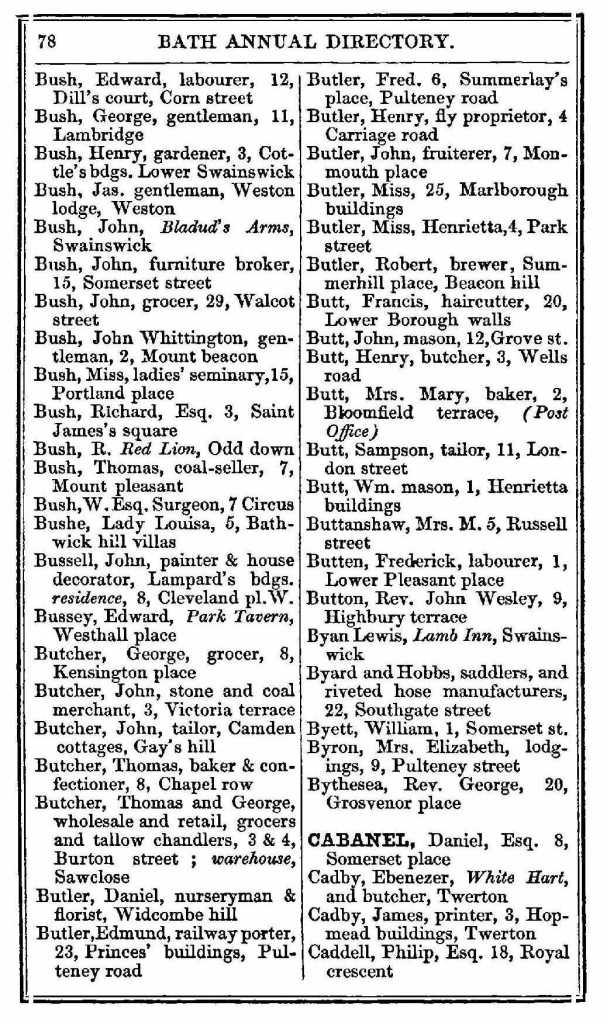
The 1852 business directory for Bath shows Ebenezer Cadby as a butcher, from the White Hart Inn in Twerton. It does seem that Ebenezer is forging ahead in the businesses of his father-in-law: inn keeping and butchering. Tragically it doesn’t last long as an obituary in 1855 states “May 1, at Twerton, aged 37, Mr Ebenezer Cadby, landlord of the White Hart Inn, in that place.”
In October 1860 a newspaper notice sheds some light on the fortunes of Amy and her father William: “October 3, at St. Andrews church, Montpelier, by the Rev. Hugh Allan, Thomas, son of Mr. James Wright, of Charlton, near Malmesbury, Wilts, to Amy Miles, widow of the late Mr. Ebenezer Cadby, and daughter of the late Mr. William Miles, of Tiverton, near Bath.”
From these documents it appears reasonable to assume that Mary (Lawrance) Miles (abt.1791-abt.1850) had died before the 1851 census; and that her husband, William Miles (1788-1854) had died before the second marriage of their daughter, Amy, to Thomas Wright in 1860. There is a record of a William Miles being buried in December 1854 at Walcot which has not yet been verified as “our” William, father of Daniel Miles who was buried with great ceremony in 1835.
The GEORGE INN, HIGH St., TWERTON
The funeral procession for Daniel Miles left from the George Inn, which no longer exists as a business, although the building still stands. However, there is a document titled “The High Street, Twerton an Historical Survey” by Mike Chapman published about 2003 which gives a very good overview of the buildings on High Street which include three inns or beer houses – the George Inn, the Old Crown Inn and the White Hart Inn.
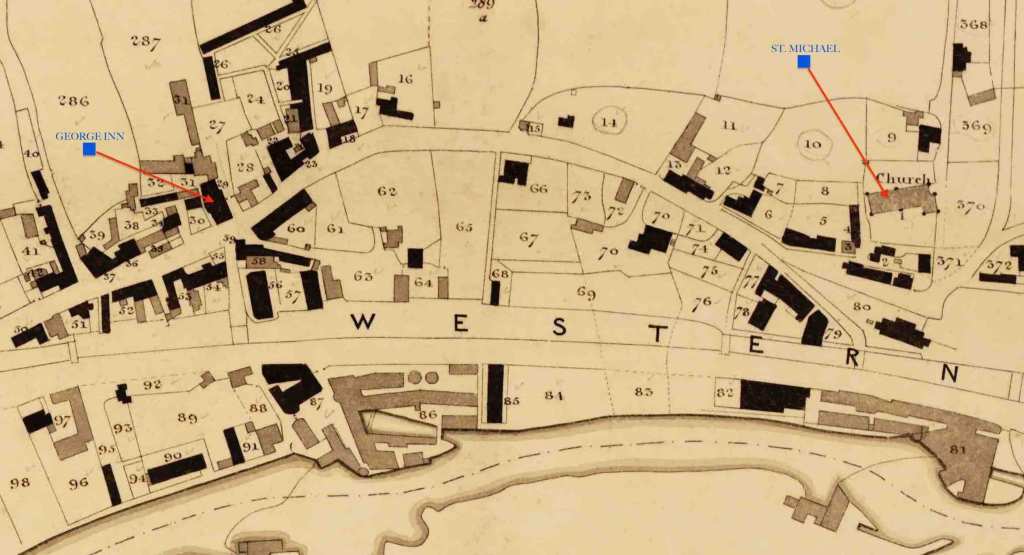
The descriptions of these Inns, from west to east are best referenced with the following map which has been copied from the parish tithe map of 1840 and is found in the Historical Survey by Mike Chapman.
“THE CROWN INN (131 High Street)
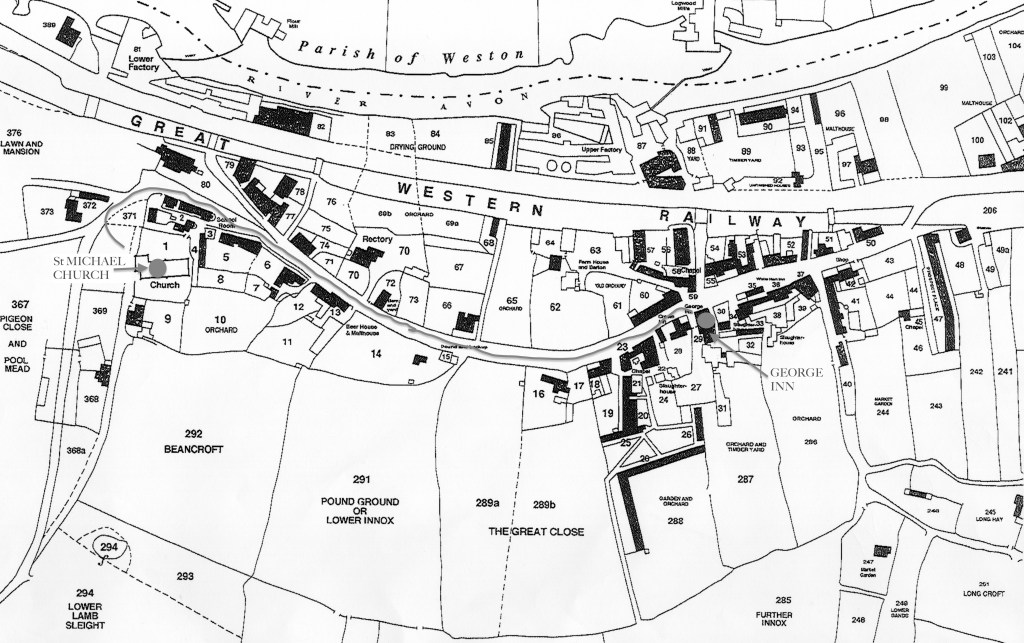
The Crown Inn: 28
The George Inn: 29
The White Hart Inn: 36
The frontage of the Crown in the 18th century were markedly different from today. The building then stood end-on to the street, and on the east side was attached to the premises of the George Inn. Between them the buildings were partly set back from the road to form a front courtyard. If the Crown had any stables, these would have been on the west side which remained an open yard with access through the lane later known as Barrett’s Buildings. During the later half of the 19th century itwas owned successively by two engineer millwrights, James Barrett (from about 1834 to 1883) and James B. Blackmore (from 1884 to 1900), both of whom ran an engineering works by the Upper Mill. It was Barrett who presumably installed the present frontage after the building was detached from the George (described below) in 1832. It was also during his time, about 1870, that the inn was renamed the ‘Old’ Crown. Despite these alterations, the Crown remains the only survivor of the three inns that once served the traffic on the 18th century turnpike road.
THE GEORGE INN 132 High Street
The main building of the George in the 18th century appears to have been the house which now stands end-on to the street on the eastern side of the present block and is of at least 17th century origin. At that time the site of the western house and the courtyard next to the Crown was occupied by other buildings set back from the road. The stables of the George stood at the back of the building, apparently reached through an alleyway on the east side. The two inns were separated and the present western house and courtyard built in 1832, the courtyard presumably being provided for better access to the stables. The gateway at that time however was set further back, on the site of the present steps up to the hall. The alleyway on the east side (now a garden footpath) was retained for pedestrian access to the rear. On the west face of the building overlooking the courtyard is a datestone marked ‘REBUILT 1832’ set around an older
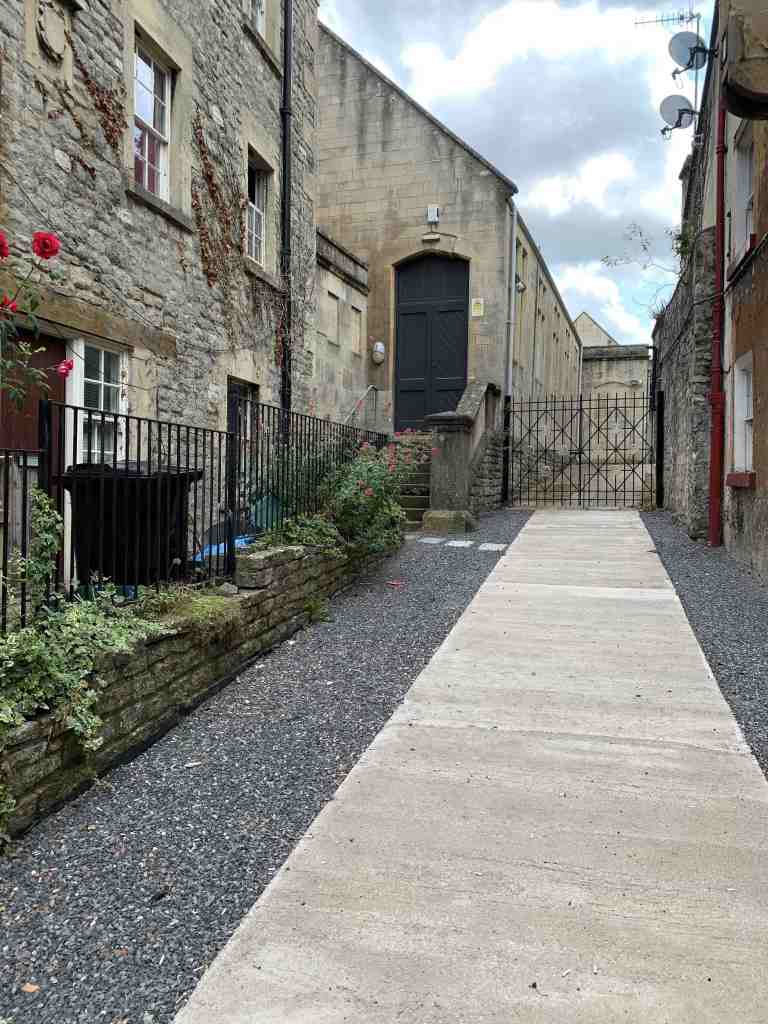
stone, its armorial lettering almost completely weathered away, which was evidently taken from part of the earlier building. The inscription, still legible in the 1930s, read “A.B.S. 1681,” the central “B” standing above the “A” and “S.” This almost certainly refers to Abel and Sarah Broad whose marriage is recorded in the parish registers in 1671. The new house was presumably built by a ‘John Smith’, who acquired the property in 1830.
However, in 1878 the inn was purchased for the parish by the owners of the Cloth mills, Isaac and William Carr, to provide premises for the Twerton Club and Institute. A library and reading rooms (previously located near the lower mill) was provided in the western wing, accessed through a door at the front facing Mill Lane. A clock was later installed above the front windows. The present hall at the rear was also built, presumably on the site of the stables, and the ornamental iron gates and spur stones installed at the front. The eastern wing, which was separated as a private dwelling, was later converted to a small shop in the early 1900s. The Institute continued in use until about 1959 when the hall was given over for the formation of the St.Michael’s and All Angels’ Youth Club and the west wing for a private dwelling. In 1965 the shop in the east wing also closed and converted back to a dwelling.
Next to the alleyway on the east side of the building was a walled garden which is clearly shown on the early maps in line with the frontage of the George. In the mid 19th century however it encroached forward, in line with the White Hart Inn on the east side, and for this reason there was insufficient room for a foot-walk between the two inns. It was not until the 1970s, when the present house was erected on the site, that the wall was removed and the boundary, now marked by a beech hedge, set back to its original alignment, providing room for a foot-walk.
THE WHITE HART INN (141-147 High Street)
This rank of buildings was almost entirely taken up by the 18th century premises of the White Hart Inn. The Inn itself occupied the site of nos.145, 146 and part of the rear of 144, which are set back from the street. These houses follow the original 18th century alignment and most probably still retain some of the earlier structure. Beyond this, on the west side, was the stable block which projected further out into the street, on the present site of nos. 142 to 144, with a narrow entrance at the east end along a narrow alleyway in the angle between nos. 144 and 145. At the extreme western end was an enclosed garden or paddock on the corner, now the site of the baker’s shop at no. 141.
At the opposite end, there was also a large house which turned at an angle into Shophouse Lane. In the early 19th century this became attached to the end of the inn with an infill building, now no. 147. Similarly, at the west end a slaughterhouse (later converted to the dwellings in Waterloo Buildings) became attached to the stable block. At some stage after 1840 the frontage at this end was rebuilt in its present form, probably about 1873 when the first baker at 141 is recorded as moving into a residence ‘in the High Street’. A continuous succession of bakers has occupied these premises through to the present day. The inn itself was relocated into these new buildings (the gable at the cast end of no. 14 still retains the faded letters, ‘WHITE HART BREWERY’), and the original building, nos. 145 and 146, converted private dwellings, the latter becoming known as Coventry Cottage after its owners. At, or soon after this time, the angle between the old and new buildings, now marked by a low wall with iron spikes, was filled in with a lean-to structure which remained in use up to WWII. It appears to have served as a small shop, and between the wars was a hairdresser’s.
In about 1899 the inn ceased to be a public house, becoming instead the ‘White Hart Restaurant or ‘Temperance Restaurant’. This evidently was not a success in Twerton, and in 1907 was converted to the three private dwellings that exist day. Nevertheless, the painted words ‘WHITE HART TEMPLAR INSTITUTE & RESTAURANT Head Quarters TWERTON LODGE’ can still be read faintly along the plat band over the lower windows. The relieving arch of the delivery entrance at the west end of the inn can also be seen in the wall of 142.”
The description of the White Hart Inn includes a reference to a slaughterhouse which is clearly marked on the map. Also marked on the map is another slaughterhouse at the rear of the George Inn and the Crown Inn. It is highly probable that these were used by the families of William Miles as part of their business in Twerton in the first half of the 19th century. The George Inn had a very large area behind it, which would have proved very suitable for stabling horses and securing freight
PORK FARMING and MALT
Pork farming and/or butchering became a larger part of the business operations for the inn keepers as brewing diminished during the 18thCentury. In 1700 most alehouses in Bath and surrounding villages brewed their own beer. Many families also brewed their own beer and cider in their own houses, and the Miles families would have not been any different. There was a change over the next decades that saw the rise of wholesale brewers who serviced the inns and alehouses in city centres such as Bath. The smaller villages, such as Priston, High Littleton, Camerton and Timsbury were slower to change but over time very few inns continued to brew their own ales. Throughout the 18th and 19th centuries relatively weak beer was the everyday beverage in both homes and institutions – it was less dangerous than many water supplies – and to protect this industry Parliament allowed brewers a general price increase in 1793. By the 1850’s nearly all beers and ales were produced by wholesalers who supplied inns and alehouses. Equally, the business opportunities for small maltsters were squeezed as large wholesale operators started to dominate the market. And in a government measure that has always emerged, small brewers and maltsters were gradually taxed out of existence in favour of the larger entrepreneurs.
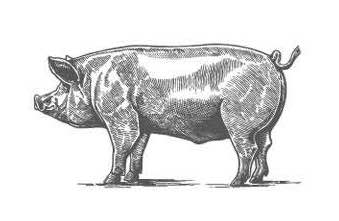
Just as most households would brew their own beer, most households would keep small numbers of pigs as a constant way of utilising scraps or slops and as a source of meat. In the villages there was probably a shared or barter system that allowed people to broaden their diet, but essentially grain breads, biscuits & cakes were the staples of most people in the 18th and 19th centuries. Produce from farming is always seasonal and pork production created an opportunity to market excess products to regional centres such as Bath and Bristol. Pig farming required much less space than grazing animals such as cattle and sheep and also enabled the preparation of varied produce that included fresh pork, corned pork, bacon and sausages. The beef and sheep farmers dealt primarily in joints of fresh meat and offal.
It is not surprising that we see during the 1700’s and early 1800’s some successful businesspeople in the Miles Clan who took the opportunity of preparing and brewing grains, selling beers and ales and farming pigs. This was the world of William Miles, his father, some uncles, some brothers, his sons and daughters’ husbands. It is why they moved out of small farming communities into the edges of towns forging different lives to their ancestors.
High Street was the main thoroughfare through Twerton (earlier known as Twiverton) on the major route that linked the towns of bath and Bristol. During the Middle Ages there were two manors, one western, the other eastern both of which operated mills next to the river Avon. By the early 1700’s these manors were gone, the road from Bristol came under the jurisdiction of a newly authorised Bath Turnpike Trust and the river was made navigable between Bristol and Bath by the Avon Navigation Company. The land and the mills became valuable and wealthy with investment and speculation during the 18th century and Twerton became a centre for service industries rather than accommodation. The mills now produced fine fabrics, writing paper, dressed leather and brass products for the ever-increasing Bristol trade. Malthouses and cloth production involved technical innovation and new factory methodologies, however despite being at the forefront of the industrial revolution Twerton was regarded as a picturesque rural village. The railway running between the Avon River and High Street was built in the 1840’s and enabled a further increase in industrial works as well as housing and a gaol.
During the first part of the 1800’s, and before construction of the railway, High Street was a very busy road. Increased heavy haulage and stage coaching was probably the reason that most properties on High Street that didn’t front directly onto the road were hidden by high walls.
The George Inn, as well as the other two accommodation and ale houses would have enjoyed high demand and custom. There is no indication that William, Daniel or Ebenezer had any financial interest in these inns, but it seems likely that they would have been very involved in their daily trade between the 1820’s to the 1850’s.
YEOMAN CAVALRY
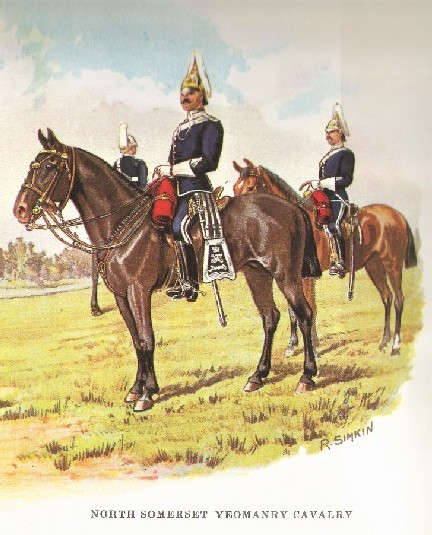
The Bath Troop of North Somerset Yeomanry Cavalry was not an isolated group of men who liked to dress in uniforms. They were part of a large group of volunteer citizens throughout the country who maintained a defence capability and readiness should the French launch an attack on England.
In 1794 after England was drawn into the French Revolutionary Wars, the government proposed that all counties should form Yeoman Cavalry that could be called on by the King to defend the country against invasion. The role of these volunteer corps was also expanded so that they could be used to subdue any civil disorder within the country. In 1798 householders in Frome “resolved to form a military association to defend the town. Its services were accepted on 2 June, and the Frome Troop of Cavalry was formed. A condition of service was that it should not be required to march more than 10 miles from the town. Other troops were formed at about the same time at Road, Wolverton, Mells, Beckington and Bath.”
In 1802 the Treaty of Amiens saw the disbanding of these troops but this peace was short-lived. The threat of invasion from Bonaparte caused changes in the organisation and size of volunteer corps across England. War was declared on France in May 1803, beginning the Napoleonic Wars and once again the Frome Volunteers offered their services. By 1814 these volunteers formed a regiment – the North Somerset Yeomanry. In general, across England, the volunteer Yeomanry declined in importance after the end of the French wars, however the North Somerset unit maintained a strong position, regularly called out to supress riots in 1810, 1812 and 1817 at Bath; in 1813 and 1817 at Radstock; and in 1816 and 1822 at Frome.
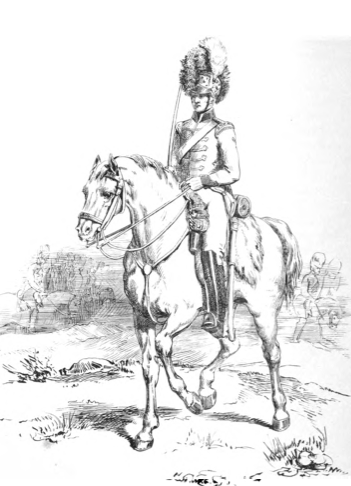
By Daniel Miles death in 1835 the troop, still a strong presence, enjoyed a peaceful position in the community. The following is an excerpt from an official book, a memoir of the cavalry:
From NORTH SOMERSET YEOMANRY Page 52 1833-37
“In this year a splendid silver vase was presented to Colonel Horner by the officers of the regiment. The vase, nearly two feet high, stands on a silver pedestal, on the tablets of which are military trophies, Colonel Horner’s arms, and the following inscription:
‘Presented to Colonel Thomas Strangways Horner, who has been thirty years in command of the North Somerset Yeomanry Cavalry, by the Officers of the Regiment, 1833.’
Captain Leigh Lye had the honour of presenting the vase to Colonel Horner, as Adjutant of the Regiment, in the name of his brother officers. Beyond the ordinary routine duties of the regiment, nothing of interest occurred in the year 1834. In 1835, the regiment was out for eight days’ training and exercise, at troop-quarters, during the month of October; previously to which the officers met at Bath for the transaction of regimental business, and afterwards dined together at the White Hart Inn. In 1836, the regiment assembled in Bath, and were inspected by Colonel Chatterton, K.H., on the 7th October.“
Some historians will say that possibly seven thousand people may have been attracted by the sound of the procession along High Street Twerton, from the George Inn to St. Michaels and All Angels Church where Daniel Miles was buried. Others will contend that newspapers were always prone to exaggeration. It is a short half-mile from the George Inn to the Church and it has been estimated that a crowd, five people deep along the route would see less than 3,000 people, in attendance or simply curious about a military procession. Daniel and his wife Ann may have been sick; at that time there were a number of diseases that were fatal, cholera in particular; and Ann died only six weeks after Daniel. The inscriptions on the burial memorial do not give any clue.
Daniel was not the only person in this family to be buried in the grounds of St. Michael and All Angels Church. There are two headstones beside each other: one for Miles, the other for Cadby. The Cadby burial plot, D.04, has a headstone, a slab and did have a footstone, which was noted in 2017 as being “not evident”. The names and memorial are Ebenezer Cadby (1817-1855); Hester Cadby (1844-1849) the daughter of Ebenezer & Amey Cadby; and Mary Jane Cadby (1848-1856) the daughter of Ebenezer & Amey Cadby.
The Miles plot, D.05, has a headstone and a footstone. The names and memorial are Daniel Miles (1808-1835); William Miles (1788-1856), Daniel’s father; Mary Miles (1786-1848), Daniel’s mother.
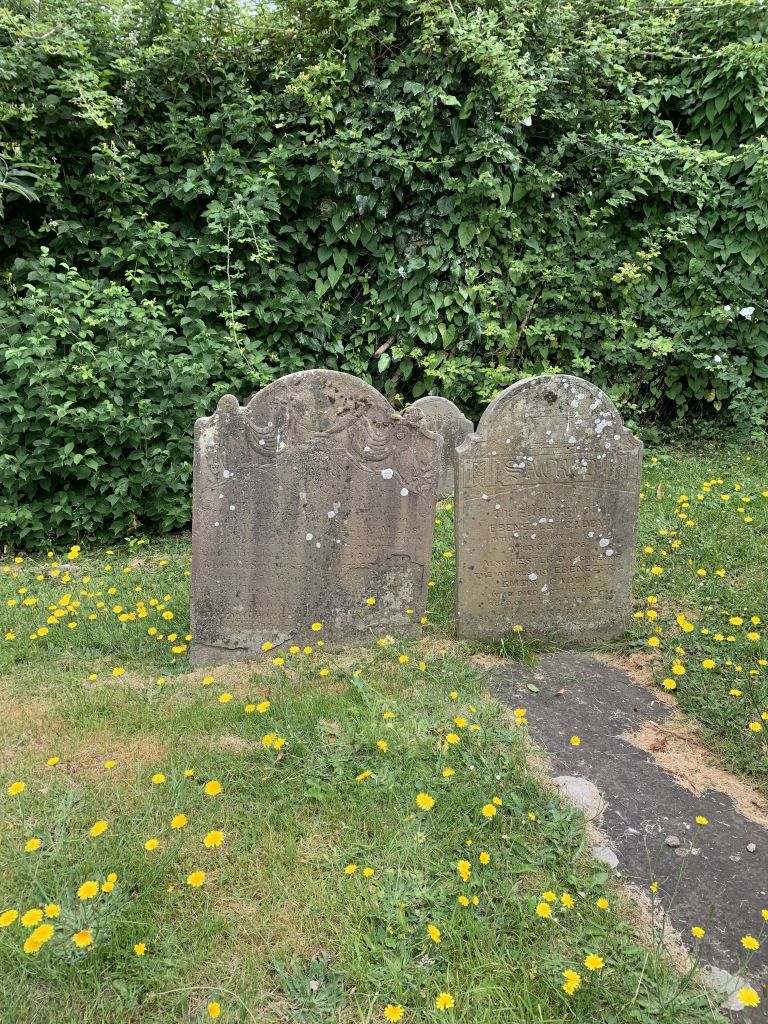
There is also an inscription that memorialises “2 Children John, George & George Miles who died in infancy. There is another inscription which says “Also to the memory of the aforesaid WILLIAM MILES WHO DIED AT NEW-HAVEN, NORTH AMERICA Oct 20th 1856 AGED 68 YEARS”
The headstones create some uncertainties: the inscription for “AMEY” has either been recut over the name “EMMA” at some point, or the other way around. In most records, the name is spelled “AMY”, so perhaps it was initially inscribed as “EMMA”, then recut.
We think that Daniel may have been born in 1809 as he was baptised on the 17th September 1809.
William was buried on the 17th December 1854, not 1856.
The second reference to William Miles was attributed to William, the father, but there was no evidence of him travelling to Connecticut. Daniels brother William, however, did migrate to Connecticut but records show that he died in 1876, not 1856. As the first inscription for William gave the death date of 1856, it is possible that depending on when the headstones were commissioned and installed, some confusion about dates resulted in these inaccuracies.
The pursuit of genealogy is often hampered by small details; and this tale revolving around the life and death of Daniel Miles is a perfect example. In the macro view we know somewhat loosely what sort of life he led, the works skills that would have been passed down by his father, the nature of marriages within families that dwell closely together, the fear of French invasion that gave rise to volunteer troops and the desire for some to seek adventure and a life in another country.
At the micro level we are specifically unsure of what people died from and what exact dates and locations they died in, and were buried in. We are also unsure of the intricacies of business relationships regarding inns, beer and pork – but they were very strong drivers in this case.
This story, the first “Milestone”, was the idea of Frances (Miles) Nelson who has greatly contributed research, records, pictures and insight to Daniels Story.
Vicki Miles is my wife.
The piece acknowledged earlier by Mike Chapman, “The High Street, Twerton an Historical Survey” published about 2003 was invaluable. Further information about business in these times was gleaned from a number of internet articles, many anonymous.
Information about the Somerset Cavalry was found on Wikipedia and the excellent book “NORTH SOMERSET YEOMANRY”.
The Bath Record Office: Archives & Local Studies provided a copy of the 1840 tithing map of Twerton, which was invaluable – even though it was drawn on a South to North perspective.
I’m sure that there are inaccuracies in this little story and I welcome both comment and correction. All stories that appear as Milestones are an attempt to show the possible reality of members of the Miles family in the spectrum of acknowledged historical events. They are also written to create interest in family history so that subsequent generations can expand the research and create vignettes at their own pace. To help facilitate this I am utilising Wikitree as a digital repository for parts of our ancestors’ life and history. It can be found here: https://www.wikitree.com/wiki/Miles-11737
And just so you know: Vicki and Daniel Miles are 1st cousins, 4X removed. Alison (Miles) Miller and Marilyn (Pinch) Lourie are also 1st cousins 4X removed to Daniel.
Vicki is a 6th great granddaughter of “Old John” Miles. Two other 6th great granddaughters of “Old John” Miles are Alison (Miles) Miller and Marilyn (Pinch) Lourie.
Frances and Daniel Miles are 3rd cousins, 2X removed.
Frances is a 4th great granddaughter of “Old John” Miles.
Vicki and Frances are 5th cousins, 2X removed
 miles of irvings
Leave a comment