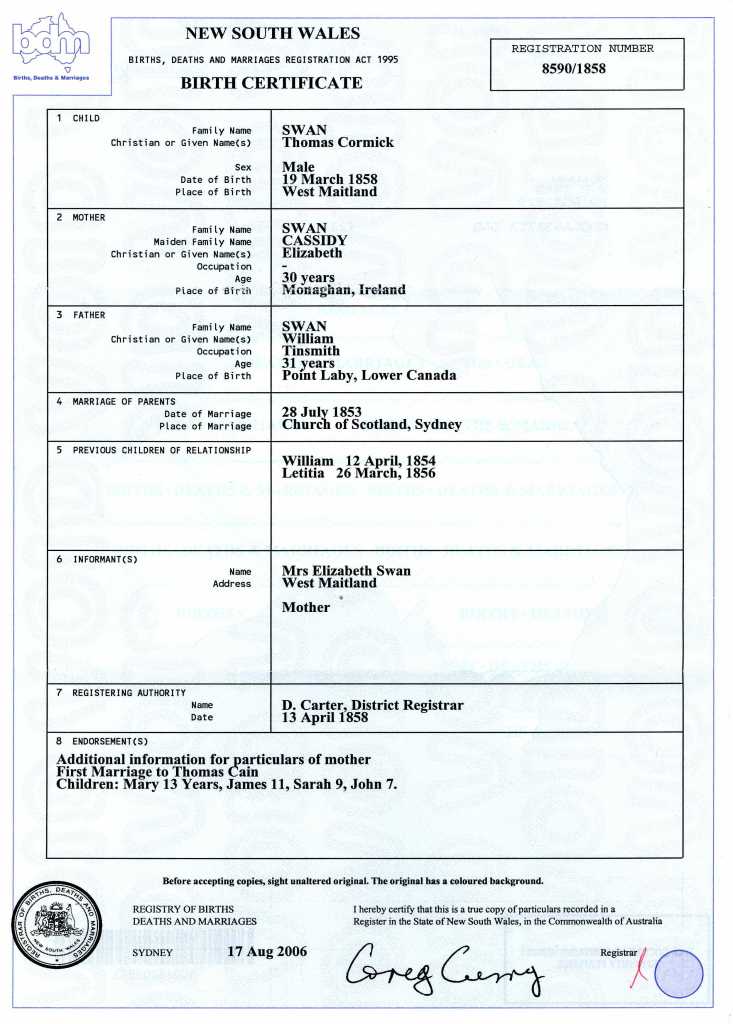
Thomas Cormick Swan was born on the 19th of March 1858 in West Maitland, the third child of Elizabeth, “Bessie“(Cassidy/Cain) Swan and William Swan. His Birth Certificate has his father, William as 31 years old, yet all other documentation suggests that William was actually about 41 years old when Thomas was born. His mother, Bessie, was 30 years old when Thomas was born and it would have been a crowded Maitland house where they lived. In addition to the baby, Thomas, and his two elder siblings (William Jnr and Letitia), there were four more children, Mary 13, James 11, Sarah 9, and John 7; all from Bessie’s first marriage to Thomas Cain. In later years Thomas Cormick Swan added the extra name “Cassidy” to his moniker, most probably as further identification of both his mother’s surname and his Irish ancestry. Cormick was his Irish grandfather’s name.
The Swans were still in Maitland in 1860 when a daughter, Louisa Alice Swan was born on the 2nd of July. The family moved back to Sydney sometime in the early 1860’s possibly when Thomas was about 5 years old; and as noted in the previous stories on the Sydney Swans, they were a very close-knit and supportive family. Three more children were born in Sydney: a son, Aden on the 13th of April 1963; another son, George was born in 1865 and tragically died in 1867. The 7th and last child was a daughter, Elizabeth who was born on the 24th of September 1867.
Two years later the household was thrown into complete disarray – Bessie (Cassidy) (Cain) Swan died less than a week after Christmas on the 30th of December 1869, only a few weeks after her 40th birthday. A lot of responsibility now fell on Letitia, as the eldest daughter in the family which now numbered six children, the youngest a two-year-old Elizabeth Swan. Two half-sisters, Mary Ann Cain (1845-1886) & Sarah Eliza Cain (1849-1916), the daughters of Bessie Cassidy and her first husband, Thomas Cain lived close by and would have provided support and care for the young family.
Thomas was a plumber and I am sure that this career was initially chosen at the direction of his father, William Swan Snr., the tinsmith. I have discussed the transition of tinsmith to plumber in the first Sydney Swans story and have recently found that Thomas was identified as a plumber in many documents and was also the plumber who worked on the construction of Duntroon, the military officers training base in Canberra immediately after WWI.
Thomas Cormick Cassidy Swan was first married on the 3rd of June 1876 in Sydney to Ellen McDermott, an Irish woman who was born in Kildare, Ireland about 1852. Ellen was six years older than the eighteen-year-old Thomas when they married and they soon moved “out west” 260 kms to Orange, New South Wales where the first three of their six children were born.
Thomas and Ellen made the 260 km journey to Orange sometime in the second half of 1876. I wondered if they were able to utilise the railway system for the total distance, but it appears that the direct line connecting Blayney to Orange was not opened until April 1877 by which time Thomas and Ellen were already in Orange. However, they could have used the railway to reach as far west as Bathurst from Sydney, which was opened in April 1876, leaving a “short” journey of 56 kms from Bathurst to Orange.
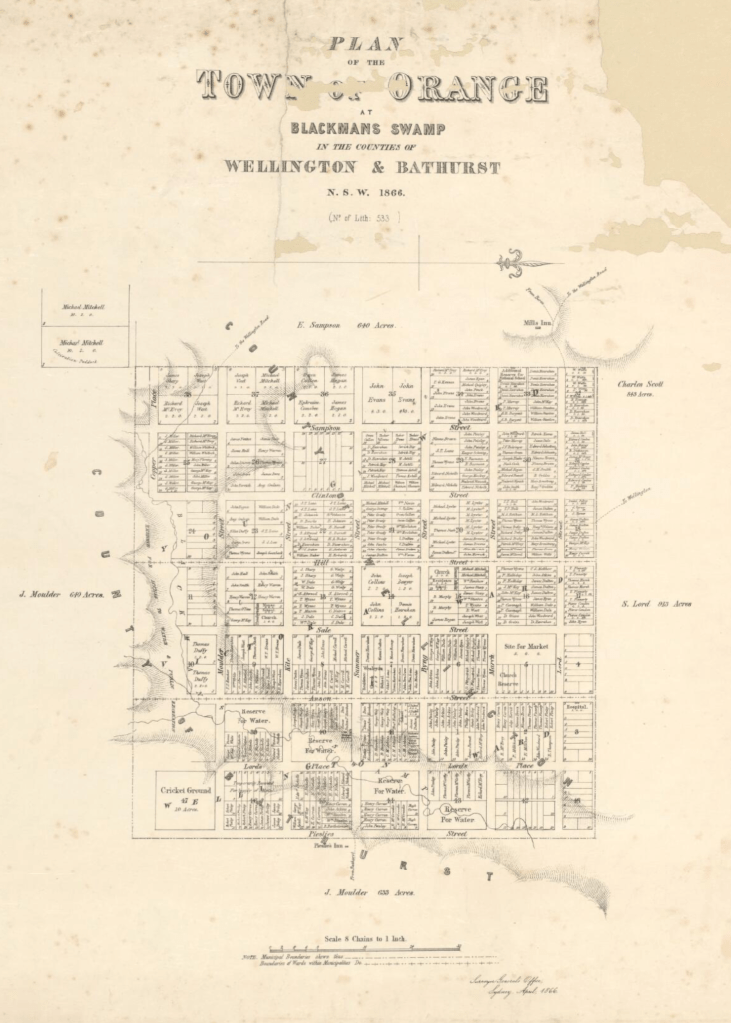
ORANGE
Orange is a city in the Central Tablelands region of New South Wales It is 254 km west of the state capital, Sydney at an altitude of 862 metres (2,828 ft). A significant nearby landmark is Mount Canobolas with a peak elevation of 1,395 m and commanding views of the district. Orange is situated within the traditional lands of the Wiradjuri tribe.
The Wiradjuri nation is defined by three rivers, the Lachlan (galari), Macquarie (wambool) and Murrumbidgee (murrumbidjeri), making it the largest indigenous nation in New South Wales. Prior to settlement the Wiradjuri people lived a hunter gather lifestyle moving from prosperous hunting grounds to riverside camps that made best use of natural resources. Wiradjuri people would travel in small groups 20 to 40 people and come together in larger groups of to feast, for ceremonies and to resolve disputes. The Wiradjuri language is no longer fluently spoken, but many words and phrases are known. Aboriginal culture, spirituality and practices are linked to the land, which provided tools, shelter, food and connections to ancestors.
While there are no specific dates for Aboriginal sites within the Orange region, the oldest approximant site date can be taken from two rock shelters 60km south-east of Wellington, this site is dated to 7150BC. Occupation of the Australian continent began over 40,000 years ago; it is likely that Aboriginal people have been living in the Orange district for most of that time.
Surveyor-General Oxley travelled through the area to the east of Orange – now known as Lewis Ponds and Ophir – in 1817 and 1818; and Surveyor Meehan, hopelessly lost, passed to the west of Orange in 1820. By 1823, occupation of the land west of Bathurst had begun.
On his way to Wellington in 1823, an English engineer, Lieutenant Percy Simpson drove his sulky across what is now the location of the City of Orange. He was accompanied by John Blackman, Chief Constable, who selected the route from Bathurst to Wellington where Simpson was involved in an experimental agricultural scheme for “educated convicts”. Blackman’s Swamp Creek, which runs through the centre of Orange, was named after the chief constable and for the next 24 years, the area was known as Blackman’s Swamp.
The survey of the district began in 1828 and in 1829 the name ‘Orange’ appears on the maps as village parish. Orange was most likely named by the very famous Sir Thomas Livingston Mitchell, Surveyor General for NSW from 1828 to 1855 as a tribute to Prince William of Orange with whom he had been associated during the Peninsular Wars in Spain. Settlers already had their eyes on the rich basalt soils of the locality, and in 1836 land on the outskirts of the village site was sold and settled. In June 1838 a licence for an inn known as the ‘Coach and Horses ’was obtained. By 1845, a village had developed at Summer Hill to the north-east of Orange, at the junction of Gosling and Fredrick’s Valley Creeks. An inn named ‘The Bush’ had been opened and a shoemaker, two stores and a tannery were also in business there.
Flour milling was the earliest industry developed in the region. Mr J. A. Templer acquired a property three miles from Orange, named ‘Narrambla’ where a large horse-driven brick flour mill was erected. In 1864 the Australian poet, Andrew Barton ‘Banjo’ Paterson was born in Mr Templer’s home.
In April 1851, the first payable gold in Australia was discovered at Ophir, approximately 28 kms from Orange, and thousands of people flocked to the diggings. Gold was found at Lucknow, 10kms from the village of Orange shortly afterwards and many more people came to the district. In 1851 the population of Orange was only 28. In the 1850s, over 700 men were working in the mines at Lucknow, while in Orange ten years later the population had reached only 581. During the next two decades there was a constant movement of gold seekers on their way to new rushes west and south of Orange. In June 1862, Cobb & Co established its headquarters at Bathurst and coaches were passing through Orange on their way to and from the Forbes diggings and in 1863, a tollgate was established on the Bathurst road on the outskirts of Orange. Tolls would have been collected on vehicles using this road on their way to the Ophir diggings and to Templer’s Flour Mill.
Thomas and Ellen were married in Sydney on the 3rd of June 1876 and six months later their first child, Mary Elizabeth Swan was born. She lived only for a very short time, passing away one month later. I thought that Thomas and Ellen might have travelled out to Orange by train, but the first train from Sydney was not until 1877. By 1881 the population of Orange had doubled from 1871 and was in excess of 2,700. The town was an important centre for agriculture, particularly wheat, and was expanding with new settlers and infrastructure, even though the mining industry was in decline.
- Their first child, Mary Elizabeth Swan was born in Orange on the 3rd of December 1876 and tragically died one month later on the 3rd of January 1877.
- The second child, a son, Thomas Cormick Edward Swan was born in 1878. After the family had moved back to Sydney, he became an electrician, then migrated north to Queensland where he married a widow, Jessie Simpson, and lived near Goodna. He died on the 5th of November 1912 at Redbank Queensland and was buried at Ipswich leaving no children.
- May (Mary) Elizabeth Swan, the third child, was born on the 18th of April 1881. She married John Burnham Hearn in Sydney on the 12th of March 1903 and lived primarily in Sydney where they had six children. Mary lived a good long life, passing on the 25th of August 1959 in Wollongong.
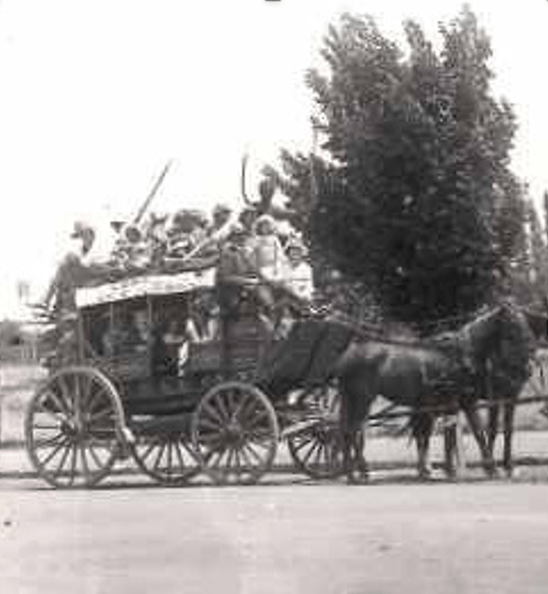
The first Cobb and Co. from
Bathurst to Orange 1862.
During the seven years that Thomas and Ellen lived in Orange, the region went through dramatic growth. We have no idea where or how Thomas plied his trade during this time. The colonies began to suffer a depression during the 1880’s which could have directly impacted Thomas negatively. He may have felt that Sydney offered better business prospects. Life in Orange might not have been as lucrative for the young family; possibly Thomas, now with eight years of plumbing experience behind him felt that he needed to seek broader horizons. Perhaps Ellen’s health was flagging. Irrespective of the reasons why, Thomas and Ellen were back in Sydney by early 1883 where they lived at 282 Elizabeth Street, the “Plumber Shop”. This was only a couple of blocks away from where Thomas’s father, William Snr., operated a tinsmith business. It was also only a short distance south of Forbes Street and Woolloomooloo where his older sister Letitia and her husband Albert Barry, after a disastrous few years were establishing their “Barry’s Butcher Shop” business. The location of Thomas’s abode today would be directly opposite Central Railway Station on the eastern side of Elizabeth Street. During a period of five years, Thomas and Ellen had three more children:
- Elizabeth Rose (Bessie) Swan was born on the 4th of February 1883. She married a Kiwi, Frederick Joseph O’Neill in Brisbane in 1903 and after having two children, one in Ipswich, the other in Sydney, moved across the ditch to Dunedin, at the head of Otago Harbour. Five more children were born in that southern city known for its Scottish and Māori heritage and Bessie died quite young on the 26th of July 1935, in Dunedin.
- Frederick William Swan 1885 – 1887 and
- Ellen Swan 1887 – 1887 both died at a very young age and only months later, their mother, and Thomas’s wife Ellen (McDermott) Swan died in Sydney on the 7th of May 1888. She was only 36 years old; Thomas was 30 years old.
Eleven months later, in April 1889, Thomas and presumably his three young children, are in the rural township of Korongvale, Victoria, more than 900kms from Sydney.
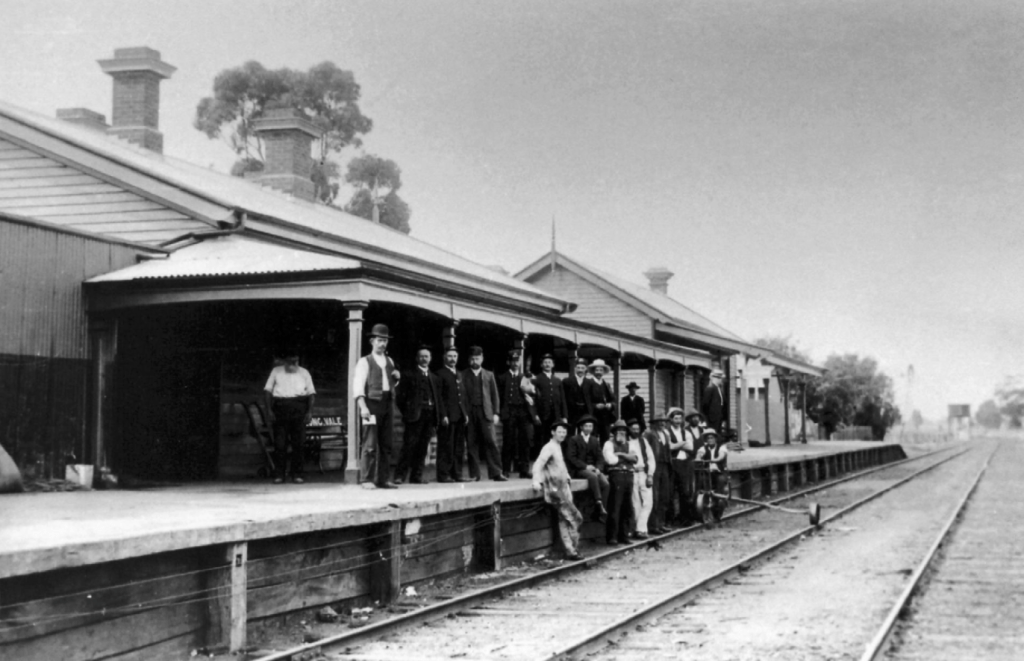
Korong Vale railway station 1880’s
And Thomas has a new wife – Esther Baines!
Esther Baines (1857-1932) was from a family of eleven children whose parents, John and Margaret Baines had migrated from Lancashire to country Victoria in the early 1850’s. Esther, the fourth child, was born in Ballarat and over the next two decades her parents moved between Ballarat and nearby Clunes which is only about 30km to the north. John and Margaret were very likely to be involved in farming of some sort. Korongvale is 122km due north of Clunes.
Chasing Thomas across the eastern colonies proved to be a difficult journey. One of Thomas’s direct descendants, Bill Swan, is a great grandson of Thomas. We are third cousins once removed and I had emailed him towards the end of 2025, seeking any inkling of just what Thomas Cormick Cassidy Swan might have been doing. My email said in part:
“Thomas moved to Korongvale about 1888/9 when somehow the two Baines sisters, Esther and Kate, who were both born in Ballarat, married two widowers, Thomas CC and Louis Borella. The weddings were seven weeks apart, Esther was 32 years old, Kate 27. The sisters were not spring chickens and at that time most women were married in their teens. I’d like to think that Louis and Thomas were wonderful “catches” that the sisters had been waiting many years for; and that the sisters were progressive and independent minded women who were content to wait for “Mr Right” rather than settle for any old hillbilly. What were the sisters doing in Korongvale?”
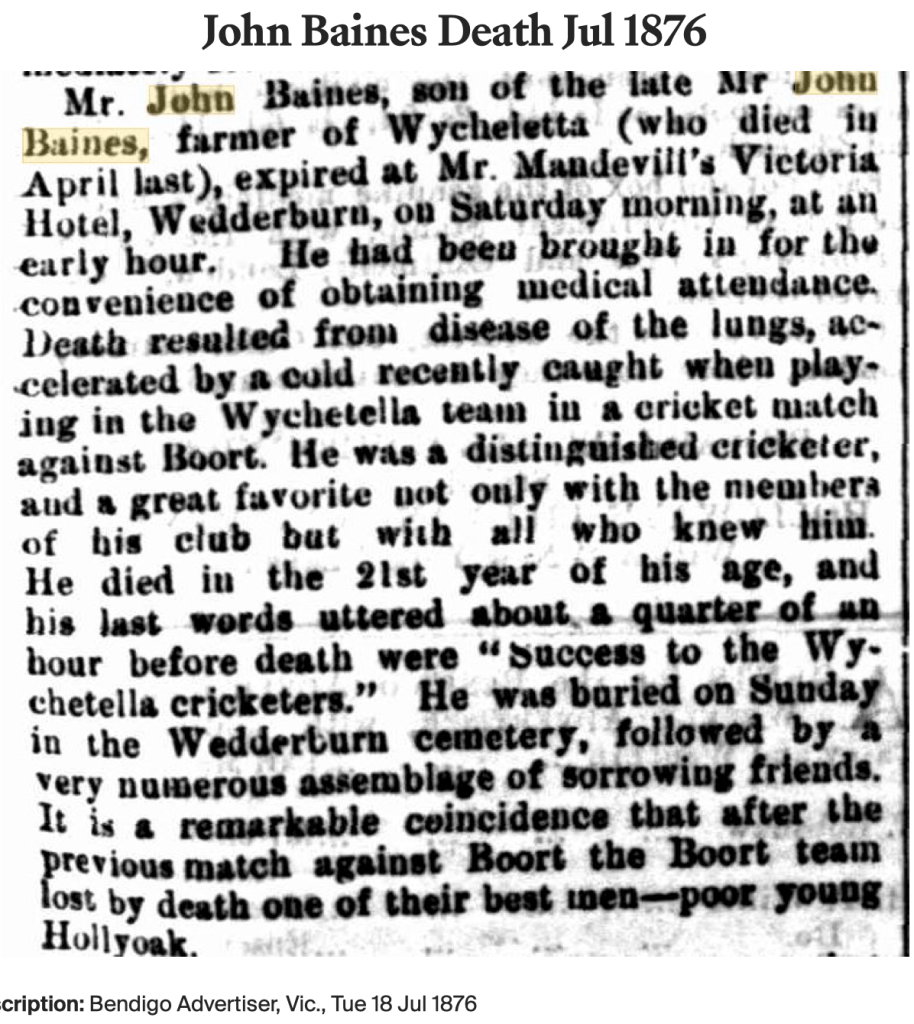
I found that four of the Baines children were all married in a twelve-month period 1889-1890 and that their father, John Baines had died in April 1876 at a place called Wychitella, a mere 17km north of Korongvale. It seems that John Snr and his eldest son, Thomas Kaye Baines (1851-1932) were farming at Wychitella when John Snr died. The second eldest son, also John, died six months later. He was only twenty-one years old and died as a result of a “disease of the lungs, accelerated by a cold recently caught when playing in the Wychetella team in a cricket match against Boort.”
Thomas Kaye Baines (1851-1932) and his younger brother, James Henry Baines (1864-1951) were farming on a property at Wychitella and had also taken up farming land just west of the township of Boort which is about 30km’s northeast of Korongvale.
The Loddon Council Heritage Study provides further information:
“Ruins of farmhouse. Whittaker Road.
This place consists of the remains of a bi-chrome brick farmhouse situated on a gentle rise, the south-east corner standing full height and consisting of red body bricks with white dressings. The walls are of 9-inch solid brickwork and the internal surfaces have solid plaster facings. The base walls survive along with twin palm trees marking the former entrance pathway and there are later peppercorns. The white bricks were manufactured by the Brunswick Brick and Tile Co. There is a depression cut into one side possibly denoting a former cellar. Elsewhere, the remains of yards at the rear include sections of low vertical slab fences and the stumps of a presumed shearing shed.
Condition: Stable. Integrity: Low.
John and Margaret Baines migrated to Australia in 1853 and eventually moved to Wychitella. Sons Thomas and Jim Baines both had property in Boort, and it is believed that these ruins are all that remain of a farmhouse built by one of these brothers. The use of pressed bricks manufactured by the Brunswick Brick and Tile Co. suggests that the house post-dates the introduction of the Bradley Craven brick press in 1887 and the formation of the Brunswick Terra Cotta Works in the same year whilst the evidence of architectural style suggests that it was probably built prior to the Depression of 1891.
Statement of Significance
The ruins of the presumed Baines farmhouse are situated on Whittaker Road, west of Boort and by their appearance may have been built between 1887 and 1891. They are of historic, aesthetic and technical interest. They are of historic interest for their presumed association with the boom years preceding the Great Depression of 1891 and with the Baines family. They are of aesthetic interest as a picturesque ruin in the rural landscape west of Boort. They are of technical interest for their known incorporation of Brunswick Brick and Tile Co. bricks demonstrating the impact of improved methods of brick manufacture at the time in conjunction with improved rail communication.”
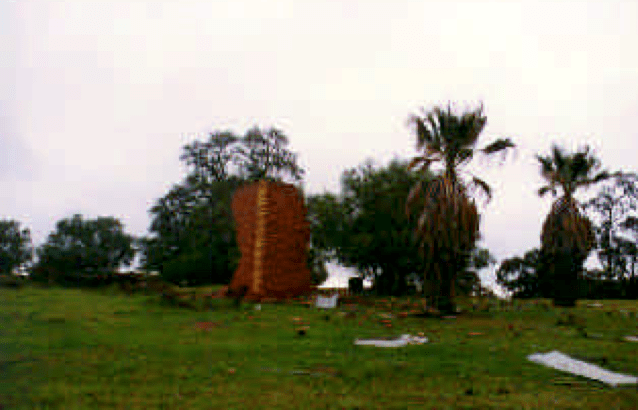
The Baines farmhouse
With this information, the four marriages in a year of the now eldest four Baines children makes a lot of sense. Farming has always been a family affair where everyone had tasks and responsibilities. As land was settled and fencing, sheds and dams were constructed the family could expand their farming infrastructure and either take on more land or divide what they had developed. The Baines children, especially after the death of their father, would have been an essential part of this expansion and improvement process and none of them could been spared for marriage unless it was advantageous to everyone!
One of the fascinating aspects of researching our collective family history is the notion that earlier generations of both Vicki and Roger’s family would have been neighbours, customers, and possibly cricket team-mates! During the Gold Rush various ancestors from both of our families lived in Ballarat, Bendigo, and many other places where the discovery of gold set off a stampede of miners from throughout Victoria, New South Wales, Europe, China and North America, all eager (often desperate) to strike it rich.
In an earlier story about the first generation of the Miles family’s migration to Victoria, we outlined how “Old Charlie” Miles received his land selection in 1888 a few km’s from Raywood, which is only 56km’s east of Korong vale. On her maternal line, Vicki has plenty of ancestors who were in and around Boort.
Two of the eleven children in the Baines family died at infancy; Elizabeth Heyes Baines (1850-1850) passed while her parents were still in Lancashire England and Henry Baines (1853-1854) soon after the family had reached Victoria.
The eldest, Thomas Kaye Baines (1851-1932) was the first to marry. At the age of 37 he married Elizabeth Guy (1863-1948) in St. Augustine Church at Inglewood, about halfway between Raywood and Korongvale on the 12th February 1889. Thomas remained in the region, farming with his brothers; he and Elizabeth had five children between 1890 and 1898 four of whom survived infancy. They both lived into their 80’s having settled in Boort.
The next to go was Catherine (Kate) Baines (1862-1941), Esther’s 27-year-old younger sister who was also born in Ballarat. On the 5th of March 1889 she married a widower, Louis Borella in St. Augustine Church Inglewood. This was the same church that elder brother Thomas Kaye had been married to Elizabeth Guy only three weeks earlier. St Augustine’s was built as a grand investment for the community, yet marriages seem to be a bit scarce at this stage.
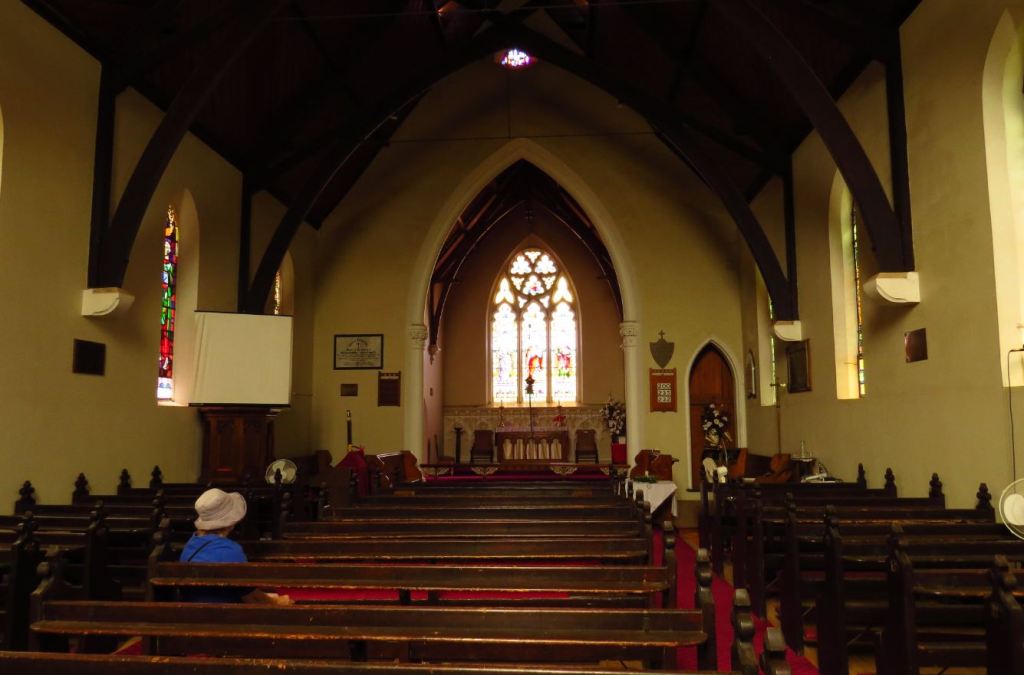
St. Augustin’s Inglewood
Kate immediately gained a family – Louis’s three children Elizabeth (1880-1955), Albert (1881-1968) and Annie (1884-1927). Louis was a local farmer with a property at Mount Korong, although his residence was the settlement of Borung, a few km’s north of Korongvale. We’ll come back to the Borella family before we leave this part of Victoria as there are some very interesting aspects to family life that should be related.
The Baines Family “Bronze Medal” went to Thomas CC Swan (1858-1943) and Esther Baines (1857-1932) who married on the 29th of April 1889, nine days after Esther had celebrated her 32nd birthday. Initially it appeared that they were married at Korongvale, however their marriage certificate shows that they were married at St. James Church in Melbourne. Other information on the Marriage Certificate that raises all sorts of questions are that Thomas is noted as a plumber working in Warragul; Esther’s sister, Elizabeth Baines is one witness, the other is Haydon Swan, younger brother of Thomas CC Swan, a man who later in these stories will have his own spotlight. Warragul is 105kms west of St James Church in Melbourne, and for the gourmets reading this, a mere 44kms to Korumburra. St James to Korongvale is 234kms. St James Old Cathedral, now at the corner of King and Batman Streets, is the oldest church in Melbourne. Originally established on a five-acre site at Bourke and William Streets in 1837, it began as a timber structure before being replaced by a Georgian/Regency style stone building, designed by Robert Russell. It is a rare example of the style in Melbourne that is more common in NSW and Tasmania because it is generally associated with the decades before Victoria’s colonisation. The foundation stone was laid in 1839 by Gov. Charles Joseph La Trobe, with construction undertaken in two stages. Charles Laing completed the work after disputes over the design led to Russell’s replacement. The unfinished church opened for worship in 1842 and in 1847 became Melbourne’s first Anglican Cathedral after it was proclaimed a city.
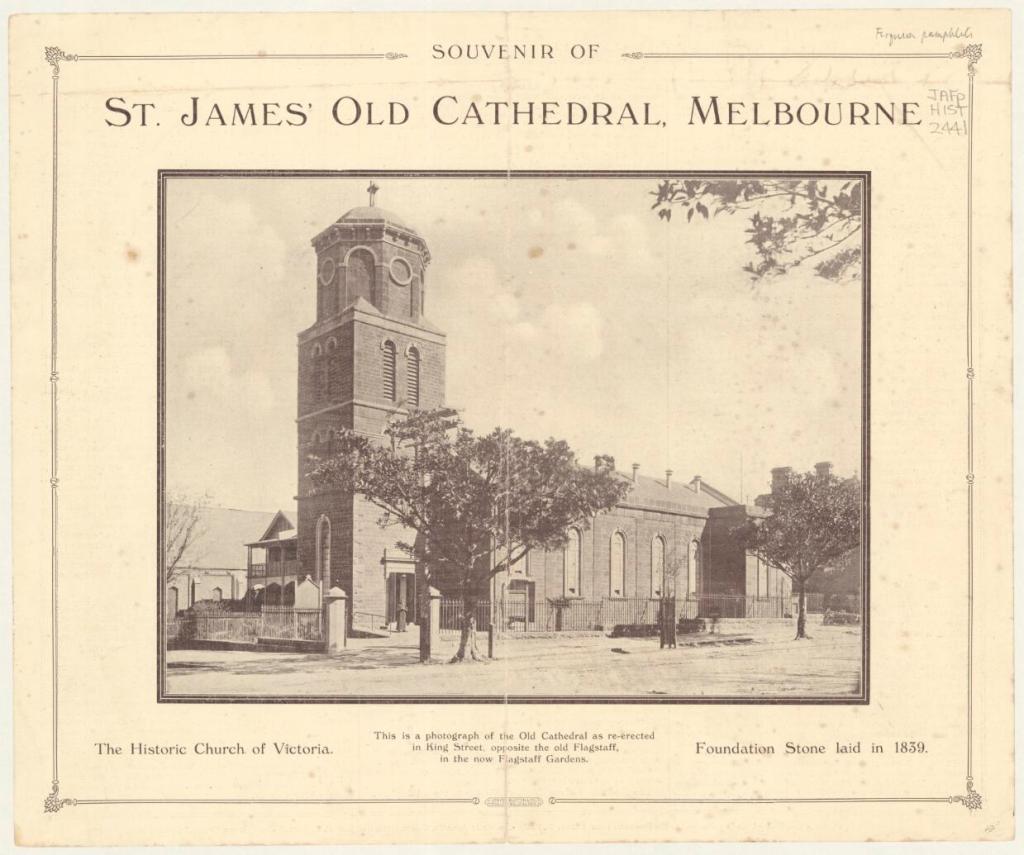
After the opening of the larger St Paul’s in Flinders Street in 1891, the cathedral status was transferred from St James. Struggling with a dwindling congregation, maintenance issues, and urban development pressures, St James narrowly avoided demolition after being condemned in 1912. Instead, it was painstakingly dismantled and relocated, (about six blocks away) stone by stone and reconstructed at its current site in West Melbourne, reopening in 1914 with a remodelled tower and other modifications.
The fourth marriage in a single year – well out of any medal – was between 26-year-old Elizabeth Baines (1859-1941) and 27-year-old Robert Irving, a farmer originally from Tasmania, and not related to Roger. The marriage was held by licence under the rite of the Roman Catholic Church on the 13th of February 1900 at the Wychitella residence of Elizabeth’s mother, Margaret Baines (1829-1924) who was a witness, as was Robert’s father, John Irving, a farmer. Elizabeth, in the space for Rank or Profession is simply noted as a “Lady”. She and Robert had six children; most of their family stayed in and around Boort. Robert passed away long before Elizabeth who lived in the Swan Hill region, part of the Murray River valley.
We have to wait for six years before there is another Baines marriage. The youngest child, Alice Baines (1871-1956) married Walter Wallace Barclay (1855-1935) at Clunes in 1896. They had four children and in the early 1900’s settled in Condobolin, New South Wales, almost 600 kms due north.
Two years later, James (Jim) Henry Baines (1864-1951), the youngest son who worked closely with his older brother married Florence Nixon (1874-1920) in 1898 at Clunes. Jim and Florence had eleven children, nine of whom survived infancy. They settled into the small town of Kyneton in Victoria with their children spread to Kyneton, the Dandenong’s, Melbourne and Kaniva which is almost as far west as the South Australia border.
A gap of three years before Margaret Baines (1867-1920) married George Thomas Jones (1876-1961) in 1901 at Clunes. Margaret and George only had the one child, a son, Stanley George. They were living in Boort when Margaret passed away at just fifty years old.
And the last Baines marriage of this generation was thirteen years later, in 1914 when Mary Jane Baines (1869-1935) married William Dalgleish (1862-1943) at Boort. They had no children and remained in Boort for the rest of their lives.
KORONGVALE
In 1889, the year that saw four Baines siblings tying the matrimonial knot, simple grain farming was the standard agricultural practice in this low-lying area between Wedderburn and Boort. In 1876 the Education Department was petitioned by one of the original land selectors, Mr. Patrick Leahey, for a school for 40 school-age children within a two-mile radius. Successfully approved, the school opened in a Wesleyan chapel that had been built in 1875. In 1881 with the surveying of the railway line, the first hotel-store was built by James Greig, former gold digger and Wycheproof selector, on the corner of what became Main and Vernon Streets. Building variances had been made to reduce the impact of regular flooding. The railway line from Inglewood was opened in 1882 with the Korongvale Railway Station completed in 1884. In 1886 a hotel-store burned down and a Mrs Scully built the existing brick hotel directly opposite the station in 1891 when the population of Korongvale was 140. In short, Korongvale didn’t bloom until the end of WWI.
We need to back up a little here so that we can introduce Louis Borella and his second wife, Kate Baines, in-laws of Thomas C.C. Swan.
Louis Borella, (1849-1922), the eldest child of Pietro Borella from Florence Italy and Alfreda Kidner, was born in Hobart, Van Diemen’s Land on the 6th of August 1849. His mother who had convict ancestors, was also born in Van Diemen’s Land. In 1860 Pietro moved his family to Talbot, Victoria, about 50 kms north of Ballarat. On the 11th of February 1880 Louis married Annie Chalmers (1853-1885) at Mount Rowan, Ballarat. They travelled 153 kms to the Korongvale area sometime before the 25th of June 1880 when Annie gave birth to their first child, a daughter, Elizabeth. The place of birth is listed as Borung, a small village about 10 kms north of Korongvale. Louis is the informant on the Birth Registration and has stated that he is a farmer residing at Borung.
Louis and Annie had two more children: a son Albert Borella, was born on the 7th of August 1881 at Borung; and a second daughter, Annie Aurora Borella, born on the 10th of January 1884 also at Borung. Annie (Chalmers) Borella contracted scarlet fever and tragically died on the 9th of January 1885 and was buried at the Wychitella Cemetery.
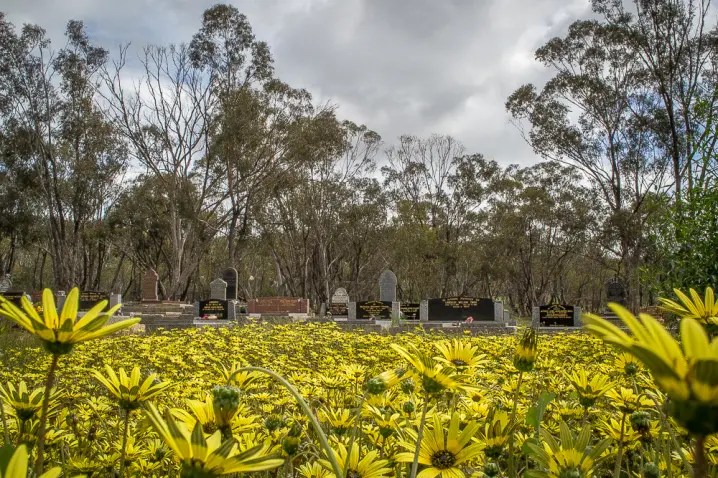
Wychitella cemetery
As we have outlined earlier, Thomas C.C. Swan married Esther Baines on the 29th of April 1889 and Louis Borella married Esther’s younger sister, Kate a few weeks earlier. Louis and Kate continued farming in the area – Korongvale, Mt Korong, Wychitella and Borung – and had six children, a daughter and five sons, over the next decade:
- Margaret Olive Borella was born on the 18th of February 1890
- Louis Percy Borella was born and died in 1891
- Charles Borella was born in 1893
- James Borella was born in 1895
- Rex Thomas Borella was born in 1897
- Louis Borella was born on the 16th of July 1899
In 1902 Louis moved his family to Thyra in New South Wales, where he continued his life as a grazier/farmer. Thyra is located well past Echuca, over the Murray River about 135 kms to the northeast.
The Marriage Registration Document for Thomas C.C. Swan and Esther Baines throws up questions rather than providing illumination on how & why Thomas found himself with a Melbourne marriage and a wife who was a farmer’s daughter from very rural Victoria. How did he arrange for his younger brother, Haydon Edward Swan to be one of the witnesses to the marriage – the last we heard from Haydon was through the New South Wales Police Gazette towards the end of 1886 when a warrant for his arrest was issued for deserting his wife, Phoebe (Birch) Swan in Sydney. I suspect that the brothers kept in contact during their lives, with Thomas possibly covering for Haydon as evidenced by elements of their sister Louisa Alice (Swan) Sceusa’s repatriation from Sicily in 1920/1. This will be fully outlined in Part Four of the Sydney Swans.
Thomas C.C. Swan’s younger brother, Haydon Edward Swan, will be the focus of Chapter Five of The Sydney Swans. After deserting his first wife in Sydney he spent many years of his life in the Victorian coastal town of Orbost. Melbourne is roughly halfway between Wychitella and Orbost.
Did Thomas spend any time in Warragul, either before or after the marriage? Wychitella and Melbourne are about 340 kms apart; Warragul is a further 105 kms east of Melbourne.
Where did Thomas and Esther meet? Were they introduced by persons unknown who were acting in good faith to both parties? In the 1880’s there was definitely no RSPV dating services, let alone Tinder!
I don’t think Thomas and Esther stayed much longer in Wychitella, or Warragul, or Melbourne after their marriage. Where are Thomas’s three children by his marriage to Ellen McDermott? May Elizabeth (1877-1959), Thomas Edward Cormick (1878-1912) and Elizabeth Rose (1883-1935) would have been 12, 11 and 6 respectively when Thomas and Esther married. Surely, they would have been with Thomas as they travelled from Sydney to Melbourne, to Wychitella, to Warragul? I know that the late 19th century was a time when children were invisible however children often had much responsibility thrust upon them at an early age.
If we follow their movements by where the children are born, it appears that their next stop was Mildura, a small town on the Murray River about 330kms north of Wychitella. They had two sons born in Mildura about three years apart – William John Swan on the 13th of May 1891, which was two years after their marriage, and James Hyland Swan, born on the 31st of August 1894.
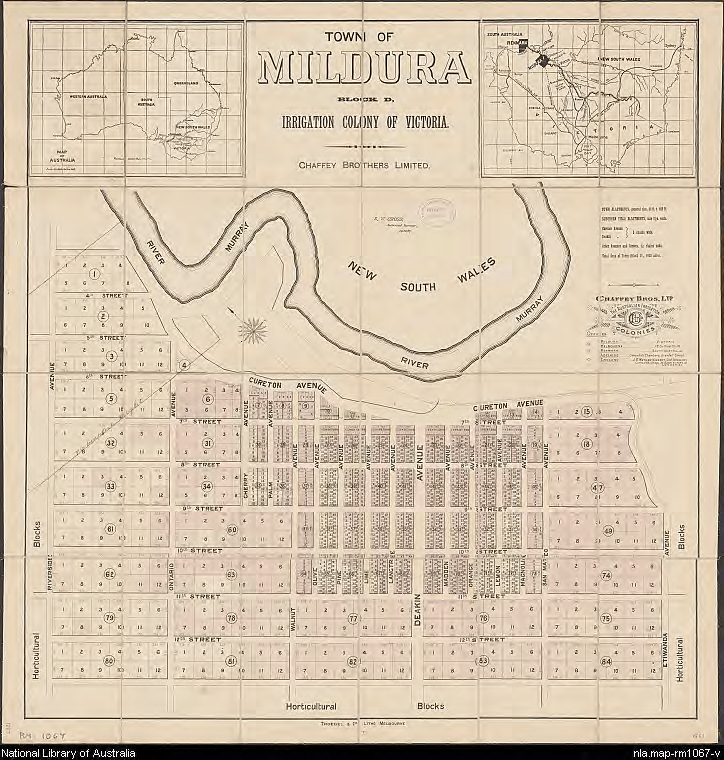
MILDURA
The Murray River is Australia’s longest river, having an extent of 2,508 km. Its tributaries include five of the next six longest rivers of Australia (the Murrumbidgee, Darling, Lachlan, Warrego and Paroo rivers). Together with that of the Murray, the catchment of these rivers form the Murray-Darling basin, which covers about one-seventh the area of Australia.The Murray rises in the Australian Alps, draining the western side of Australia’s highest mountains, then meanders northwest across Australia’s inland plains, forming the border between the states of New South Wales and Victoria as it flows into South Australia. Despite discharging considerable volumes of water at times, the waters at the Murray Mouth where it empties into Encounter Bay are almost invariably slow and shallow. It is a navigable river, however shipping cannot enter the Murray from the sea because it does not have an estuary. By the early 1840’s commercial trade was supported by shallow draft paddle steamers.
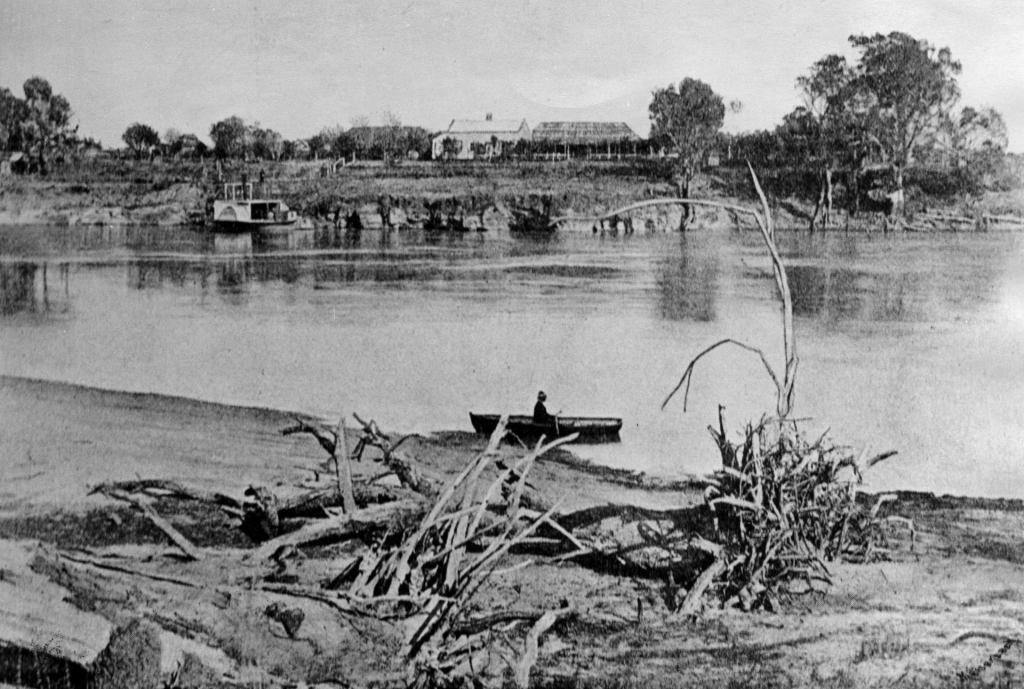
Sometime in the 1840’s, two Jamieson brothers, Hugh and John, were granted a licence to take up land for pastoral use. In 1847 they built a homestead initially known as “Yerre Yerre”. The area was later known as Mildura and for almost half a century it was a sheep station named “The Mildura Run” that had a very mixed record of success and disappointment predominately due to the inconsistent nature of flood and drought.
In the early 1880’s Mr. Alfred Deakin, the Minister for Water Supply for Victoria became a strong advocate of irrigation projects for Victoria. The gold rush had made Victoria able to support a vision of what the Murray River had to offer in irrigation. This was based on the advantages and possibilities Deakin had seen in both California and India.
Canadian brothers, George and William Benjamin (WB) Chaffey were developing an irrigation settlement in Ontario, California when approached by Alfred Deakin’s visit to the region. The Chaffey’s’ model irrigation settlement impressed Deakin, who in turn impressed them with the potential for irrigation from the Murray River in Australia. The Chaffey brothers subsequently came to Australia, and in 1887 purchased the then defunct pastoral lease and created the Mildura Irrigation Colony. The indenture was signed on 31 May 1887 between the State Government and the Chaffey brothers.
The Mildura Run was already in liquidation at this time. As early as 1864 the 3 governments concerned had met to discuss the construction of a system of weirs on the Murray and Darling rivers, to control the cycles of flood and drought that badly disrupted river traffic for months at a time. I wonder how river management is faring 150 years later?
The Chaffey’s adapted the town plan of Ontario to the present site of Mildura with numbered streets and named avenues. George developed a series of steam-driven pumps to lift water from the Murray River, first into King’s Billabong, then subsequently using two more lifts and a series of channels to irrigate up to 33,000 acres. The Chaffey brothers wanted to make Mildura a vibrant community. Their plans included many visionary concepts including an agricultural college.
Australia’s first irrigation colonies on the Murray River at Mildura and Renmark in South Australia began with great success. Their pioneering work in developing the Murray River irrigation system is considered a significant part of Australian history. Early harvests were excellent. The breaking of the drought in NSW in 1889 led to floods and good rains for the next 3 years.
Was this innovative project the reason Thomas C.C. Swan travelled north with his young family and new wife? Thomas married Esther at the end of April, 1889 and I think that he saw a great opportunity to successfully utilise his plumbing talents and business acumen by being part of this great project. Their first child, a son, William John Swan was born in Mildura on the 13th of May 1891; and their second, also a son, James Hyland Swan , was born in Mildura on the 31stAugust 1894. Mildura was booming!
By 1890 a township of 405 hectares was three-quarters sold. Building included a government school (1888), Methodist and Anglican churches (1888), several shops, two bank branches, a coffee palace, but no hotel as Mildura was to remain a ‘dry’ area until 1920. Langtree Hall in Walnut Street also dates from these years. There were three pumping stations (Psyche, Billabong and Nichols Point, 1889), ice-making, cool storage, a sawmill and three newspapers. On 10 January 1890 the Mildura shire was formed by severance from Swan Hill shire, and its census population the following year was 2235. In the 1890s a cottage hospital (1892), the Settlers’ Club (1893) and the Working Men’s Club (1894) were established.
By 1892, 8090 hectares were cleared and 4850 hectares fenced from rabbits. Produce was transported by river boat; a large wharf being built in 1892. In 1893, however, river levels caused boats to be stranded, and much of the fruit was lost. Some was saved by drying, but the year coincided with yabby-damage to channels, early salt seepage around orchards and the 1890s depression. By 1896 the Chaffey’s’ Mildura Irrigation Company had been forced to close because of financial troubles, and hundreds of settlers faced losing their farms and businesses.
The crash had come with the land boom, a situation that was to be repeated again in other parts of Australia in later years. The first result was that many of the settlers cleared out, many to Western Australia. Some came back in time, others wished to but were not able. They scattered all over the world.
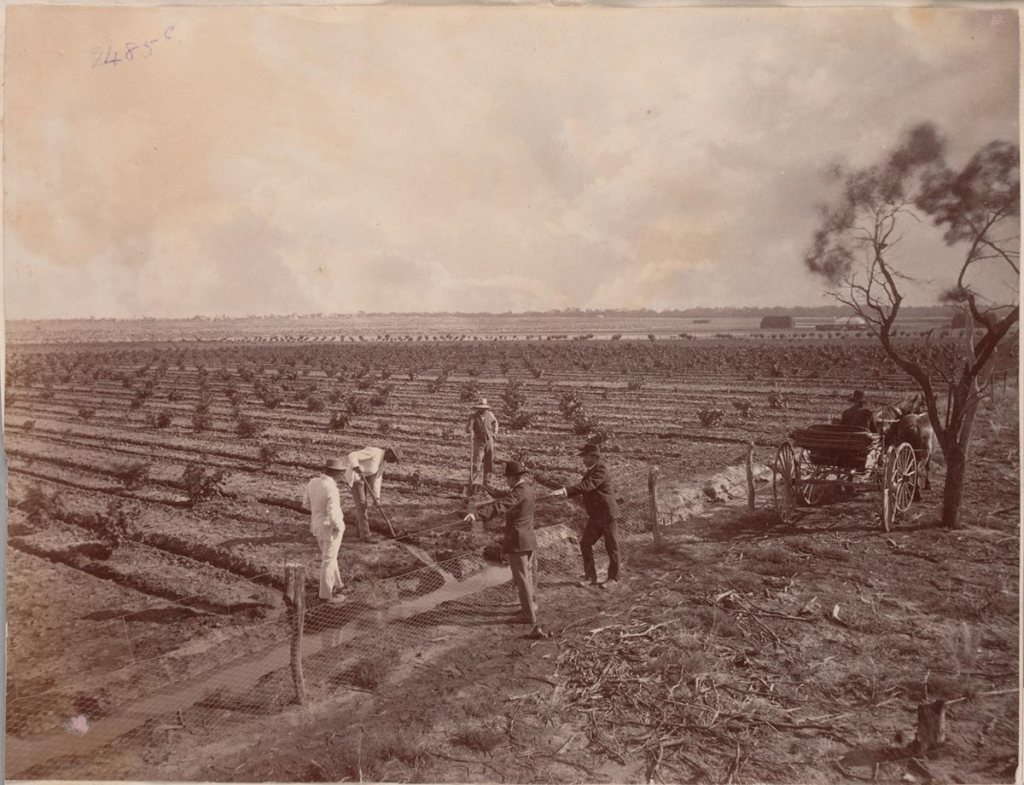
planting Mildura orchards
Thomas C.C. Swan, with his wife Esther, the three children from his first marriage and the two young infants born in Mildura was one of the men who went to Western Australia. We have no idea if he had flourished and left for Western Australia with a substantial nest egg; or if he was someone who came to Mildura with some money and left with nothing. Irrespective, Thomas, obviously not one to sit and moan, took the family west probably in 1895/1896 as the Chaffey’s grand vision collapsed.
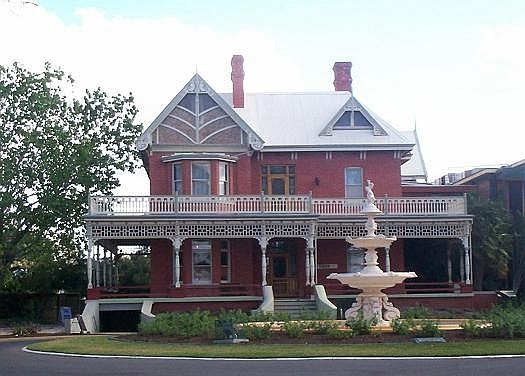
Chaffey’s Rio Vista is still in use
In East Perth, West Australia on the 18th of March 1897, a distance of 3,500 kms from Mildura, Esther gave birth to a daughter, Margaret Swan (1897 – 1935), who was the last addition to their family. She was probably named after Esther’s mother.
Once more, it begs the question why Perth? After the collapse of Chaffey’s irrigation project in Mildura many people travelled west in the hope of making their fortune “this time!”
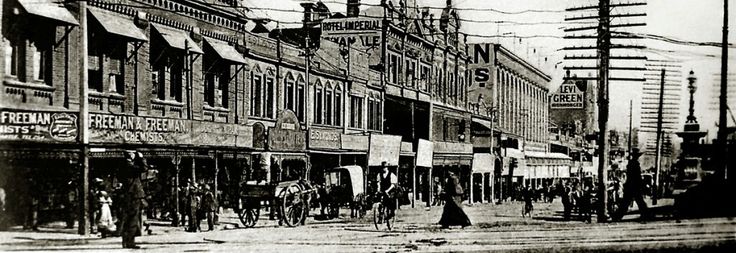
Perth in the early 1890’s
In 1849, after a decade of meagre growth, Perth became a penal colony and in the next 16 years received an influx of nearly 10,000 convicts. By the time transportation ceased in 1868 convicts outnumbered free settlers 9,700 to 7,300. This significantly changed the social and economic dynamics of the colony. The convicts were involved in the construction of a large amount of infrastructure and this shaped the character of the city. Perth’s early buildings had been rudimentary and simple, however with the arrival of labour in the form of a convict workforce, new buildings of colonial authority arose. The new buildings embraced the culture and aspirations of Empire in a remote settlement and were largely constructed in the Gothic style so much in vogue in England at the time.
Although the convict workforce led to an improvement in the prospects of the colony, Perth’s underlying identity as a remote and rustic frontier town remained unchanged. The latter half of the nineteenth century, and in particular the last two decades, saw Perth begin to grow in a significant way. In 1887, a telegraph line from Adelaide to Perth was completed, vastly improving intracontinental communication. This increased the growth of colonial media, such as the first weekly newspaper. The Western Mail, which began publishing in 1885. By the 1880’s residential development had commenced in West Perth, while industrial development was concentrated in East Perth. It has been said that the mark of transition from a town to a city towards the end of the nineteenth century is the establishment of Department Stores. Perth saw the opening of Western Australia’s first department store, Boans, in 1895!
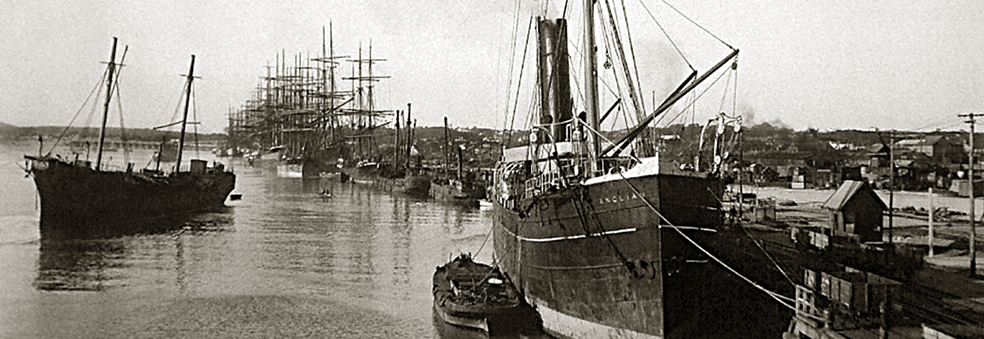
Fremantle harbour 1890’s
The discovery of gold in the Kalgoorlie region in the early 1890’s enabled an even greater impact on the development of Perth. The physical nature of the city changed dramatically with economic prosperity and the increased population as a result of gold rush immigration. In one decade, the population of the city had tripled, from 8,447 in 1891 to 27,553 in 1901.
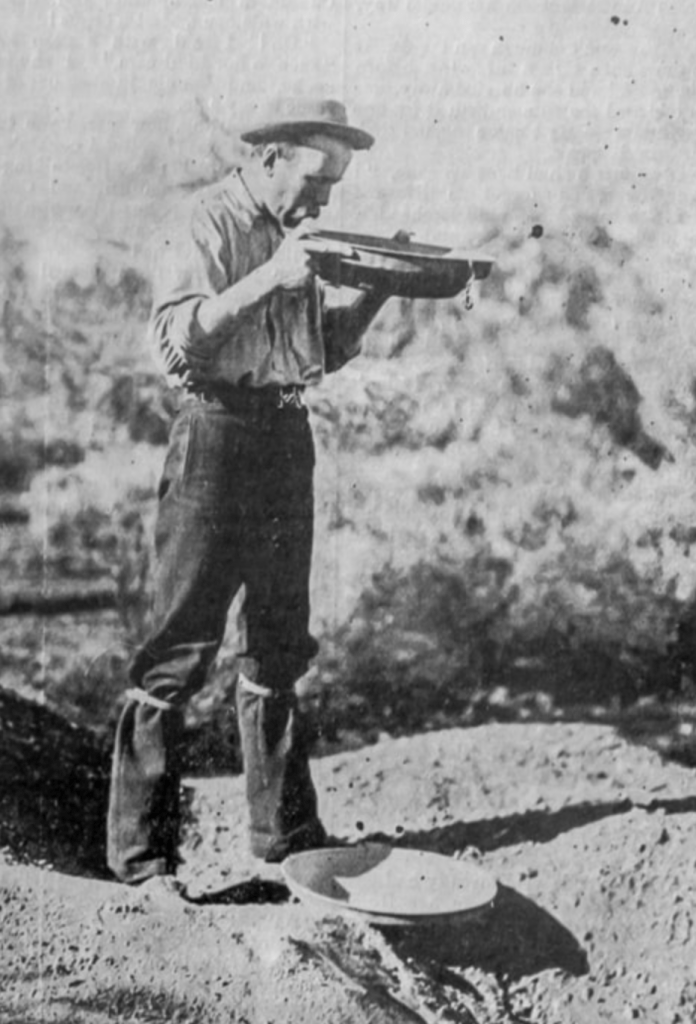
Gold fever comes to West Australia
After the collapse of the Mildura Irrigation project, many adventurous people, like Thomas C.C., would have been aware of great opportunities in both Perth and the Kalgoorlie goldfields.
I have found no trace of Thomas C.C. in Perth or in the gold towns which are 600kms to the east. His son, James Hyland Swan was born in Mildura on the 31st of August 1894; his daughter, Margaret was born in East Perth on the 18th of March 1897. It seems very likely that Thomas C.C. and his family were back in Redfern, Sydney by 1901-1902. He may have made a small fortune, or he was simply able to keep his family well fed in comfortable surroundings.
However, the only information I have found concerning Thomas in West Australia is the birth record of Margaret.
In the early 1900’s the full circle of travel finds the family back in Redfern, Sydney.
Thomas was moving from Sydney to Wychitella, marrying, having children, living in Mildura, moving to Perth and then moving back to Sydney. In addition to the three youngest children he had with Esther – William John, James and Margaret, he also had in tow three children from his first marriage, Thomas Edward (1878-1912), May Elizabeth (1881-1959) and Elizabeth Rose (1883-1935) who were all rapidly growing into adulthood and parenthood.
Although the Sands Sydney Business Directory of 1902 shows Thomas Swan, plumber, living at 92 Dowling Street, Redfern, some of the family may have been back in Sydney prior to this date. The eldest of Thomas’s daughters, May Elizabeth Swan (1881-1959) married a John Burnham Hearn at St Michaels church, Waterloo on the 12th of March 1903, however Thomas is not shown as a witness on the marriage document. May and John Hearn welcomed their first born, a son, named after his father on the first of August 1903.
Elizabeth Rose (Bessie) Swan (1883-1935) also married in 1903; to a New Zealander, Frederick Joseph O’Neill (1876 – 1957) in Brisbane.
Bessie and Frederick O’Neill’s first child, a daughter, Teresa Ellen O’Neill, (1904 – 1908) was born outside Brisbane in Ipswich on the 28th of July 1904. A second daughter, Esther May Pearl O’Neill was born in November 1905, in Waterloo, only about a kilometre away from where Thomas C.C. Swan was living on Dowling Street, Redfern which was just across the road from Moore Park. Thomas now had five grandchildren as May and John Hearn had a daughter, May Catherine Hearn (1904 – 1983), born in Dubbo in 1904. This family certainly got around; they were back in Redfern (again close to Grandpa Thomas C.C. ) for the 1906 birth of their second son, James Thomas Hearn (1906-2003). Another son, William George Hearn (1909-1994) was born in Waterloo in 1909; and their second daughter Ellen Madeline Hearn (1910-1980) was born in 1910, also in Waterloo. Two years later, back in Redfern a third daughter, Ethel Doreen Hearn (1912 – 1993) was born, giving Grandpa Thomas ten grandchildren.
The ninth grandchild (check my math!) was Elizabeth Edith O’Neill (1907 -1908) who was the first grandchild born outside Australia. The O’Neills had moved to Dunedin, New Zealand sometime in 1906 or 1907. Tragically, Elizabeth died as an infant of only 9 months and the eldest, Teresa died three months later, December 1908, both in Dunedin. Their father, Frederick Joseph O’Neill was born about 90kms west of Dunedin in 1876 at a place called Gabriels Gully the site of New Zealand’s first gold discovery in 1861.
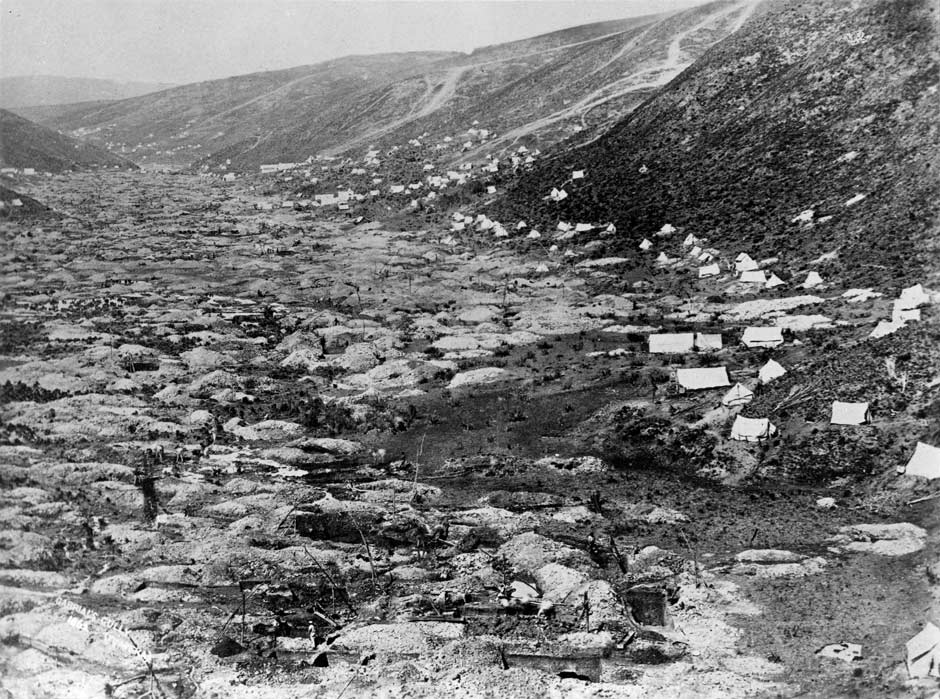
Gabriel’s Gully mining camp
Brisbane must have had some attraction to the family as Thomas Edward Cormick Swan (1878 – 1912) , the first born to Thomas and Ellen McDermott, was also married in that city in 1905 to Jessie Donald, a hotelier. They had no children and Thomas Edward Cormick Swan died in Redbank, Brisbane on the 5th of November 1912.
The O’Neills remained in New Zealand for the rest of their lives and had four more children, all born in Dunedin:
- Theresa Edith O’Neill 1914 – 1992
- Frederick Arthur O’Neill 1920 – 1985
- Betty Joyce O’Neill 1923 – 2008
- Harry O’Neill 1924 – 1924
May (Swan) and John Hearn had one more child, a daughter Valda Margaret Bessie Hearn (1920 – aft. 1977) who was born in Nowra, south of Wollongong where the family had settled, probably after WWI.
These grandchildren I have outlined were born to the two middle daughters of the marriage between Thomas C.C. Swan and his first wife, Ellen McDermott :
- May Elizabeth (Swan) Heard (1881-1959) and
- Elizabeth Rose “Bessie” (Swan) McDermott (1883 – 1935).
Before I delve into the marriages and children of the three children born to Thomas C.C. Swan and his second wife, Esther (Baines) Swan:
- William John Swan (1891 – 1971),
- James Hyland Swan (1894 – 1978) and
- Margaret (Swan) Brassil (1897 – 1935);
I’d like to return to some of their cousins (as promised).
OK, we are now back to the early 1880’s and in Korongvale/Borung where Louis Borella (1849 – 1922) had married Annie Fair Black Chalmers (1853 – 1885). They had three children:
- Beatrice Elizabeth Alfreda “Lily” Borella (1880 – 1955)
- Albert Borella (1881 – 1968)
- Annie Aurora Borella (1884 – 1927)
…. and tragically their mother Annie Fair Black (Chalmers) Borella died from scarlet fever on the ninth of January 1885.
As we have outlined earlier, Thomas C.C. Swan married Esther Baines on the 29th of April 1889 and Louis Borella married Esther’s younger sister, Kate a few weeks earlier. Louis and Kate continued farming in the area – Korongvale, Mt Korong, Wychitella and Borung – and had six children, a daughter and five sons, over the next decade:
- Margaret Olive Borella was born on the 18th of February 1890 and died in 1979
- Louis Percy Borella was born and died in 1891
- Charles Borella was born in 1893 and died in 1960
- James Borella was born in 1895 and died in 1919
- Rex Thomas Borella was born in 1897 and died in 1954
- Louis Borella was born on the 16th of July 1899 and died in 1966
Four of the five Borella brothers, Albert, Charles, James and Rex served in the military during WWI.
- Rex served in Palestine with the Australian section of the Imperial camel Corps.
- James was hospitalised in England with gunshot wounds to his thigh. He died from blood poisoning after returning to Australia.
- Charles returned to Australia, invalided from gunshot wounds to the chest.
- Albert fought at Gallipoli for three months; was severely wounded at Pozieres, France; was awarded the Military Medal for bravery in the field, mentioned in despatches and awarded the Victoria Cross for conspicuous bravery in an attack.
Albert Chalmers-Borella.
Albert was born in 1881 at Korong Vale in western Victoria. He grew up on a farm at Wychitella in the foothills of Mount Egbert, known locally as the Granites. Albert was the second of 3 children born to Louis Borella and his first wife Annie Chalmers.
Annie died from typhoid in early 1885 when Albert was only 3. Albert lived with his maternal grandparents at Mount Rowan for 4 years, some 150 km to the south. When Louis remarried in 1889, Albert returned to the family farm. Louis and his new wife moved to a farm at Thyra in New South Wales, and they had 6 children together.
Albert attended small primary schools at Borung and Wychitella. His family exhibited dogs, produce and handicrafts at local agricultural shows. A drawing by Albert, aged 14, was commended in a Weekly Times competition. The Borella men were foundation members of a gun club at Mysia (now Borung) in 1899. On a hunting trip, Albert was said to have shot off the top of his finger after he’d been bitten by a snake. For 18 months, Albert volunteered with the Victorian Rangers, a local group of the Militia Forces.
Albert worked on his father’s farm until about 1910 when he moved to Melbourne. He applied to the police force, but there were no vacancies. So, he worked as a fireman with the Metropolitan Fire Brigade for 3 years. He cared for the horses and drove the fire cart. Then, with 2 fire brigade friends, R. Parker and A. Lewis, he moved to Darwin, in the Northern Territory. They did casual labouring while waiting to take up farming. They soon won a ballot for a lease of land on the Daly River. Albert’s friends decided to leave him to it. With help from First Nations labourers, he built a house and started clearing and fencing the land for farming.
Albert enlisted in the Australian Imperial Force (AIF) at Townsville on 15 March 1915. He named his father as his next of kin. He was 31. The medical examiner described him as 5 foot 11 inches tall, weighing 10 stone 8 pounds, with a dark complexion, grey eyes, and brown hair.
Albert was assigned to the 26th Infantry Battalion (Queensland and Tasmania). After basic training in Australia, Albert embarked on overseas service. After more training in Egypt, he left Alexandria on 4 September 1915, was promoted to corporal on 8 September and landed at Gallipoli on 12 September.
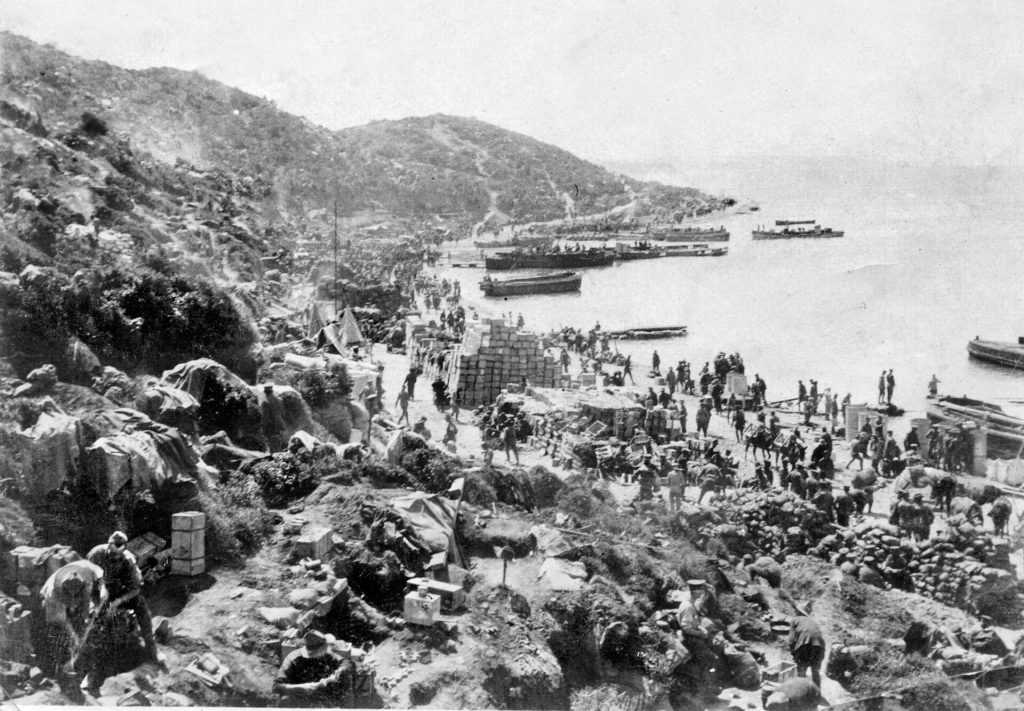
Gallipoli was hell
Between 23 July and 3 September, the 26th Battalion was involved in operations near the village of Pozieres, including the Battle of Mouquet Farm. Albert was treated for a ‘slight’ gunshot wound to his right arm on 24 July. Then on 29 July, he received a more serious shrapnel wound to his right forearm. He was evacuated to No. 3 Canadian General Hospital at Boulogne and invalided to England for recovery.
Albert returned to France in early November 1916, missing his unit’s action in the Battle of Flers. The British Somme Offensive ended with the first fall of snow on 18 November. It was the start of a wet and bitterly cold winter. The men of I ANZAC Corps spent 3 months in mud-filled or frozen trenches. Albert was promoted to sergeant in January, although he spent the month recovering from influenza at Norfolk War Hospital in Norwich, England.
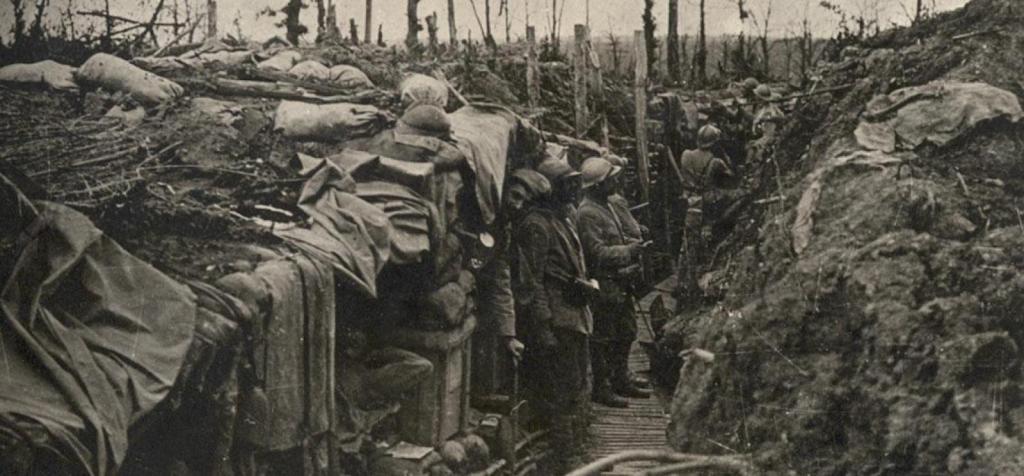
WWI trench warfare
From 21 March 1917, Albert’s unit was involved in a series of attacks in open fields and on villages between Bapuame and the German army’s newly reinforced Hindenburg Line. For his actions at Malt Trench, (Warlencourt village), on 31 March, Albert was awarded the Military Medal for bravery in the field.
Albert received a special mention in Sir Douglas Haig’s dispatch of 9 April, and he was promoted to 2nd lieutenant.
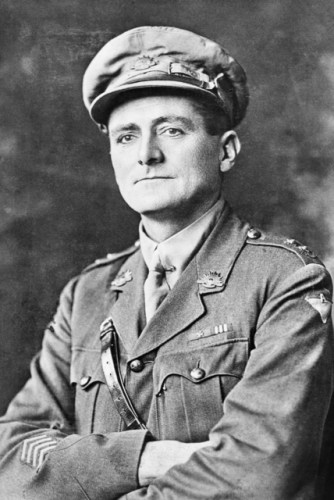
Albert Borella V.C. M.M.
Albert’s unit was involved in the Second Battle of Bullecourt from 3 to 17 May. After over 2 weeks of bitter trench fighting, the I ANZAC Corps helped to clear and hold part of the Hindenburg Line.
On 17 July 1918, the 26th Battalion attacked the German line east of Amiens. Albert led his platoon towards the German held Jaffa Trench even though it was beyond their official objective. He maintained the position against two German counterattacks. This earned him the Victoria Cross, which was then Britain’s highest award for gallantry.
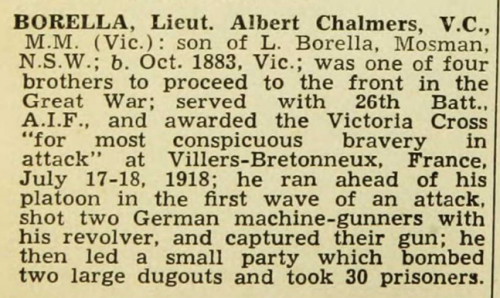
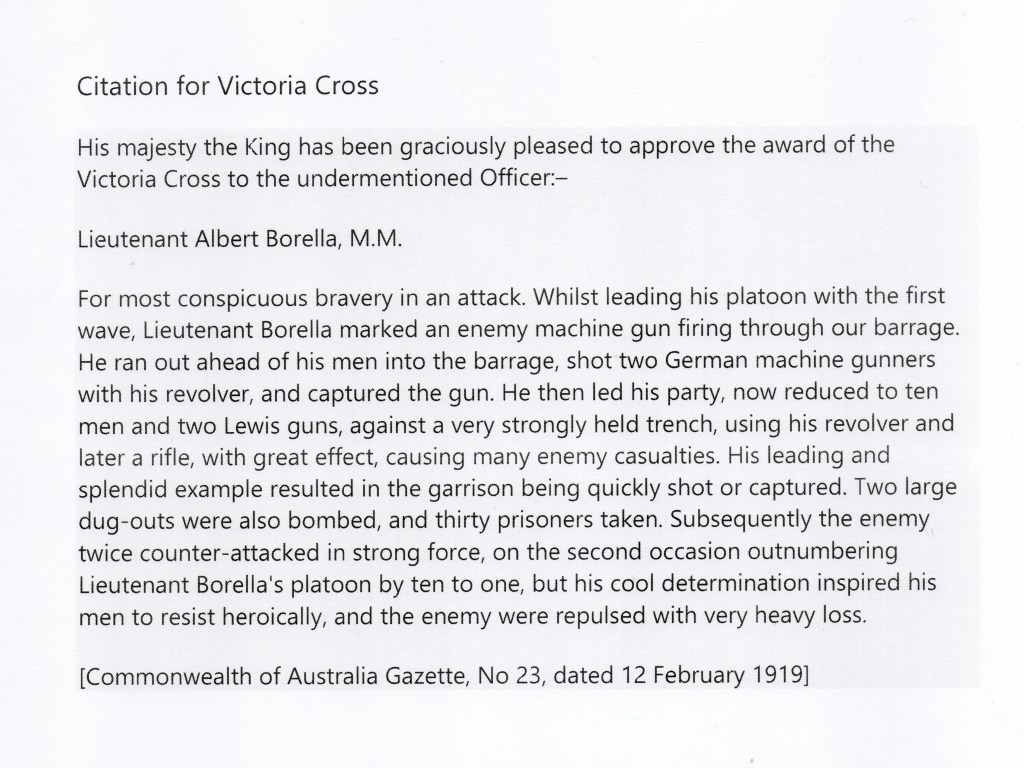
I am writing this piece family history with a background of genocide in Gaza and the subsequent ill-founded (and illegal) attacks on both Iran and Lebanon. I fully support efforts for both Trump and Netanyahu to face international war crimes.
However, I am in total awe of the courage and sacrifice shown by all combatants in WWI and all other conflicts that world “leaders” ask their citizens to participate in.
Albert Borella must have been an incredibly brave and selfless man.
Two maxims about war stand out for me: “truth is the first casualty of war” and “we don’t learn from history”.
The historical literature on World War I is still arguing about the number of WWI casualties, with a range between 6 and 13 million. The main reason for the different estimates lies in the term ‘loss’, which in the military terminology of the time included all those soldiers who were no longer able to fight, and who may have been dead, wounded or captured. Nevertheless, some figures relating to military losses are more accurate, specifically those concerning soldiers who died on the battlefield or as prisoners of war. Of the 60 million soldiers who fought in the First World War, over 9 million were killed — 14% of the combat troops or 6,000 dead soldiers per day. The Somme offensive, which took place in France between 1 July and 18 November is considered to probably have the highest casualty figures of WWI – more than 3 million men fought with more than 1 million either wounded or killed. Data on civilian casualties from WWI are very limited and uncertain, suggesting an estimated 6 million casualties among the civilian population. The highest death rate was caused by hunger, deprivation and disease, while civilian casualties must also include military occupation and retaliation.
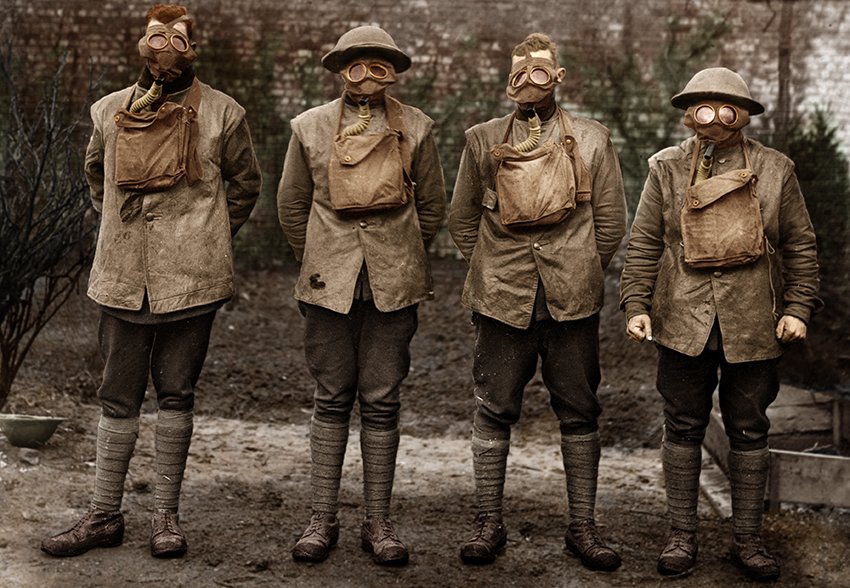
The horror of mustard gas
Thomas and his family had returned to New South Wales by 1902 and were living in Sydney where the Sands Directories between 1902 and 1912 listed Thomas at 92, then 110 Dowling Street Redfern as a plumber. As noted earlier, Thomas Edward Cormick Swan, the youngest of the surviving sons of Thomas and his first wife, Ellen McDermott, died in Redbank, Brisbane on the 5th of November 1912. He was 34 years old.
During the first fifteen years of the 20th Century, when Thomas C.C. and his family returned to Sydney from Perth, he located himself on Dowling Street Redfern. A few blocks north also on Dowling Street his sister Letitia (Swan) Barry and her husband were establishing a successful meat business, both retail and wholesale. So far, I have not found any correspondence or communication between the siblings, however I’m sure that there was regular contact between the family members – Sydney was a small town in those days with Woolloomooloo and Redfern only a few miles apart.
Electoral rolls or voters lists from 1910 to 1925 show that in 1913 Esther Swan and her son William John Swan were living at 55 Redfern Street, a few blocks from 110 Dowling Street where Thomas C.C. had been last listed in 1912. Apart from this 1913 entry, which did not include Thomas C.C., I can find no entries for any of the Swan family from 1913 to 1925.
The two sons of Thomas C. C. and Esther Baines, William John Swan (1891-1971) and James Hyland Swan (1894-1978) both married in September 1915. On the 14th of September, James married Emily Stollery (1889-1964) in a Catholic ceremony at St. Joseph’s Church on the corner of Bedford St and Station St, in Newtown. Two weeks later, on the 27th of September, William John married his first cousin, Margaret Olive Borella (1890-1979) whose mother was Esthers sister Kate (Baines) Borella. The family anecdotal history suggest that William and Margaret eloped and that their marriage did cause some concern and displeasure. Their marriage record shows the venue as the Anglican church, St. Paul’s on Cleveland Street, which would have been in Redfern, only a mile from Thomas C.C.’s old address on Dowling Street and about two miles from St Joseph’s in Newtown. The two brothers, William and James were very close and both were witnesses for each other’s marriage, displaying a great sense of support between them.
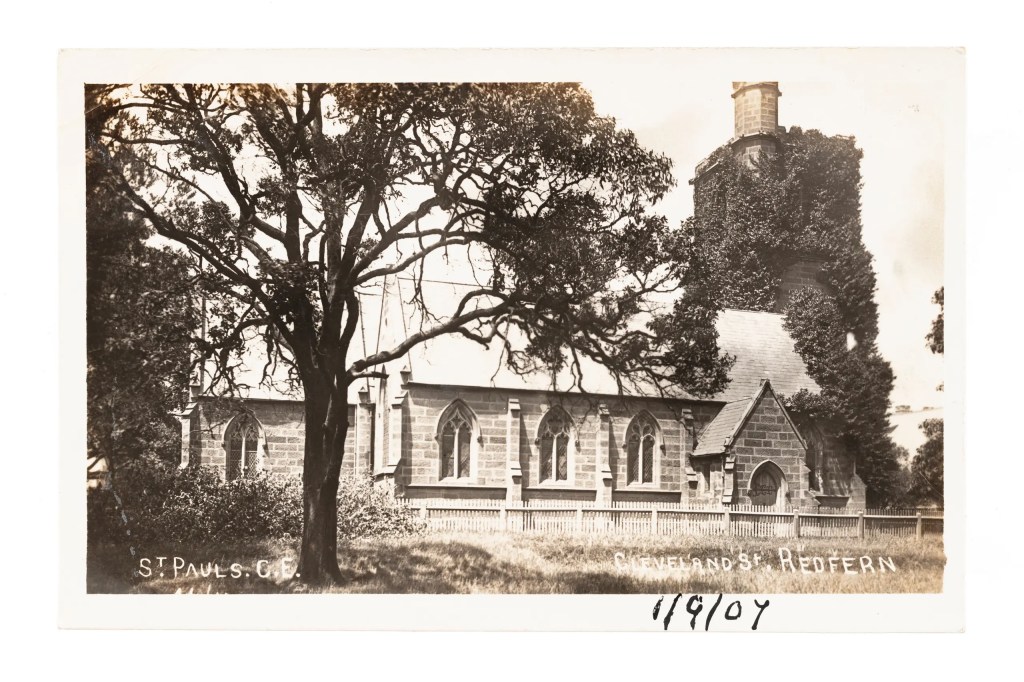
St.Pauls Church, on the northeastern side of the very prominent intersection (sometimes referred to as St. Paul’s Place) of Regent and Cleveland Streets’ corner, is now the Greek Orthodox Cathedral of the Annunciation of Our Lady. The Church was a well-known landmark, designed by Edmund Blacket and built from 1848. It would seem that William and Margaret did not choose an inconspicuous place to marry!
Around this time, possibly as early as 1913, Thomas C.C. secured a role as the plumber at the Royal Military College, Duntroon, Canberra, the site of Australia’s first Commonwealth training and education facility for junior officers of the Australian Army, Royal Australian Airforce and Royal Australian Navy. The last Directory listing for him is in 1912. He does not appear on the 1913 electoral roll which shows his wife, Esther and their eldest son, William John Swan have moved to 55 Redfern Street, Redfern, about one mile west of the family home at 110 Dowling Street. In 1925 the Directories show Thomas C.C. at 92 Dowling Street, Redfern and also at Durham Street Hurstville. Family anecdotal history suggests that he spent some years at Duntroon, possibly from 1913 to 1924 which has been verified by government correspondence in 1920 and 1921 when his widowed younger sister, Louisa Alice (Swan) Sceusa was repatriated from Sicily to Sydney.
This will be fully outlined in Louisa’s story which central to Chapter Four of The Sydney Swans.
The Royal Military College of Duntroon (RMC-D) was first opened on 27 June 1911 by the Governor General, Lord Dudley. RMC-D was situated on the Campbell homestead in Duntroon Canberra. The family had named it after Duntrune Castle, their ancestral home on Loch Crenan in Argyllshire, Scotland. The Government first rented the Duntroon homestead for two years and finally acquired the freehold to the estate and 370 acres of land after the creation of the Federal Capital.
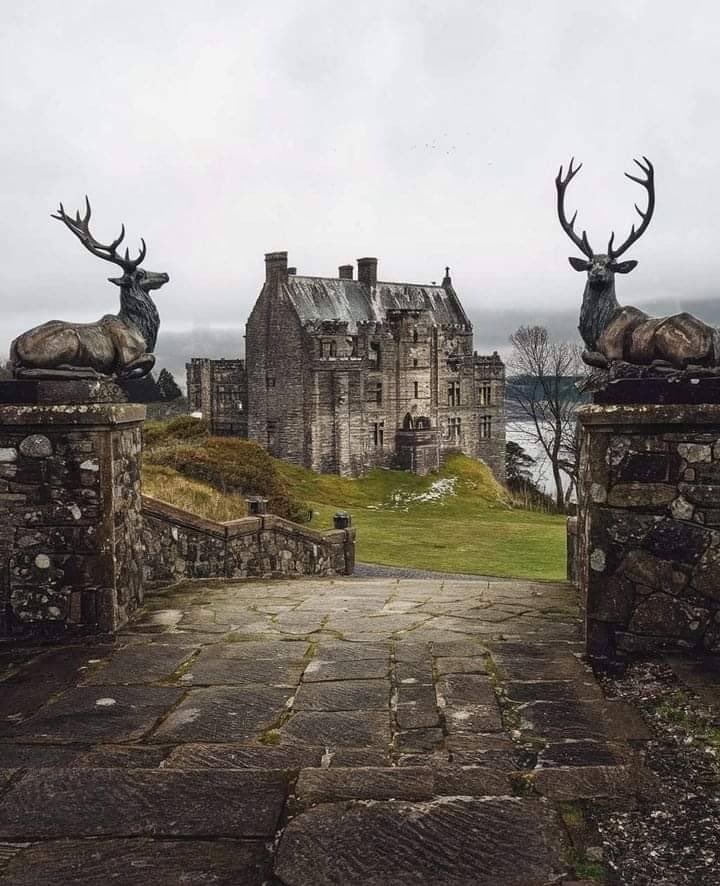
Duntrune Scotland
Duntroon was chosen after lengthy consideration. General Bridges had stipulated that it should be nowhere near a big city like Sydney or Melbourne as there would be a shortage of open ground for exercise purposes. As Canberra had been named as Australia’s Federal Capital, it was decided that a location few kilometres from the site of the proposed city was the ideal location for the College.
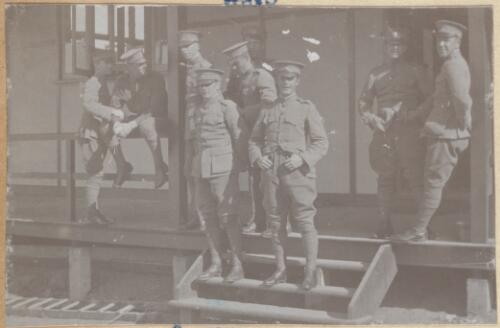
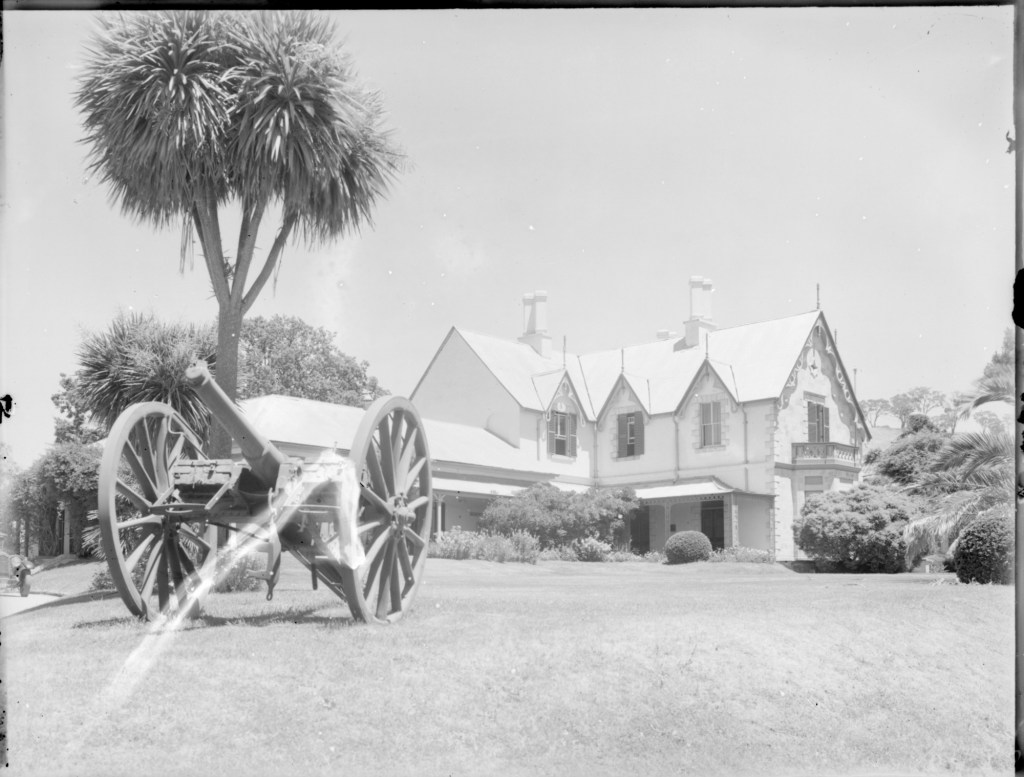
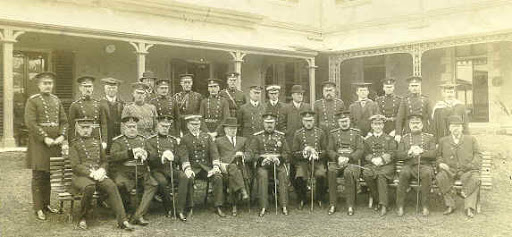
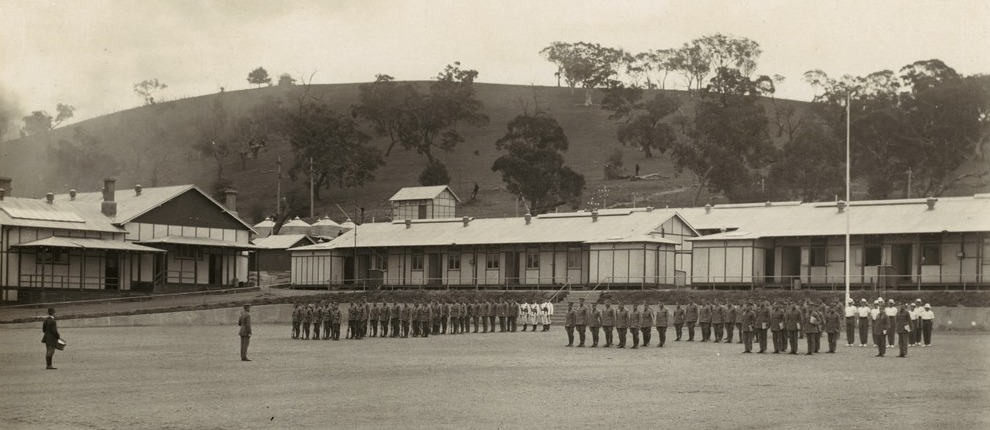
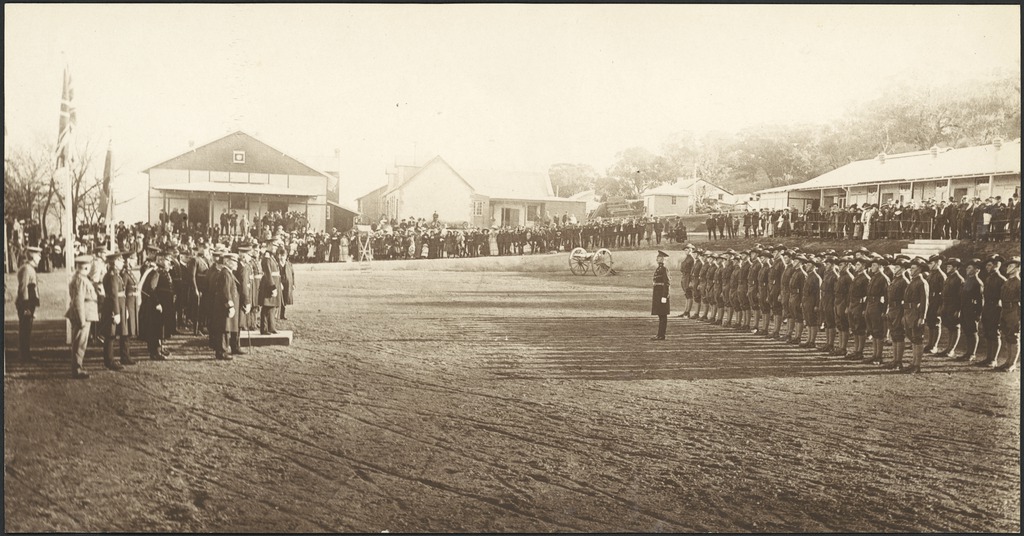
Duntroon was chosen due to the nearby availability of unpopulated areas which would be suitable for training. These areas are still used today and are known as the Majura Range.
In 1912, the time the Royal Military College, Duntroon, was established Canberra was very much a rural community with a scattered population of just 1,700. The college also started small: the first intake was 42 cadets, with about 40 academic and support staff.
At a military function towards the end of 2025, I met the “Head, Australian Army History Unit” and asked him if there might be any reference to Thomas C.C.’s employment at Duntroon. He graciously replied:
“I wanted to let you know I have had a chance to speak with the Duntroon Museum Manager and Curator. Unfortunately, but as expected, the museum does do not hold any records or objects that relate to your 3rd Great Uncle, Thomas Cormick Cassidy Swan, employed as a plumber at Duntroon between 1913 and 1925. That is not especially surprising, as the museum’s focus is on the cadets and trainees, and then the military staff. The museum holds almost nothing on the civilian academic staff, let alone the supporting civilian staff, such as your 3rd Great Uncle. Moreover, the museum’s focus is on objects, rather than records, and the only records of substance it holds are the training reports raised on the cadets, or records about the objects in the collection. That is also consistent with Army’s other museums, which generally don’t replicate the archives responsibility which is held elsewhere in Army and the Department of Defence. So, I regret to say, I have drawn a blank there.”
Thomas C.C. became a grandfather nine more times:
William John Swan (1891 – 1971) and his wife, Margaret Olive (Borella) Swan (1890-1979) had two sons:
James Borella Swan (1918-1969) who was known as “Jim”
Lawson John Swan (1923-1995) who was known as “Jack”
….who grew up on Sydney’s northern beaches in a sandstone house built by their father.
James Hyland Swan (1894-1978) and his wife Emily (Stollery) Swan (1889-1964) had 2 children, a son and a daughter.
Margaret (Swan) Brassil (1897-1935) and her husband Francis Brassil (1890-1937) who married in Hurstville in 1927 had five children, three daughters and two sons.
So, I understand that Thomas C.C. spent some years between 1915 and 1925 as “a” or “the” plumber at Duntroon. I’m sure that he would have travelled back to Sydney and his extended family on a regular basis to be part of marriages, birthdays, festive occasions and all gatherings that a revered grandfather would delight in. We will see him in a supportive elder brother role in the life of Louisa Alice (Swan) Sceusa outlined in Chapter Four of The Sydney Swans and Hayden Edward Henry Swan in Chapter Five.
After his time at Duntroon, he and Esther settled into the suburbia of Hurstville and Kogarah, about 15km south of Redfern. The 1925 & 1930 Directories have Thomas and Esther, both now in their seventies, living at Durham Street Hurstville. He is listed as a plumber and Esther as “domestic”.
In June 1932 at Hurstville, Esther passed away. They were married for 43 years and had quite an adventurous life across Victoria, New South Wales and West Australia.
Sometime in 1937 Thomas moved to 20 Gray Street, Kogarah which is now the site of the St George Hospital.
On the 3rd of December 1943 Thomas died, the cause of death shown as a carcinoma of the lip. He was 85 years old.
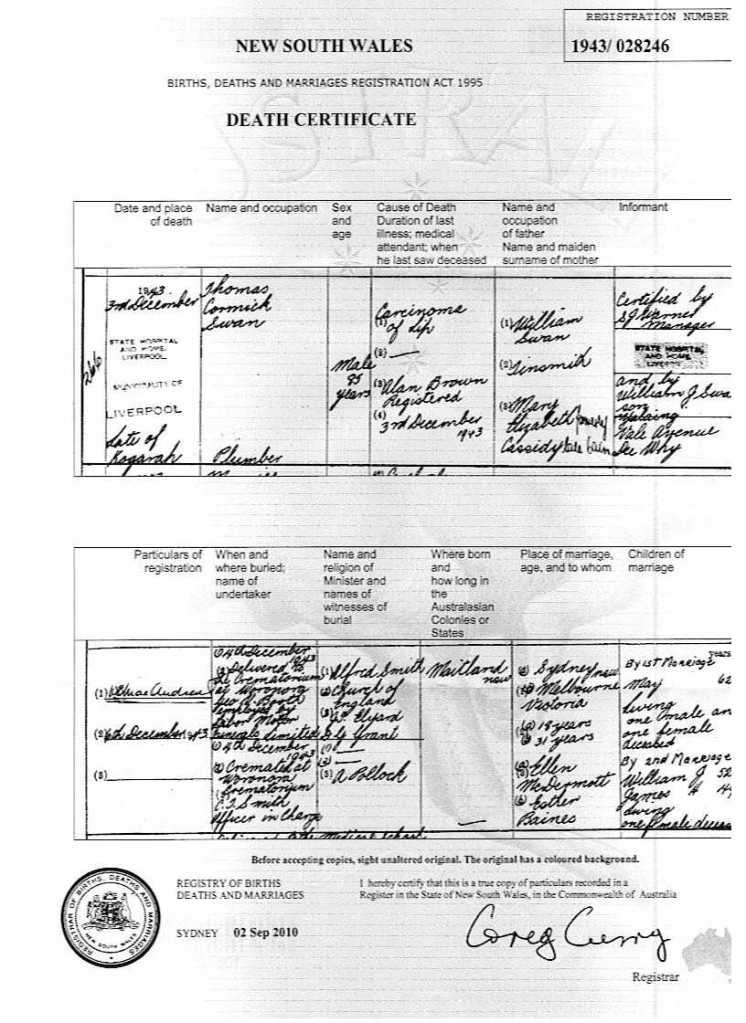
I have outlined his family life through his two wives, nine children and twenty-three grandchildren. There are many more varied and interesting descendants in his extended blood line which I’ll leave for others to expand upon.
Research into his life was from a broad range of sources not all documented (or included) to the exacting standard of 4thcousin, once removed, Cathy (Parry) Shashkof.
She is an absolute treasure.
The work done and shared by 3rd cousin, once removed, Bill Swan was of immense assistance.
Thank you both.
~~~~~~~~~~
Wikipedia
Mildura Visitor Information Centre; 180-190 Deakin Avenue, Mildura
explore@thechaffeytrail.com.au
Northern Territory Major Events; 16 Bennett Street, Darwin City
ancestry.com.au
https://familyhistory.bdm.nsw.gov.au
https://mhnsw.au Museums of History New South Wales
https://naa.gov.au National Archives Of Australia
https://dictionaryofsydney.org State Library NSW Dictionary Of Sydney
Orange Regional Museum museum@orange.nsw.gov.au
Orange City Library library@orange.nsw.gov.au
Mildura Heritage Study Stage 2 August 2012
https://www.awm.gov.au/visit/exhibitions/salute/start/duntroon
 miles of irvings
Leave a comment