This is an excerpt from a book
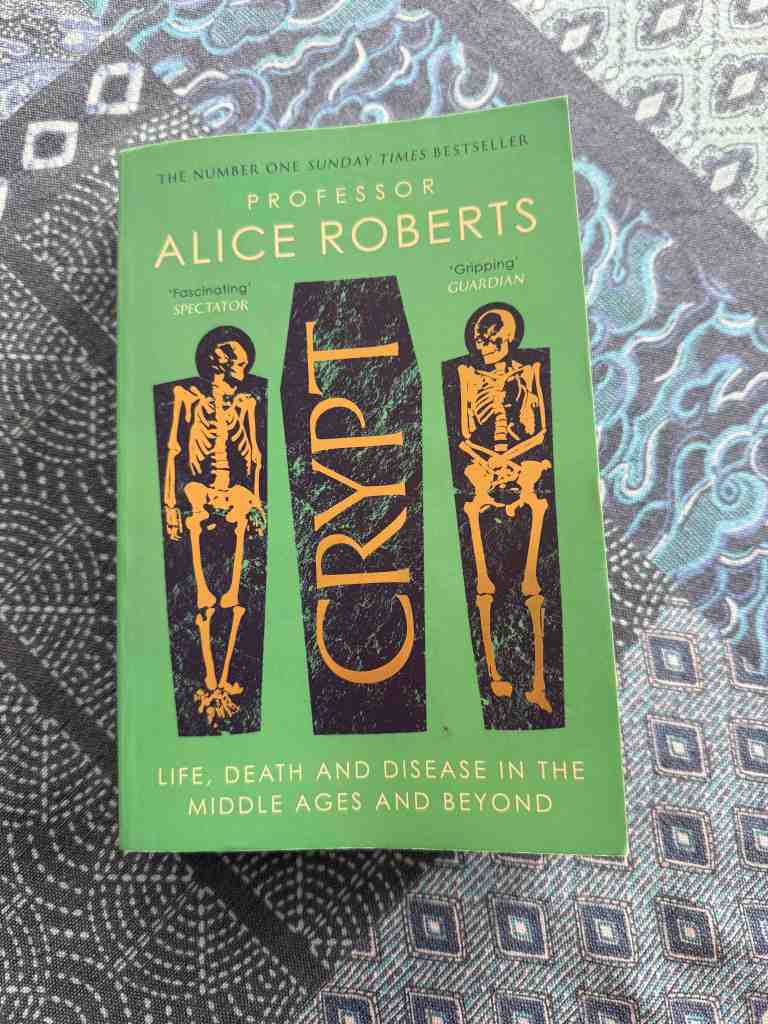
‘CRYPT’ written by Professor Alice Roberts, first published in Great Britain by Simon & Schuster UK Ltd, 2024.
Professor Alice Roberts is an academic, author and broadcaster – specialising in anatomy and biological anthropology. She has presented over a hundred television programmes, on biology, archaeology and history, including landmark BBC series such as The Incredible Human Journey, Origins of Us and Digging for Britain. She also presents Britain’s Most Historic Towns on Channel 4.
At the time of adding this post to my blog, Alice has written more than ten popular science (and children’s) books, many of which we have in the library. In ‘CRYPT Professor Alice Roberts provides a fascinating view of life, death and disease in the Middle Ages and beyond. There are seven stories in “Crypt” where Professor Roberts examines the history of the Middle Ages but not in the usual manner of focusing on the lives of the rich and powerful. Instead, she shows how cutting-edge science, through archaeology, allows an understanding of the past that is both intimate and inclusive.
And yes, I highly recommend reading this book – particularly as these seven stories broadly show a society “struggling to make sense of disease, disability and death, as incurable epidemics sweep through medieval Europe”.
The following excerpt is a few selected paragraphs from the foreword or preface, and the epilogue to “CRYPT”
“OSTEOBIOGRAPHY”
Literally: written in bone.
It is through written language that we transcend the communication barriers of distance and time. Ideas and images, reconstructed in words, flow from one human brain to another. It’s the most extraordinary technology, allowing us to read something that has been in someone’s mind, far away, perhaps even on the other side of the world. We may never have met that person; maybe we never will. We can also read the thoughts of someone who is no longer here, who passed away last year, or a few decades ago, or hundreds, thousands of years ago.
(I think about this when I’m writing. How extraordinary and yet how ordinary it has become, that I can write these words and that you, somewhere, sometime, are reading them. Well, you’re only two pages in, so I hope you like the rest!)
In the depths of prehistory, we don’t have any written record of the world, of the lives of our ancestors. That is, after all, the definition of that time: it is pre-history. But we have archaeology, which is both a branch of anthropology and a historical science. We can look at the physical remains of our ancestors’ culture and technology, the things they made and built, and even at the physical remains of them, and draw inferences about a world, about lives, long forgotten. Advances in our technology, the scientific techniques we use to interrogate the past, mean that we can now unlock more of those secrets than ever before. We cab collect information from satellite data, drone footage and from geophysical surveys. We can date objects very precisely using radiometric dating techniques, such as radiocarbon dating. We can analyse the chemical compositions of rocks and minerals to find out where they came from before humans moved them around. And when it comes to human remains, we now have an impressive toolkit of techniques that can help us to find out where someone grew up a s a child (by analysing the chemical composition of their teeth) and – perhaps most excitingly – we can extract and sequence ancient DNA; not just fragments of it, but entire genomes. Those genomes can tell us an enormous amount: about individuals, about kinship between people buried in the same tomb or cemetery, about how much people were moving around and migrating from one place to another.
All that archaeology is a precious resource for our understanding of prehistory, but those same sources of information exist in the historical era, too. There, archaeology can show us a very different picture from history. It’s not just there to illustrate the written sources, either: it’s an independent source of data that enables us to look at wider questions, to track changes through time and – sometimes – to test what the historical documents seem to be saying. It also lets us glimpse the lives of ordinary people – people missing from the historical record.
Archaeology is not ancillary to history; it is not its slightly scruffier, grubbier handmaiden. It’s unashamedly earthy, grounded and physical, but out of the dirt come gems of understanding, bringing together these two disciplines – history and archaeology, with all these new scientific techniques – we now have an extremely powerful way of interrogating and understanding the past.
This is the third book of a series in which I have explored the stories of the past that archaeology can now reconstruct, focusing on burials and the analysis of human remains. But don’t worry if you haven’t read the other two. There’s a chronology running through them: in the first book, Ancestors, I looked at what prehistoric burials tell us about ancient lives; in the second book, Buried, I moved into the first millennium of the Common Era (Anno Domini in old money), with stories of Romans, Vikings and Anglo-Saxons. This book is located in the High and Late Middle Ages – roughly 1000 CE to 1500 CE – with a brief but useful foray into the sixteenth century. And it’s a bit different from the others in that there’s a focus on pathology: on disease and injury; the experience of human suffering in the past; and on the evolution of the diseases themselves. The study of diseases and injuries in the past has its own name: palaeopathology. That investigation starts with looking for marks on bones, the stigmata of inflammation, infection or injury, and continues with radiological and genetic analyses.”
“The new synthesis of history, archaeology and genetics offers us a much more detailed picture of the past than we’ve ever been able to see before. Not just at a grand scale – though it certainly does that too – but at an individual level. Piecing together different sources of information, we can paint detailed portraits of people, some of whose names we know; many we don’t.
Osteoarchaeology, palaeopathology and now archaeogenomics are transforming our understanding of the past, making us look again at the broad sweep of history, now that we see more clearly how epidemics were ignited and spread, and now that we can so precisely diagnose the diseases that people were suffering from. We can unlock secrets from bones preserved for centuries in tombs, graves and crypts. We can see how disease is an enduring part of the human condition; how pathogens we thought had come along recently have been with us for millennia; how changes in microbes and changes in society can alter the human experience of disease; how easily words spoken by those in power can be translated into violence; and what Japanese baseball pitchers and medieval archers have in common.”
“To be human is to feel pain, to experience loss. We are not ethereal creatures, made of pure thought, but physical beings – biological entities. We experience the world through our bodies, and our lives are written into those bodies and into our bones.
And this is what the skeletons of the dead say to us when we find them: Listen to us. We have stories to tell.”
 miles of irvings
Leave a comment