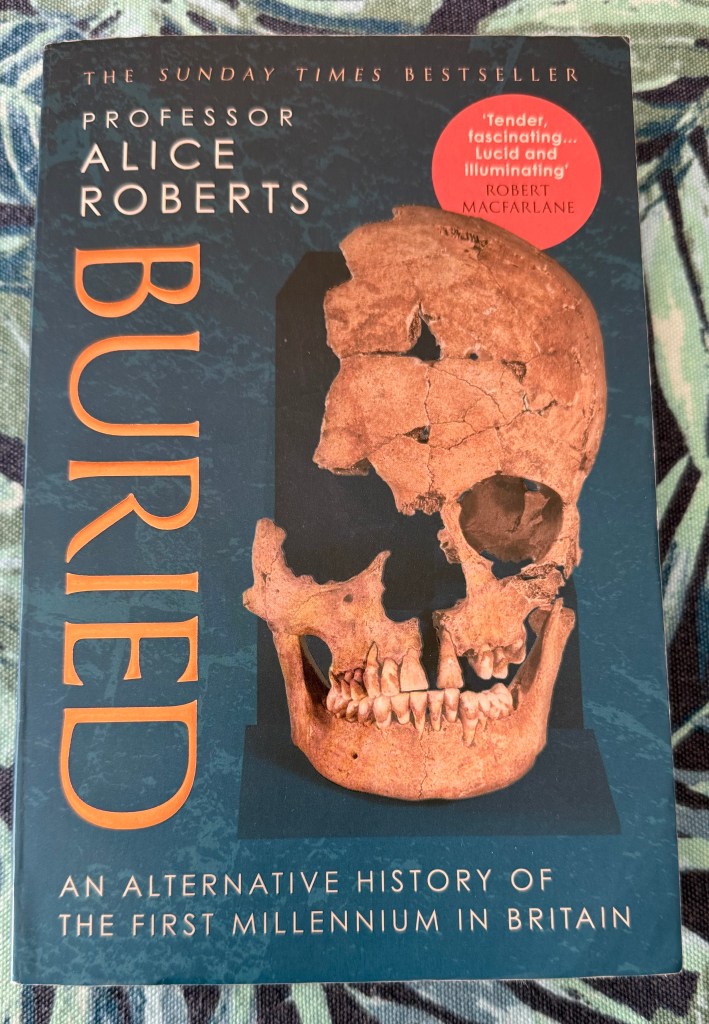
This is an excerpt from a book
‘BURIED’ written by Professor Alice Roberts, first published in Great Britain by Simon & Schuster UK Ltd, 2022.
Professor Alice Roberts is an academic, author and broadcaster – specialising in anatomy and biological anthropology. She has presented over a hundred television programmes, on biology, archaeology and history, including landmark BBC series such as The Incredible Human Journey, Origins of Us and Digging for Britain. She also presents Britain’s Most Historic Towns on Channel 4.
At the time of adding this post to my blog, Alice has written more than ten popular science (and children’s) books, many of which we have in the library. In ‘’BURIED’ Professor Alice Roberts provides an alternative history of the First Millenium in Britain. I highly recommend reading this book and any others she has written.
The following excerpt is most of the Prologue “A Blessing and a Curse”; and the first, and the last two paragraphs of the Postscript: “A Note on the Use of the Term ‘Anglo-Saxon’.”
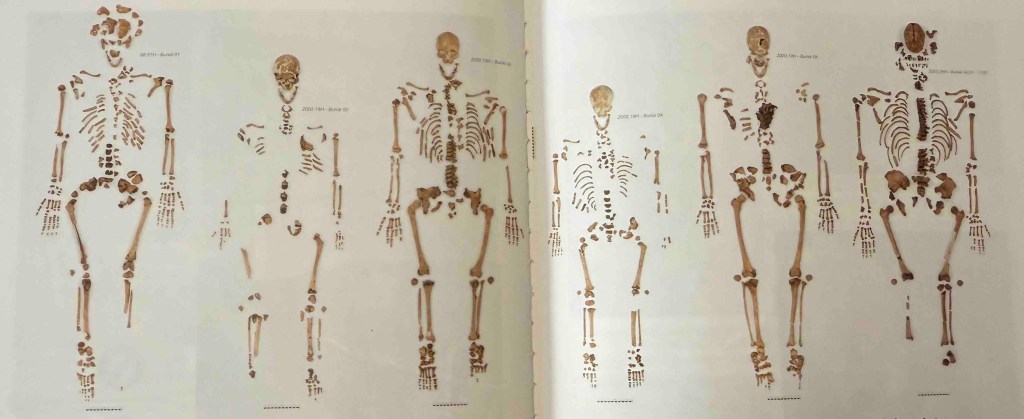
“There’s a lot you can tell from a skeleton. As a biological anthropologist, I’ve specialised in drawing out information from old bones. It’s not always easy, and how much I can reliably infer depends on the state of preservation of the human remains. But I might be able to determine the biological sex of an individual, give a good idea of their age at death, and also offer some details about some of the illnesses and injuries they suffered during their lives.
In the last decade, the information I can extract by careful, visual analysis of bones and teeth, helped by the judicious use of X-rays, has been vastly extended by a range of different biochemical techniques. It’s now possible to analyse the chemical composition of bones and teeth and draw inferences about where a person lived and what their diet was like. But we’re also experiencing a revolution in archaeology, driven by ancient DNA (aDNA). Archaeogeneticists are now able to extract DNA from ancient bones and sequence entire genomes. It’s only just over two decades since the first-single-human genome was sequenced, and the pace of change in genetic technology has been breathtaking. Sequencing is now faster by several orders of magnitude, and we have the ability to compile whole DNA libraries drawn from both the living and the dead.
On an individual basis, an ancient genome can provide information about the sex of a person and even provide clues to appearance. But the revelations become even more interesting when we start to compare genomes from different individuals, revealing family connections. And wider studies of relatedness and ancestry can help us to track changes at a population level. Amassed genomic data are starting to shed light on major population movements, mobility and migration in the past. It’s an exciting time, but when new technologies burst onto the scene like this, they can also be disruptive. Scholarly feathers are ruffled, and sometimes the claws come out. The potential for huge advances in understanding is there – but it’s also important not to rush to conclusions or to be seduced by sensational headlines about breakthroughs. We can be excited and cautious at the same time.
In prehistory, that great swathe of time before the written word, archaeology is the only way that we can hope to learn anything about our ancestors. We look at the physical traces of their culture, and at the remains of individuals themselves, usually reduced to just their bones and teeth – but with precious DNA locked away in those hard tissues, and now amenable to analysis.
Once we move into the realms of history, we have some documentary evidence to look at. The written history of Britain begins with occasional classical references to an island off the coast of continental northwest Europe, going back to the middle of the first millennium BCE – Before the Common Era. (I use BCE/CE rather than BC/AD – it’s the academic standard and is religiously neutral, as well as having been in use since the seventeenth century, so it’s not a new thing.) By the first century BCE, Britain is drawing the attention of the expanding Roman Empire, with Julius Caesar visiting in a not-particularly- friendly sort of way in 55 and 54, and Claudius following up with a full-on invasion in 43 CE. For almost four centuries after that, we have the luxury of quite a lot of written information about life in Roman Britain. I say “luxury”, but that history is both a blessing and a curse. First of all, it’s very biased – it was necessarily produced by literate individuals, who were elite Romanophiles. Most of the classical authors who wrote about Roman Britain didn’t even live here, such as the senators Tacitus and Dio Cassius. And they were focused on military history, giving us a very skewed view.
In the post-Roman period in Britain, contemporary written records all but disappear. Literacy is still there, but it’s harder to find traces of it. We get some glimpses from high-status sites, including monasteries. This is the period which used to be referred to as the “Dark Ages”, which is now seen as a pejorative term, suggesting that Britain descended into “darkness”, into a period of ignorance and barbarism, when the Roman army pulled out in the fifth century. But even if the term is problematic, there’s no denying that the historical record for the fifth to eighth centuries is patchy at best.
Looking at the first millennium of the Common Era, burial archaeology can provide us with precious glimpses of individuals, their culture and beliefs. We can see how funerary practices change over time, as different influences arrive or wane. And archaeogenomics now holds out the promise of finding out just how important migration was – how much people were moving around at different times, and where they were coming from. History becomes very personal – as we learn about people who lived in this land all those centuries before us.
This is not a comprehensive survey of British archaeology in the first millennium CE. It is a personal selection of stories, including some individuals whose bones I know very well, but I hope it captures some of the diversity of lives, cultures and beliefs in Britain over those centuries. I’m writing this at an exciting time, when aDNA is transforming, or at the very least challenging, some of our long-held assumptions about what Roman Britain was really like, and about what was actually happening during those historically dark post-Roman centuries.
There’s also something here about belonging; being part of a landscape that has been inhabited for a very long time. Bones and burials tell the stories of those generations who have gone before, with a aDNA unlocking new secrets all the time, and new archaeological discoveries providing fresh insights. Funerary ritual and burial itself represent attempts to understand mortality, to make sense of loss, to fix the departed in memory, and to tie them – and us – to a landscape.
A landscape in which we are just the latest inhabitants.”
~ ~ ~ ~ ~
“It’s not just the idea of an Anglo-Saxon invasion or mass migration that’s currently being hotly debated. It’s the term ‘Anglo-Saxon’ itself. It enshrines that idea of Germanic origins, if not for a whole population, then certainly for its royal dynasties. But although later Anglo-Saxon kings were keen to stress their Germanic roots, there’s plenty of archaeological evidence for much more widespread connections and influences – as with the Gallo-Roman-styled belts of office from the Dyke Hills of Dorchester, the Byzantine bucket at Breamore, and the Frankish and Byzantine vibes of the daintier cruciform brooch styles that developed in the late sixth century. The histories contain lots of oddities and contradictions too, like the Anglo-Saxon Chronicle telling us of Cerdic and Cynric coming over; but if they did come from somewhere else, we may ask, why did they have such distinctly British names? There’s also a disparity between words and deeds in how the early medieval kings demonstrated their legitimacy. The royal genealogies drawn up by the likes of Bede demonstrate that Anglo-Saxon kings were descended from legendary Germanic forebears, including Hengist and Horsa, and all the way back to the god Woden (a tradition that stuck, even when the kings had turned Christian). But with those Germanic pedigrees on paper (or vellum), Anglo-Saxon royalty and elites were projecting different ancestral links with their burial practices – emphasising their connections with ancient British forebears, reusing prehistoric barrows, or making brand new ones which also harked back to those ancient practices and people.
If it’s possible to retain ‘Anglo-Saxon’ in the historical sense, then it must be constrained to describing a polity, a particular period in English history, and even a particular culture – and explicitly not used as an ethnic definition. In this way, the term is much more about an era and political allegiances, as Susan Reynolds suggested – similar to the Elizabethans, the Georgians, the Edwardians. That means we can talk about Anglo-Saxons in the past, where they belong – but cannot talk about them existing in the present. There are no living Anglo-Saxons, in the same way that there are no living Elizabethans.
There are good reasons for holding onto ‘Anglo-Saxon’, as well as very valid reasons to want to get rid of it. Anyone working in the field or writing about it should certainly be aware of the controversy, and anyone who chooses to continue using the term must do so advisedly and responsibly. But it’s also important to have these conversations – and top keep re-examining the language we use, and not simply to hang onto words for the sake of tradition. Academic research doesn’t exist in a bubble, away from current political and social realities.”
~ ~ ~ ~ ~
 miles of irvings
Leave a comment