In October 2024, we caught up with one of Vicki’s 1st cousins, Alison (Miles) Miller in beautiful Melbourne. Vicki and Alison have been communicating for more than a few years so with Karen and Debra in tow, we made the journey to the shores of Port Philip Bay and caught up with cousins that they hadn’t seen for more than 50 years!
And what a wonderful weekend it was. A bunch of Alison’s family, Major Miles and his father and Marilyn, a 3rdcousin from William Miles’s branch of the Miles Tree. Marilyn has researched and written some wonderful family history, bringing alive the voyages to Victoria and settlement of families in the mid 1880’s.
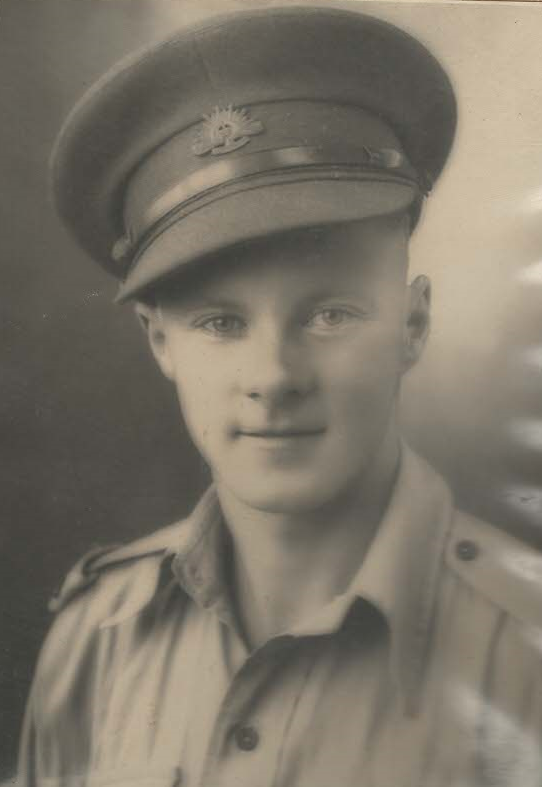
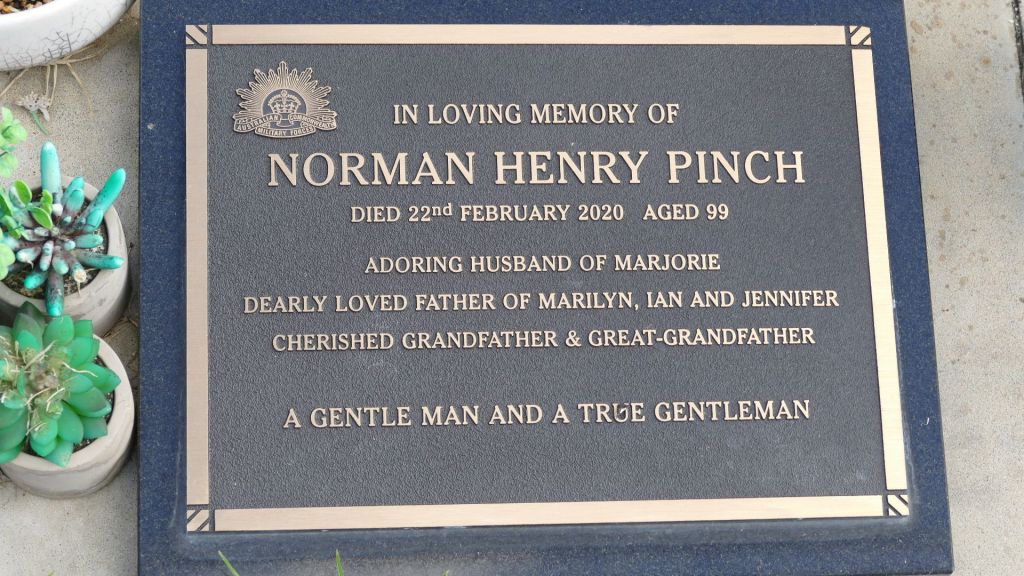
This is a special story about a special member of the extended Miles Family ~ Norman Henry Pinch, Marilyn’s father.
Norm was born in Bendigo, Victoria on the 8th of July 1920. His parents, Edward John Pinch (1868-1964) and Sarah Emily Miles (1883-1963) were both born in the Colony of Victoria. All four of Norm’s grandparents were English; William (1830-1912) and Mary Jane (1834-1911) Pinch, from Cornwall, were already married with children before making the sea voyage to Victoria. William Miles (1836-1925) the eldest son of the Miles family from Englishcombe in Somerset, sailed on the “Marshall Bennett” to Geelong in 1854 with his parents and siblings; and his wife, Jane Wiffen (1842-1930), Essex born, also migrated to Geelong in 1854 with her family, aboard the “America”.
Norm’s parents were married at Emu Creek in July 1906, only a few years after the Federation of Australia. His mother, Sarah Miles, was from nearby Axe Creek where her father was farming. His father, Edward Pinch, was born in Long Gully, a part of Bendigo inhabited by Cornish miners when the big mining companies started operating underground. Edward moved to the Emu Creek area after his father bought land to farm around 1891.
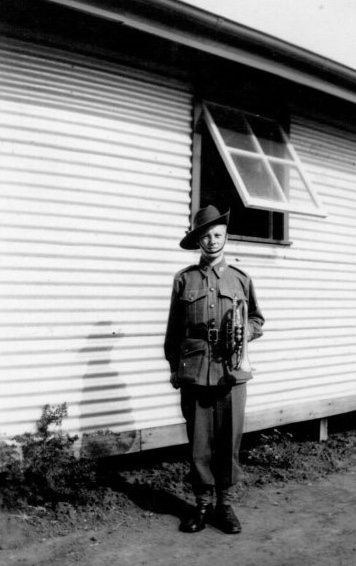
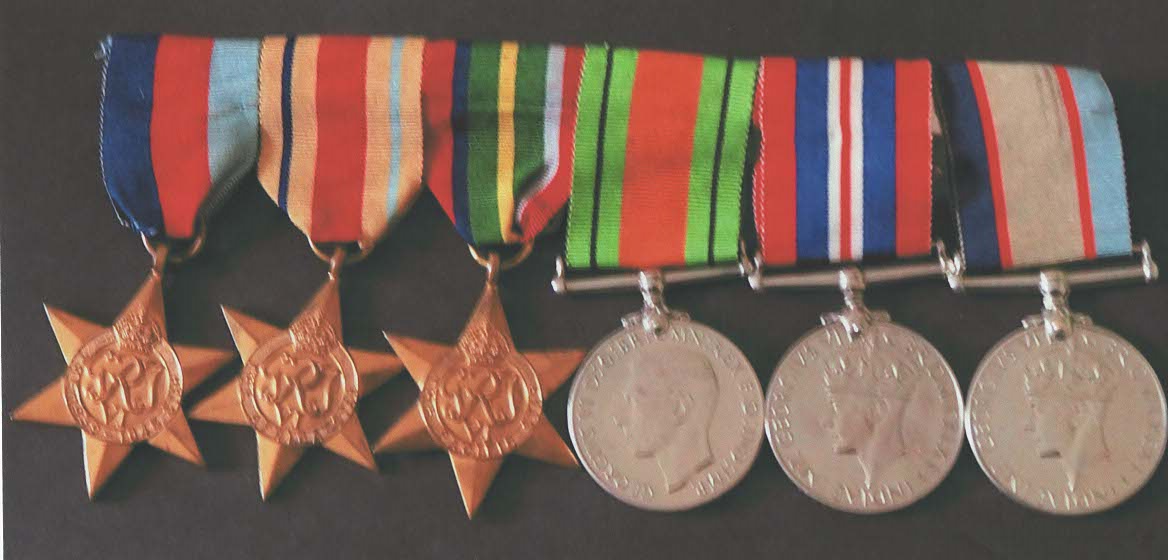
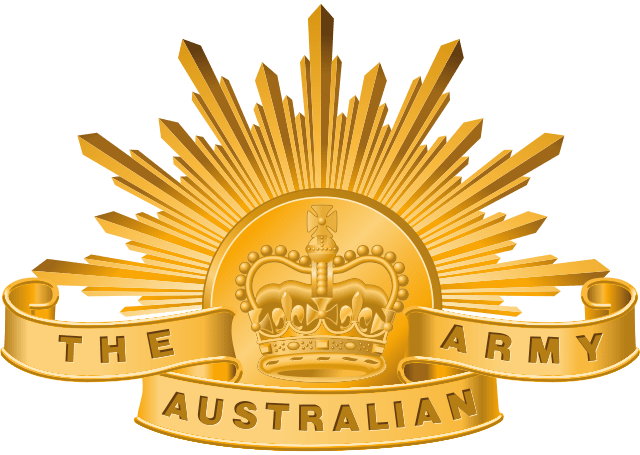
Norm was 20 when he enlisted in the Army. Initially joining as a bugler, Norm became part of an Ammunition unit and for the next five years was posted both overseas and in Australia. First stop was Egypt for a few weeks training before Palestine and Syria. He was then sent back to Australia: Perth, Adelaide, Terowie (S.A.), Townsville, Hughenden and then up to Dutch New Guinea and Jacky Jacky on the tip of Cape York, Queensland before being sent to Thursday Island.
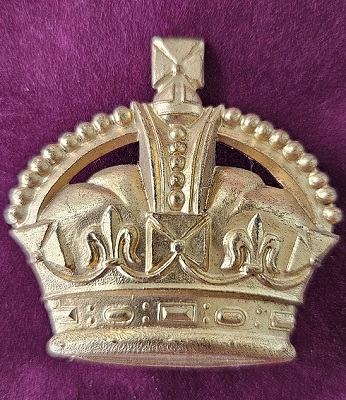
During this time Norm was promoted a number of times, finishing his service in WWII as a Warrant Officer 2ndClass.
The following narrative is wholly Norms without any editing. He dictated his life story to his granddaughter who transcribed it word for word as a document. This account is of Norm’s time in the Australian Army from 1940 to 1945. Norm lived to be just a few months short of a century and there are many more of his insightful stories held by the family.
Army Life
Experiencing my only white Christmas, meeting my future wife, travelling through holy lands, the rise and abrupt fall of my touch rugby career, and coming home.
Joining up and playing in the Band
“I was 20 when I joined the Army. I played in the Band. I joined because the Municipal Band Bandmaster, Bobby McCaskill, was to form an Army Band at Royal Park. I think that’s still present now, one of the main Bands in the Army – the 3rd Military District I think it is. Any rate there was a lot of us from the Municipal Band and a few from some of the other Bands and they joined this Army Band. So I was in that for about 6 months, I joined it in October 1940.”
“And then come around about April and I thought “Ah, I’m not gunna stay in Royal Park all the time”. We used to go in and we used to do concerts at lunchtime, and recruitment drives and that sort of thing. In the morning we’d march the soldiers around for Parade and all that sort of business. So I said, “Well, I’ll join the AIF”. Well, of course I was only 20 so I had to get my parents’ permission. In those days you had to be 21. And Mum said to me, “They also serve who only stand and wait”, but I wasn’t going to stand and wait in Royal Park any longer. So I joined up.”
“As a matter of fact when we were playing near the Town Hall one day a Captain came to me and he said, “We are forming an ammunition unit that’s going to go overseas and we’re looking for a bugler”. And I thought, “This’ll be me”. So I joined up. And when I joined the AIF I got sent up to Albury where this unit was being formed. From there I went over to the Middle East.”
“I was 7 stone 8 for 15 years and you had to be 8 stone. But it didn’t matter when we joined the Band. But to join the AIF you had to be 8 stone. You were supposed to be 8 stone. You were supposed to be, at that time I think it was 5 foot four or something and I was only about 5 foot two. Any rate, this chap that was doing the recruiting, he said to me, “You can’t join up, you’re too short and you’re too light”. So I saw the Colonel striding across the ground, and I went up, I saluted him. I said, “Excuse me Sir, I want to join the AIF, I’ve got a unit to go to”. See I did have a unit to go to. “But they’re not going to take me because I’m too short and too light.” So he went into the recruiting officer and he said, “Enlist this man for special services”. And the bloke, did he give me a look! “Look at this little bugger, he’s got in! They’ve got influence, I don’t know!” But any rate that’s how I got it. So, went over to the Middle East.”
The journey to the Middle East
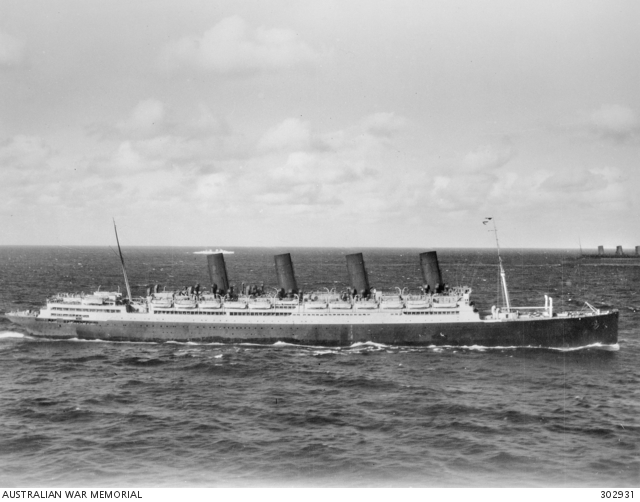
“First of all we had the Queen Elizabeth and the Aquitania. The Aquitania was an old 4 funnelled ship and it had New Zealanders on it. We met somewhere down, wherever it was, somewhere down round near Tasmania. Any rate, we were going and that convoy had about, I think, 9000 troops. It was supposed to be going to Greece, but before we got there Greece had fallen, Crete had fallen. We had 6 days at anchor in the Red Sea. I think that was when it was decided that we couldn’t go any further. And so then we went over to Egypt to a place called El Tel el Kebir, I don’t know what that means, that was a training camp. And we were there for only a few weeks actually.”
“About on our second night one of our blokes got shot. He was in his tent, on his bunk and I don’t think they ever knew whether it was a stray sniper, or whether it was just an accidental shot, but our Captain, who finished being our Captain up in Dutch New Guinea, he was lucky. We used to have kind of cane beds, pretty light sort of things. And his had collapsed and he was sleeping next to the edge of the tent and the bullet went over him and hit our, he was our Quartermaster, dishes out all the stores, yeah. It killed him. Killed him. We got called out in the middle of the night and they inspected everyone’s rifle, naturally, to see if any had been used.”
Travelling through the Middle East – white Christmas, precious heaters and French Foreign Legion luxury
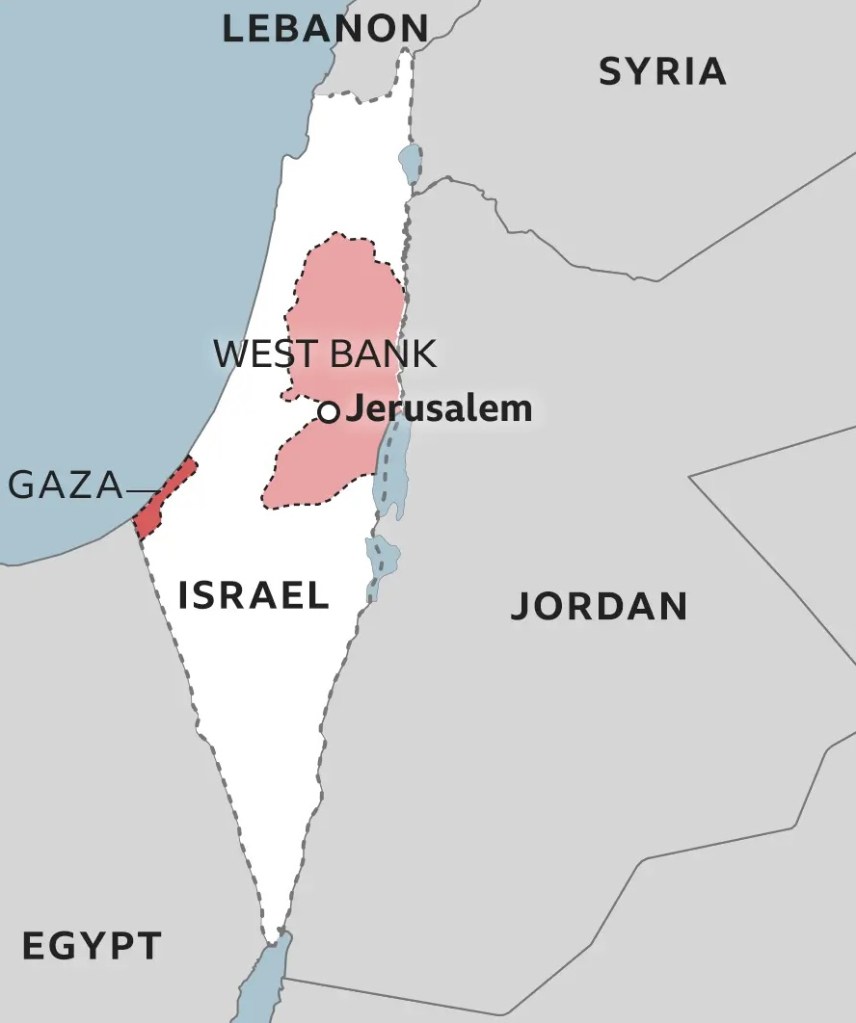
“So then we were to go to Palestine. I can remember we crossed the canal, and we’re waiting for the, there was a train ran up there then. Waiting for the train, and we’re all lined up and we were getting pestered by the natives. “Give us baksheesh George”. Everyone was called George, because it was King George at the time. “Give us baksheesh, George”. “Get away, get away”. And all of a sudden over come a couple of German planes and they just scattered and we stayed there.”
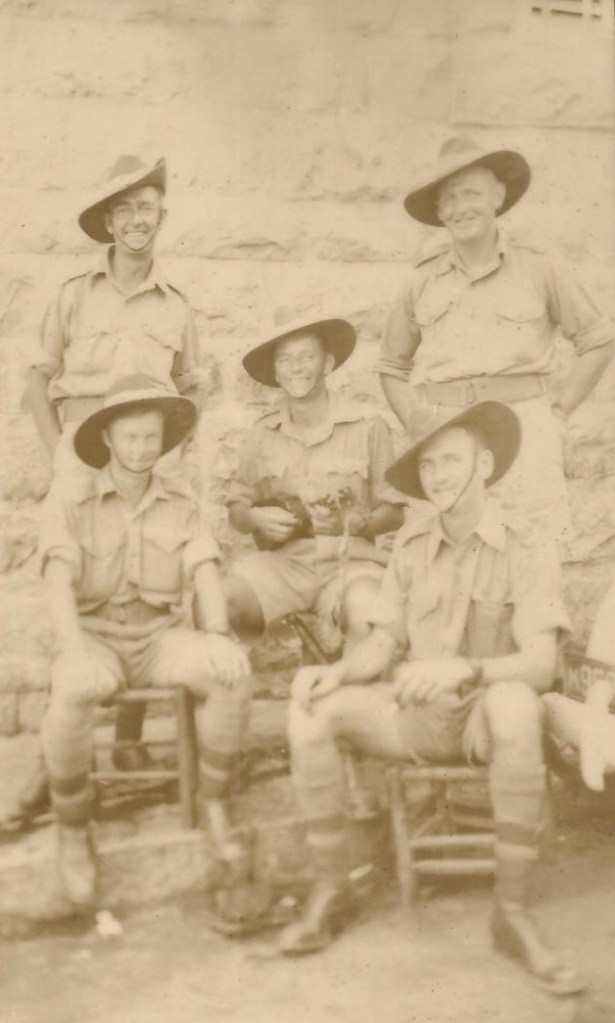
“Any rate we went up to a place called Wadi Sarah and set up our ammunition camp there. Wadi is a depression, like you’d say it was a creek or something like that, not enough to be a river. And if that was in flood it would have flown into the Jordan, just north of the Dead Sea. Any rate we were there for quite a while, then we had to go up to Syria, right. We get on the train, and, where we got in at the station somebody had nicked the Stationmaster’s bell, and there was hell to pay for a while with that. Any rate we got as far as Haifa that night and stayed in the train all night. When we got up in the morning we looked, and in the next carriage, in the next line to us, this carriage is full of ammo. During the night there was an air raid. Well you gotta be lucky.”
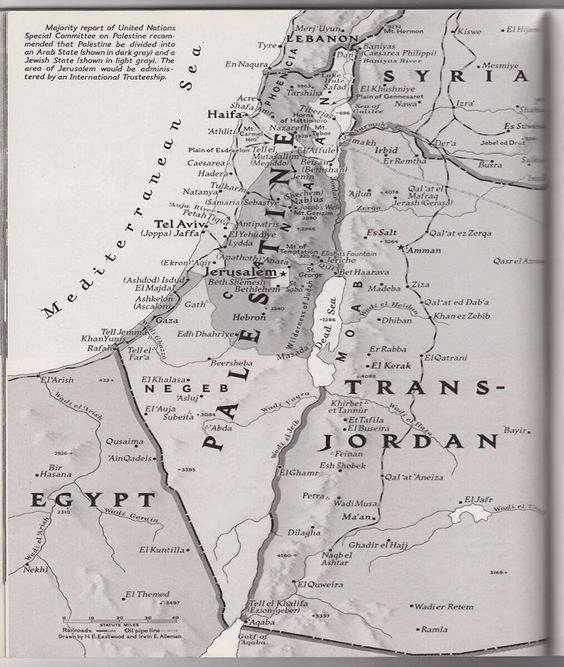
“Yes, any rate, we went by train then, up the Jordan valley, which was very hilly, past the Sea of Galilee, I thought that was lovely, that was where Jesus was from. And past the Sea of Galilee and up to Darrah. That’s right out in the Syrian Desert. And then we came back and overnight in Damascus. That’s where we stayed in the French Foreign Legion Barracks. Concrete floor and one blanket.”
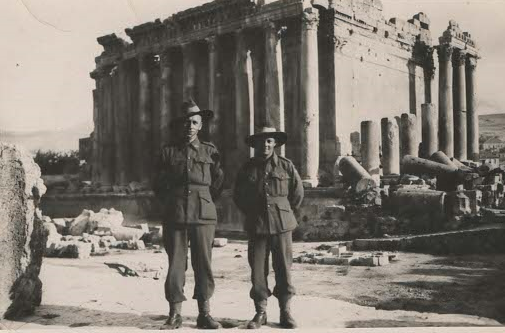
“So the next day we’re off and we finish up going to a place called Talia, which is between Rayak and Baalbeck. And it was there, that was where I had the white Christmas. 1941. Then I got sent down to El Tel el Kebir in Egypt to do another course. A training course. Me and a couple of other English chaps, because we were half English, and half Australian.”
“Well, I was in the Second First Ammunition Company. Our company had a dump at Wadi Sarah, and then we went up to Syria and this was at Talia. There was others that had a dump at Aleppo. See you split the company up. There was some at Beirut and Tripoli, on the coast. So any rate, I went down to, back to El Tel el Kebir, for my course. But when I came back, our unit had already been on the way back to Australia. So the English Commandant said to me, “Now you can join with us or we’ll send you on and catch up with your unit”. I said, “I’ll go and catch up with my unit”. Yeah, well all Australians wanted to get back ‘cos the Japs had come in. Yeah.”
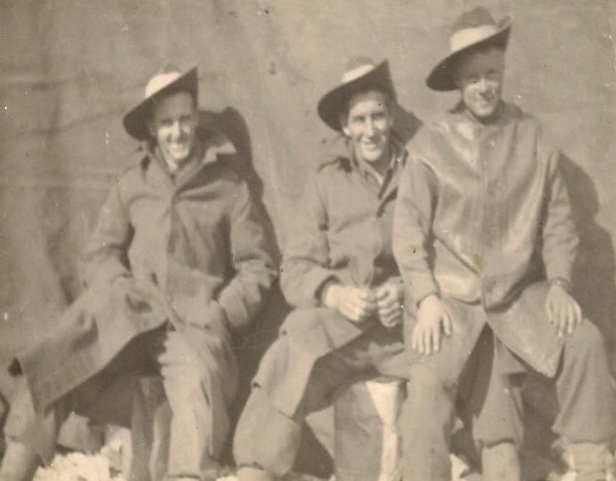
“While we were there, there was a rather humorous incident at Talia. It was very cold. And in our wooden huts, there was only one little heater. And there was a real buck-toothed Pom who used to flog this heater. Any rate, he used to sleep up one end of the hut and he’d have the heater, and we’d be down the other end, cold. Any rate Freddy Slater, poor old Freddy’s dead now, he was one of my good old mates, he had been to the canteen and got a few in and he came in. He said “Right, we’re gonna have that heater”. So he went up and he got it and brought it back and the old Pommy was carrying on. Any rate, just while they’re in the middle of an argument in come the orderly sergeant, who makes everyone set down for the night, you know. Any rate Fred got, he got mad and he wasn’t going to give up this heater. The sergeant said, “Consider yourself under arrest Fred”. In the morning Fred’s up before the Colonel. Colonel McVicker was the Colonel and he was an Australian. And Fred was on 5 charges, you know, so McVicker thought, “This is ridiculous”. He had to find him guilty, so he fined him 5 shillings for 5 charges, a shilling a charge. That was easy.”
“Any rate I said, “Alright I’ll go and catch up”. And I caught them up at a place called Barbara, down in Palestine. And from there you went to the boat to take you home. You had to march, with all your pack on through the sand. Ooh it was hard, yeah. I can remember Kenny McCance, one of our other mates, he wasn’t gonna carry all his blankets, so he put it in another bloke’s pack. I think Charlie Leigh was his name. If Charlie had have found them he’d have killed him!”
Back home to Australia
“Then we came back and we were supposed, talk about luck, I was lucky all the way through. We were supposed to be going to Java, which is now Indonesia, because the Japs were coming down. And we were held up in Colombo Harbour for quite a while. I don’t know how many days. Of course then they changed their mind, so we come back to Fremantle. Overnight in Fremantle. Oh, it was lovely coming across the Indian Ocean and seeing the first sight of land, which was Rottnest Island. Oh, this was when you thought of Walter Scott, “Breathes there a man with a soul so dead, who never to himself has said, this is my own, my native land, whose heart has ne’er within him burned, as when homeward his footsteps he has turned from wandering on a foreign strand”. Any rate that was it.”
“So then the next morning we set off and we come into Adelaide. There was a couple of blokes that went AWL and didn’t catch the boat and they got picked up and they got fined 5 bob and 28 days in the boob. 28 days. There was Martin Clancy, an Irishman with us and he missed it, but he went and paid his fare over from Perth to Adelaide, but he still got his 28 days because he was AWL.”
South Australia – dust and weddings
“Anyway, so then I went up to Terowie, which is up north of Adelaide, just south of Peterborough. But why we had it at Terowie, there’s nothing at Terowie now I believe, was there was the railway line that went over to Broken Hill or you could go up north. The idea with the ammunition dumps was to have them so that whichever way it’s needed you can send it that way. So that’s the way it was.”
“We were there for about 6 weeks, in the red dust. I think there was 1 shower and you were lucky if you got in the end of it, if you’d get a bit of water. But that was beside the point.”
“Any rate one of our chaps got married when we was over there and I went, I got invited to the wedding, up at Peterborough. We had a good day, yeah.”
Heading up north to Queensland – goats, flying foxes and scrub turkeys, but no bananas or pineapples!
“Any rate one Sunday morning they called us out on parade, a few names were called out, you were going to Queensland. We thought, “This was good, bananas and pineapples, that’ll do us”. So we get on the train to Melbourne. I think they gave us 2 days leave. My parents came down from Bendigo. Then up north – a day to Sydney, a day to Brisbane, 2 days to Townsville. Thought, “Oh, haven’t seen too many bananas and pineapples yet”. So we head out west and the next Sunday, it was a Sunday morning we arrived at Hughenden. Got out of the train and all that meets us is a herd of goats. No bananas or pineapples in sight!”
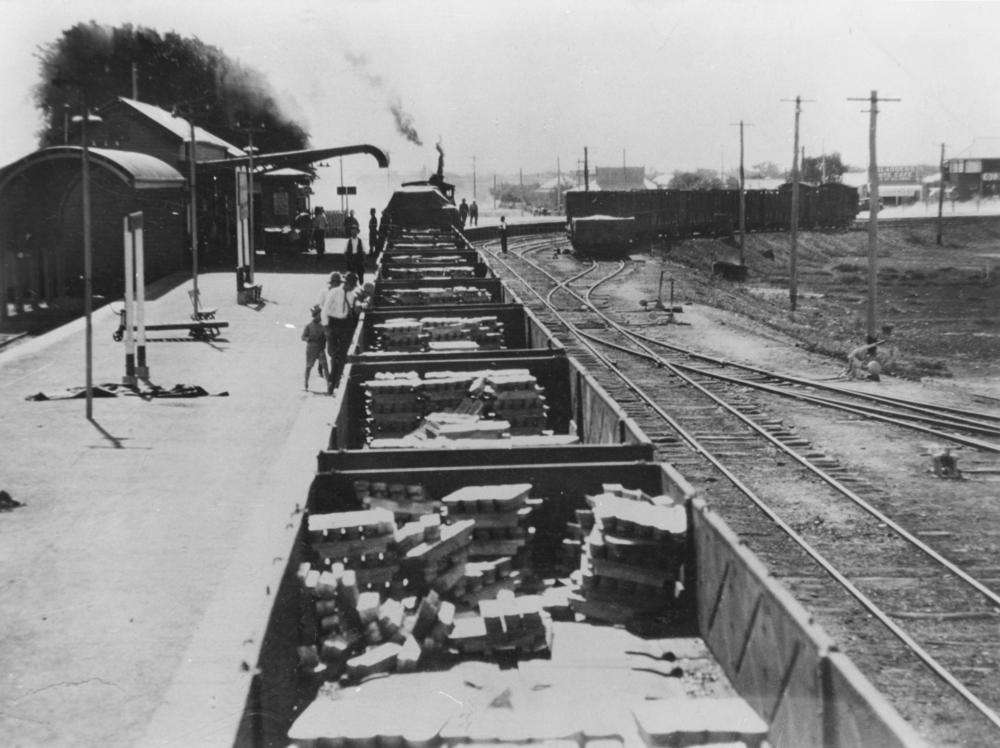
“So then we set up our ammo dump, up the creek. I think it’s part of the Flinders River, I think, or it’s a tributary of the Flinders River. It was a very nice place. It was very interesting, because we’d never seen anything like it. Flying foxes in the trees and scrub turkeys.”
“Well it was on this creek where there was plenty of water, you see. We dug into the creek and got nice fresh water. Any rate, we had our dump there. We used to go into town and we were the first returned soldiers in town, so we were it. Absolutely.”
Racehorse owner for a day
“That’s where I became part owner of a racehorse. They had a race day, so they said, “Well, you can buy the horse for the day”. Well there was Brown Eagle. I think there were 7 of us put in 5 bob each and bought Brown Eagle. Thirty-five bob. Any rate, one of our blokes had been a bit of a jockey. He didn’t have much of a hope because you could see the professional jockeys were all working it out, who was going to win before she started. I think poor old Brown Eagle came about third last. We had to back it on principle. Any rate that’s the day I was part owner of a racehorse. Yeah.”
“Then we decided we’d have to shift the ammunition dump a bit closer to Townsville. It wasn’t that far, that was just between Hughenden and Prairie. But there was a railway siding, and that was good. And of course the thing was you had it there so you could of gone north up towards the Gulf, or sent it out to Mt Isa. ‘Cos Mt Isa would have been a place worth defending. At that time they didn’t know where the Japs were going to come and land. And had they not been defeated in the Battle of the Coral Sea, they really expected the landings around about Cairns or Townsville. Oh yes, at that time there was talk of a Brisbane line. If necessary they were prepared to, which is ridiculous – you don’t give them an inch of the country. So we were there for quite a while.”
Raining fish
“That’s where I saw it rain fish, yes. It rained fish. In the tropical storm time they tell me that the spawn is carried up in the air, and by the time it comes down there’s little wee fish. We saw that in the drains we had around our tents. In the water there was all these little fish.”
“I saw a lot of ironstone ridges there. See the lightning jump from one ironstone ridge to another. We had some ammo close to them but we were lucky we had it in wooden boxes and not tin boxes.”
Dutch New Guinea – bully beef, the arrival of the Americans and touch rugby
“Yeah, so from there of course, we were going to Dutch New Guinea. We didn’t know where we were going. And then we went up, not all of us, there were only some, and some stayed there.”
“We went up to Cairns, to wait for a Dutch boat. It was still Dutch territory so we had to wait for a Dutch boat, the old Vanderlinden she was. Luckily we had our mobile cookhouse strapped to the deck and we could have our own tucker.”
“And we waited, I think, about a couple of weeks I think, waiting for this Dutch boat. ‘Cos up there we even got paid in Dutch gilders, because it was still Dutch territories, you see. Well, there wasn’t much to buy. You didn’t get, well we did get a canteen, and as things went on it got better. But for the first 3 months we camped on the ground and never had a taste of bread. Bully beef and dog biscuits. Yeah, it was pretty rugged actually.”

the Maro River.
“But see the Dutch, although it was Dutch territory, it was nearly all Australian troops there. The 11th Brigade, part of the Independent 11th Brigade. But then they built an airstrip and that’s when things changed.”
“’Cos before the Japs could come over unhindered,and before planes could get from the mainland, they’d be gone back again. They used to come from the Aru and Tanimbar Islands, as far as we were given to understand. And that’s where they were also bombing Darwin. Because this was in the Timor Sea,these islands.”
“But once they built the airstrip we got the CBs, Construction Battalions of the Americans. A lot of them were Negro chaps, and they were good, because once they come they had good tucker and we could go over there and get a feed. Yeah. And one amusing thing I know where, ‘cos we had their ammunition, you know, ammo for them. And I remember that one day one truck came up with a couple of native fellas and we were ready to load it up, we’ve got the ammo dump there. And a bloke gets out and he’s directing his mate with the truck, “Come back mate, come back mate, come back ‘til you feel something”. We thought, “Well, we wouldn’t back a truck into a stack of ammo!” “But they did and they got away with it.”
“We went up in ’42 and I came back in ’43. They sent me back in ’43 because they needed somebody down at Jacky Jacky – that’s the tip of Cape York. I had 13 months up there, yeah.”
“That’s where I had me ankle broken, playing rugby. That was good. Well they were nearly all Queenslanders and us Victorians, we’d never played any rugby. They said, “Will you have a go?” “Oh, yes we’ll have a go”. I said, “What have you got to do?” The Captain said, “Well you go five eighth”. I said “What’s that?” He said, “Well the half back takes it from the scrum and he hands it, he passes it to you and you go for your life.” So I went for me life and I wasn’t as smart as I thought I was, and 2 big blokes caught me and down I went and it cracked like a stick!”
“By the time I’d hobbled off to the sidelines, she was up like that. Into hospital,11 weeks. But I was lucky because the Airforce had a field hospital there. ‘Cos we didn’t have a field hospital there, because there wasn’t that many Australian Army troops, because mainly it was going to be an Airforce base, which it was, to bomb the Japanese. Any rate, eleven weeks in hospital.”
Back to Northern Australia, marriage and the honeymoon.
“Then I went back to Jacky Jacky. I was there about 4-5 weeks, I suppose, a couple of months, and they decided to set us up over in Thursday Island. Then I went up to Thursday Island, I think I had about 6 months there. And by that time the Japs had been pulled back enough that they could do without those places.”
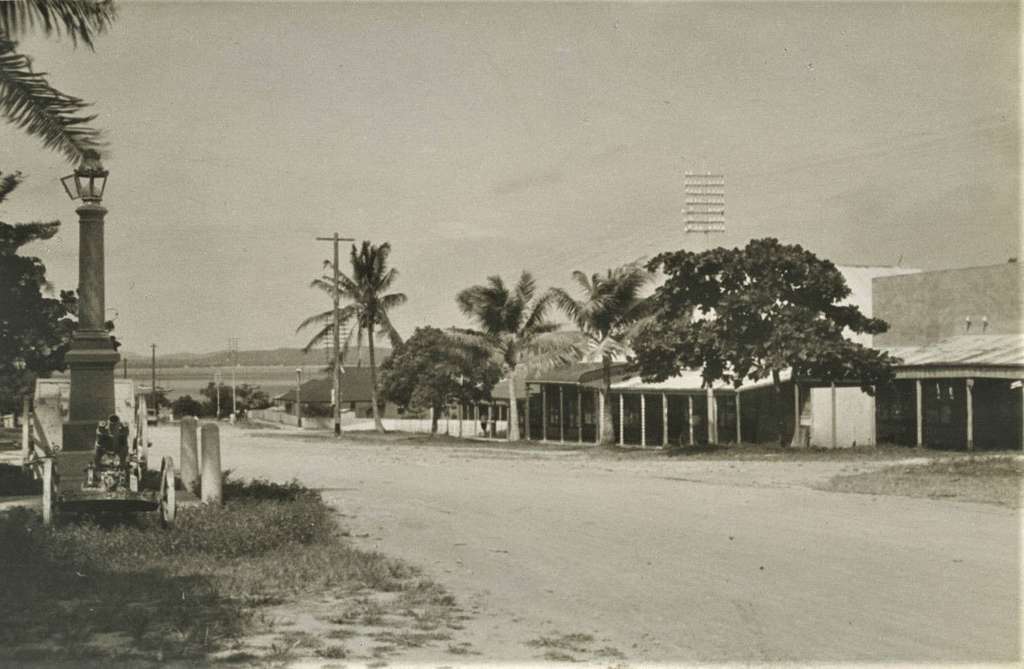
“And I remember the Captain and I, the Captain and I went up to the Tablelands and we shifted across to Thursday Island. And as soon as I arrived there, Captain Yates, from Brisbane, was the captain. Algae, ‘cos you called him his initials, L.G., so we called him Algae. Any rate he said to me, “How long since you’ve been on leave?” And I said, “Eighteen months”. But I think he was at Victoria Barracks in Brisbane, so he probably went home, if not every night, he went home every weekend. So I went down on leave and that’s where I met your Nan.”
“I met her at my brother’s place. Up in View Street. She worked with Dorrie and my brother, Bill, at the egg floor. I hadn’t seen her before and when I walked in, I thought, “That’s the girl I’m going to marry”. Yeah, amazing, but that was it.”
“I had her photo up near the bunk, up at Thursday Island, and a great mate of mine, Rusty Franklin from Mackay, we were great friends. And he’d get up in the mornings and he’d say, “It’s alright, she’s still smiling.” Yeah, I tried to contact Rusty, but no one seemed to know where he was. He was a good bloke.”
“So I come back to Thursday Island and after about 6 months was up, we went down and folded her up and I come home and that’s when we got married.”
“We were going to go to Tasmania for our honeymoon. We could have got there but there was no guarantee that we could get back. You only had so many days leave, so we went to Geelong. Honeymoon at Geelong. Caught the train down and back. Nice hotel, yeah. The hotel was good, that part of it was good. But we would have liked to have gone to Tassie, but travel was restricted. You could have got over there but there was no guarantee we could have got back in time. And if I hadn’t got back in time I’d’ve been AWL. And I would’ve had 28 days in the boob. We went in the train to Melbourne first and stayed overnight in Melbourne. We went to one of the hotels that was nearby, near Spencer Street and then caught the train to Geelong.”
“And, going back North again, about half way up and all the whistles started to blow and horns to toot. The war was over. Which was lucky for me because when you were married you got more points towards discharge than a single bloke. We didn’t realise that, but any rate that was good. Yeah.”
At the end of the war
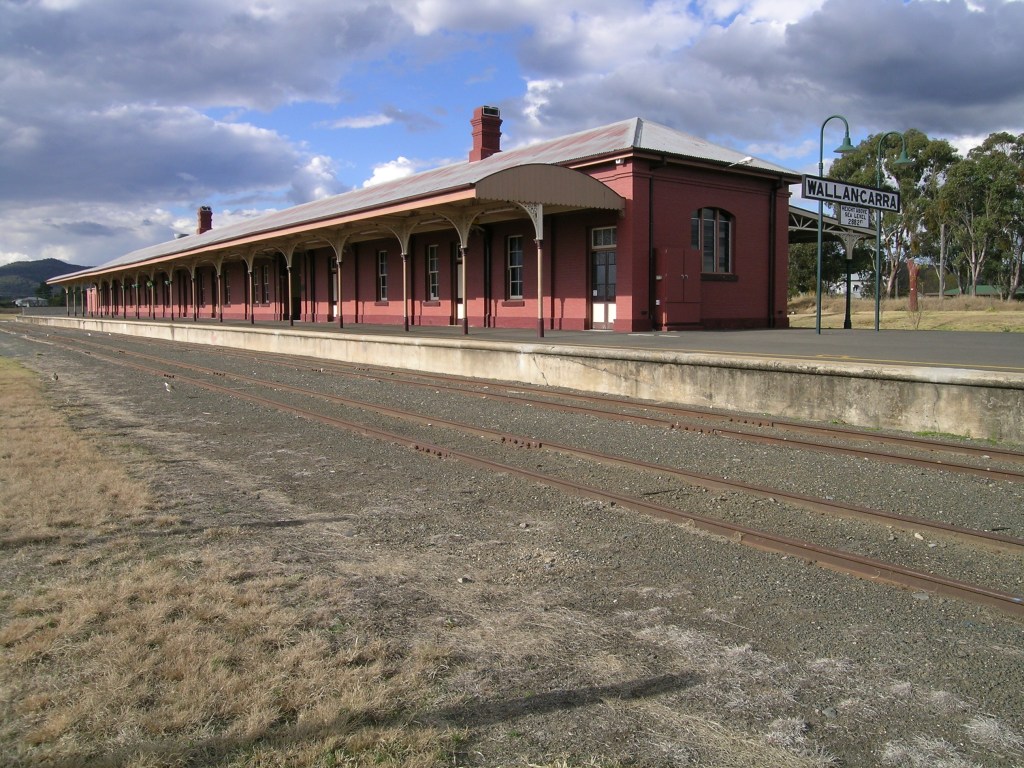
“We went to a staging camp outside of Brisbane and then I got sent down to Wallangarra, which is on the New South Wales, well, Wallangarra’s on the Queensland – New South Wales border. Yes it would have been a couple of months, because this war ended in August and I got discharged in November, the 8th of November 1945. I got discharged, yeah. Dad’s Birthday. And that was that.”
~ ~ ~ ~ ~
Who’s Who?
It is wonderful to be able to meet all sorts of cousins, hear their stories and determine the relationships.
Marilyn is a 3rd cousin of Vicki’s, so naturally she is also a 3rd cousin of KJ, Karen, Debra and David. She is also a 3rd cousin of Alison and her siblings.
Frances (Miles) Nelson and Marilyn are 5th cousins, twice removed.
Marilyn and Major Miles are 3rd cousins once removed.
Frances (Miles) Nelson and Major Miles are 5th cousins, three times removed.
 miles of irvings
Leave a comment