
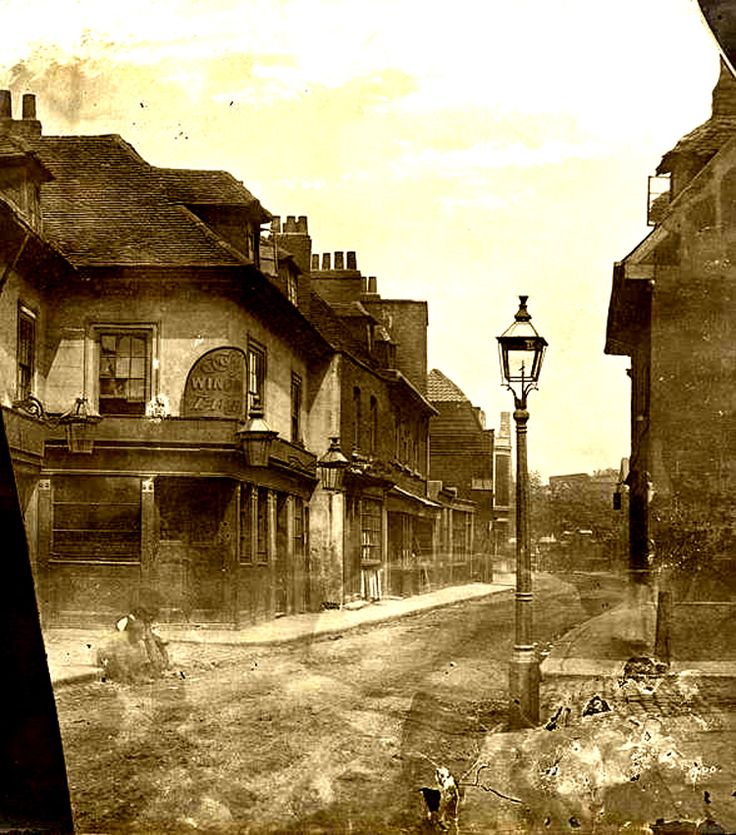
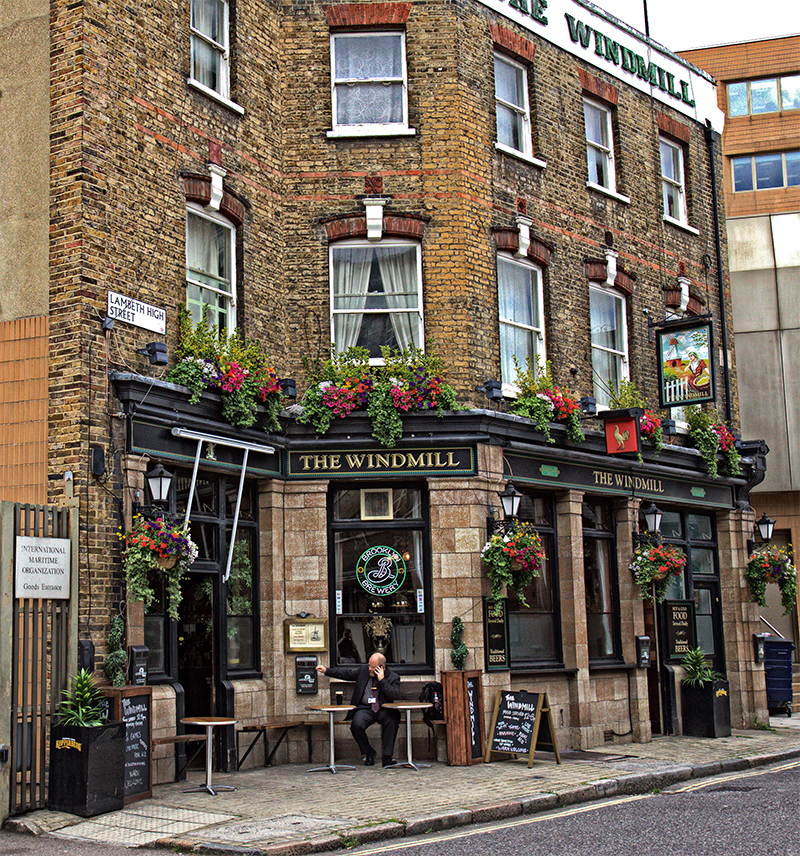
This is the story of “The Sign of the Windmill” a pub in Lambeth that Roger’s ancestors were closely linked, about a block from the Thames and still operating today.
In September 2016 we based the London part of our England/Scotland trip at The Vauxhall Suites, apartments across the Thames from the Tate gallery (Vicki’s favourite), close to the underground and quite central to the things we wanted to do and places we wanted to see. What we didn’t know was that we’d be five minutes’ walk from the Windmill Pub in Lambeth and that we had a family connection to the pub!
Rosemary Crook, our Southampton cousin from the Lovesey side of the family, sent me some information on London connections when she heard that we were going to be visiting England. I’ve already written a small piece about “The Fox Under the Hill”, the pub mentioned in two of Dicken’s books just below The Strand. Both the Lovesey’s and William Hambly lived in Lambeth in the first half of the 19th century.
Rosemary’s note said: “Lambeth High Street – Samuel Lovesey, brother of Thomas was Victualler of The Windmill ( rebuilt in 1860’s)and he also owned other properties there until his death in 1837. He mentions Thomas and his children, all named, together with his brother John’s (died 1809 )children in his Will.
Salamanca Street, Lambeth – Samuel William Lovesey b.1843 was living here when he was killed in a Hansom cab accident in 1885. (Old) Paradise Street, Lambeth – Samuel William’s children John and Annie were living here in 1901 Census.
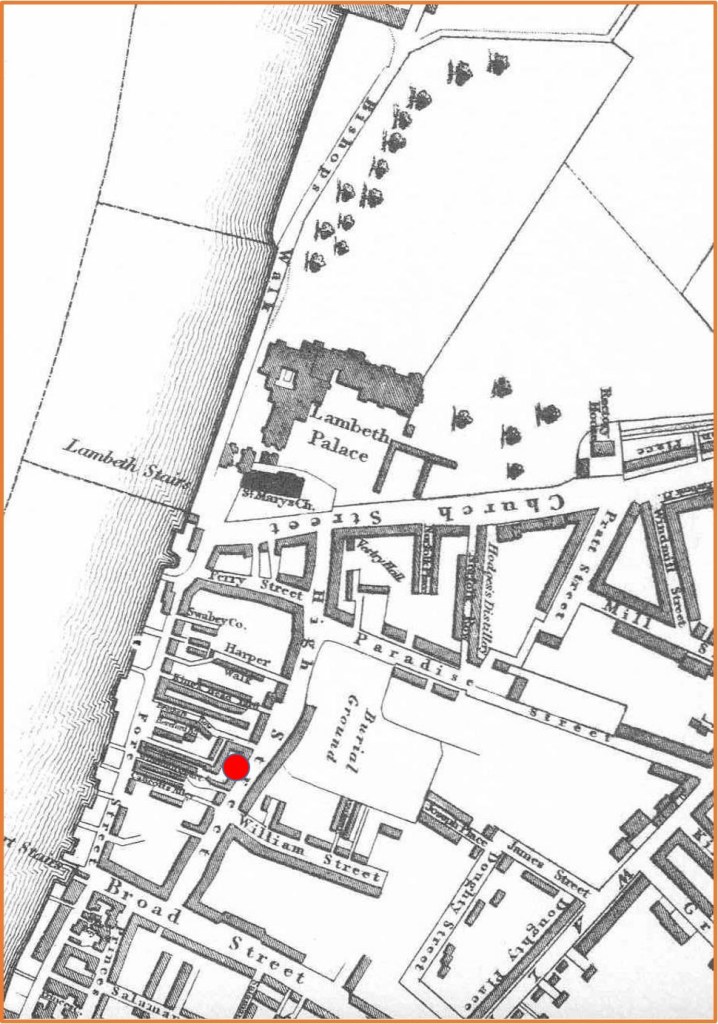
A brief history of this area across the Thames from Westminster: Lambeth is an ancient south London district bordering the Thames opposite Westminster, the name probably meant that lambs were offloaded at a landing place here, although others suggest that it is a corruption of ‘loamhithe’, and thus refers to the muddy nature of the landing place. This was the spot from which archbishops of Canterbury took the ferry across to Westminster and it therefore made an ideal location for their London residence.
The archbishops were lords of the manor of Lambeth from 1197 and soon afterwards built a chapel and a residence on the riverside. Until the early 19th century much of north Lambeth (now known as the South Bank)was mostly marsh. The settlement of Lambeth Marsh was built on a raised through road over the marsh lands, potentially dating back to Roman times. The land on which it stands was owned by the church of England, with Lambeth Palace nearby. Records and maps show that it was a separate village until the early 19th Century when the church sold off the land in small pockets, thereby leading to random development of individual houses rather than the grander redevelopments occurring north of the river.
The land was flat, partly marshy and poorly drained by ditches, and only started to be developed with the draining of Lambeth Marsh in the mid-18th century but remained a village. Prior to this it provided market garden produce for the nearby City of London. Westminster Bridge was opened in 1750 and marked the beginning of any major development in Lambeth. Until the beginning of the 19th Century Lambeth Marsh was surrounded by open fields, and the farming assisted by many windmills. Swamp drainage and reclamation works during the rise of the Industrial Revolution enabled factories to be built, such as Maudslay’s Ironworks, Doulton pottery, printers, engineers and in 1815, the Bedlam Hospital. Vauxhall Bridge and Vauxhall Bridge Road were opened in 1816.
Within a few years a warren of streets had surrounded the Palace and filled the former Lambeth Marsh, providing housing for a rapidly growing workforce. Residents worked at the wharves and boatyards on the waterfront as well as being absorbed into the factories and associated distribution networks now being established. By 1824, most of the cultivated land had been built over. Waterloo station was built in 1848 and completely changed forever Lambeth Marsh’s relationship to its surroundings. The sheer scale and proximity of the railway created a barrier between the riverside streets and the rest of the Lambeth Marsh.
Although other bridges existed nearby, ferries continued to provide the most direct means of crossing the river until 1862, when a suspension bridge connected Lambeth Road with Westminster’s Horseferry Road. Soon afterwards the construction of the Albert Embankment erased many of the riverside yards, while helping to protect the area from flooding. Lambeth Palace now found itself set well back from the river.
The Lovesey’s became well entrenched in Lambeth, Thomas (Elizabeth Hambly’s coal merchant husband), and his brothers John and Samuel, as well as William Hambly and their families, all lived in the area even though the Adelphi wharves, where the coal trade was conducted, was on the other side of the Thames. The rapidly growing residential and commercial region would have provided all sorts of opportunities for this extended family that included a publican & property investor, coal merchants and over time transport workers.
Samuel Lovesey, brother –in-law of Elizabeth, was married to Frances, who was 5 years older than him and took over the Windmill in 1817. It appears that Samuel was a good businessman, not only having many successful years with “The Fox Under the Hill” but operating the “Sign of the Windmill” as the Lambeth area started to grow rapidly. He also invested in properties in the area and was the executor of his younger brother’s will (John Lovesey died in 1809). Samuel died in February 1837 at the grand old age of 75 and I think that he must have known his end was near as his will was made out in August 1836. His will is testament to his business acumen and his generosity to family. He makes provision for his wife, his brother Thomas, his nephews, nieces, godson; and his wife’s nieces and nephew to the tune of more than a thousand pounds. The will also indicates that he had a business partner, a John Lawrence, who was to have the right to buy out Samuels share of their business enterprise. It is also obvious through the wording of his will that Samuel was an active victualler right up to his death.
The Lovesey’s were living in Lambeth through the 1820’s and early 1830’s living at both High Street (the same street as the “Sign of the Windmill”) and William Street, which was the same street that William Hambly moved his family to in the mid 1820’s after initially living close to The Strand. William Hambly moved back across the Thames in 1830 and the Lovesey’s were living below the Adelphi Terraces at St Martin in the Fields in 1836. William had moved back to Cornwall in the late 1830’s and the 1841 Census shows the Loveseys still at Adelphi. By 1851 the Loveseys are all in Lambeth, this time living at James Street. Old Paradise Road and Salamanca Street were also addresses that the growing family moved to.
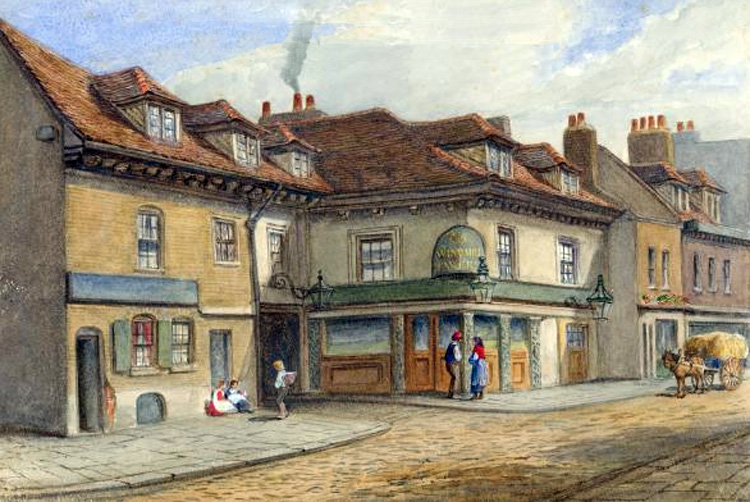
The “Sign of the Windmill” was completely rebuilt in 1860 but none of the Lovesey brothers’ descendants were tempted to make a career of victualling. They grew & expanded, as families do; and thrived in Lambeth, Southbank, Middlesex and other parts of London.
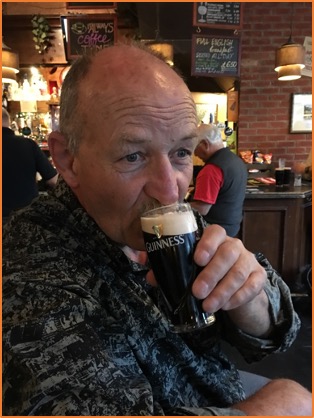
We dropped in to the Windmill a few times while we were in London, taking in the atmosphere and imagining a time when perhaps WSR was in town to see his Uncle William, his Hambly cousins, his Aunty Elizabeth and old Uncle Thomas Lovesey and the Lovesey cousins; catching up with family gossip and London scandals, sharing dreams of overseas adventures and possible fortunes to be won. He may have even attended Samuel Lovesey’s funeral in 1837. In any case, the “Sign of the Windmill” would have been worlds away from his mining life in Cornwall, from travels across America and the voyage to Australia. Perhaps they shared a quiet libation out the front of the pub, or like me, accepted the Guinness sales managers offer of a tall glass of refreshing stout.
Lambeth and Vauxhall played a very big part in our ancestors lives. Samuel Lovesey and his pub, the “Sign of the Windmill” were very central to the Lovesey’s lives.
 miles of irvings
Leave a comment