Rosemary Crook is another cousin of ours with a great Ancestry Tree “Lovesey Family Tree”. She is also a descendant from my 4th Great Grandparents, David Hambly and Mary Sandoe, through a Londoner, Thomas Lovesey who married Elizabeth Hambly (my 3rd Great Grandfather John Hambly’s older sister) in 1813. Thomas Lovesey was in business with another of John Hambly’s siblings, William. They were involved in the London coal trade, operating from the Adelphi Wharf, just below the Strand. Rosemary and her husband Reg are now fully retired and live in Southampton. When she knew that we’d be staying in Vauxhall back in September 2016, right next to Lambeth, where the Lovesey’s lived during most of the 19th century, and that we were interested in chasing down any “family history” aspects of the area she sent me the following:
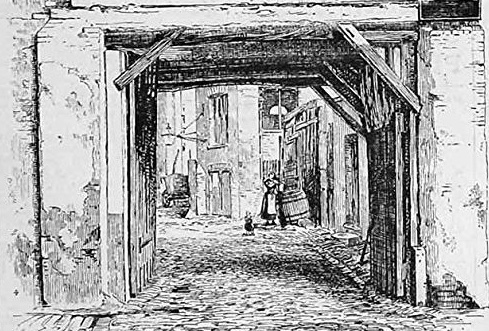
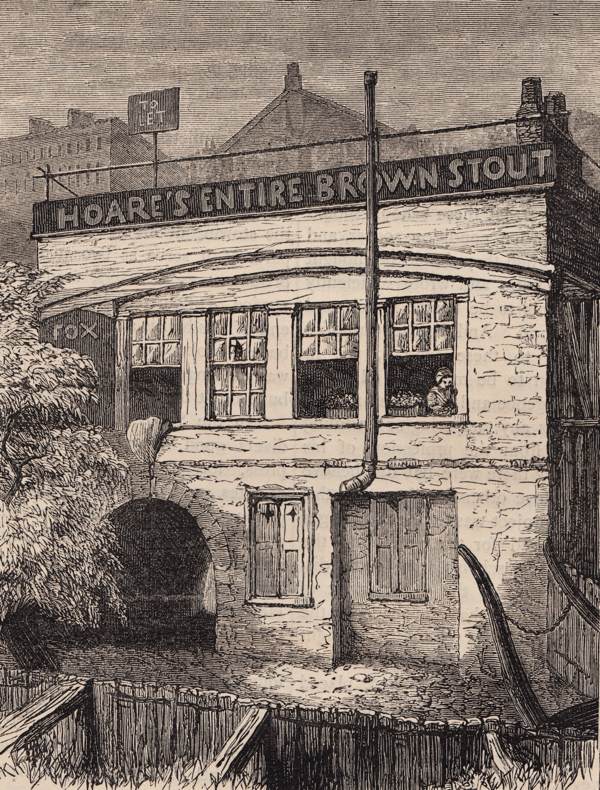
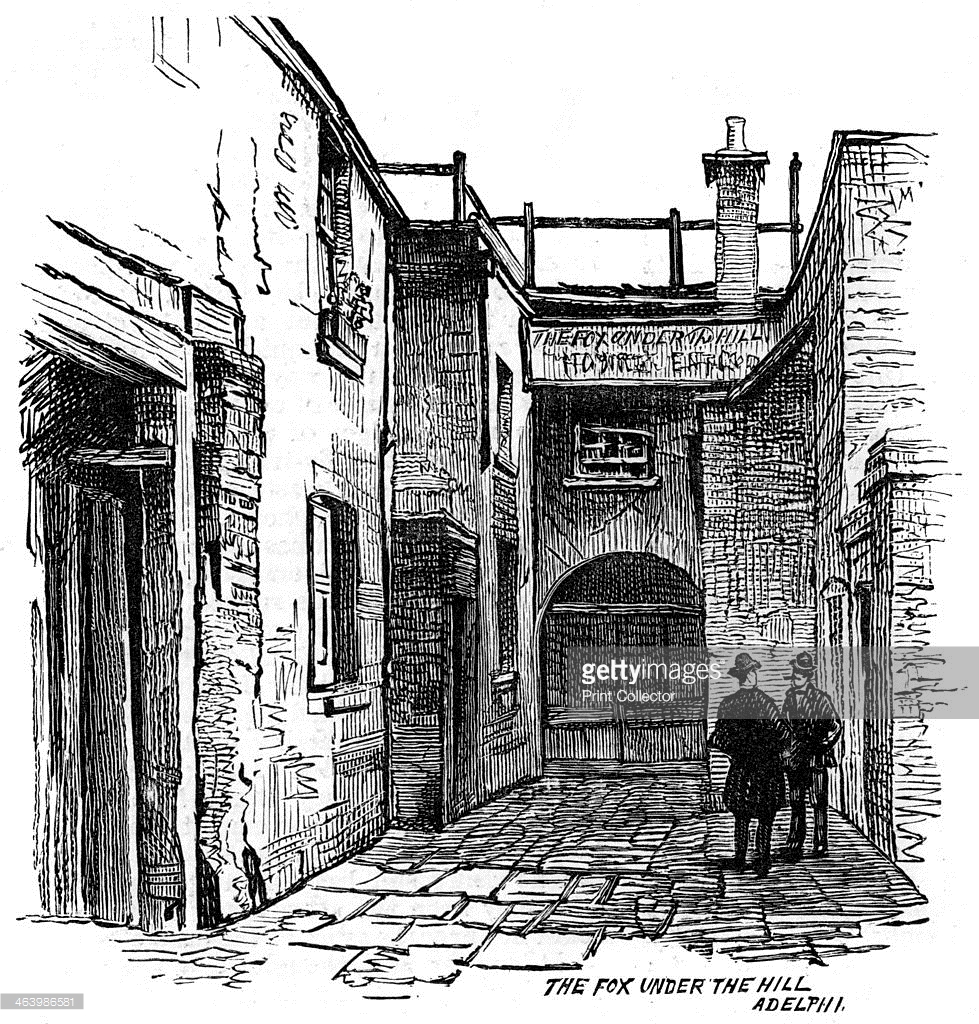
“The Royal Society of Arts in John Adam Street off of the Strand, is the only part left of what was Adelphi. Ivybridge Lane which is an alley next along to Adam Street, blink and you would miss it. At the end of this was the Fox Under The Hill, where Samuel Lovesey was the Victualler in 1796. It was mentioned in David Copperfield and Pickwick Papers.
Lambeth High Street – Samuel Lovesey, brother of Thomas was Victualler of The Windmill ( rebuilt in 1860’s) and he also owned other properties there until his death in 1837. He mentions Thomas and his children, all named, together with his brother John’s (died 1809 ) children in his Will. Salamanca Street, Lambeth – Samuel William Lovesey b.1843 was living here when he was killed in a Hansom cab accident in (Old) Paradise Street, Lambeth – Samuel William’s children John and Annie were living here in 1901 Census.
Sadly, James Street, Lambeth is no more.
I do hope this is of some interest.
All the best to you and Vicki.”
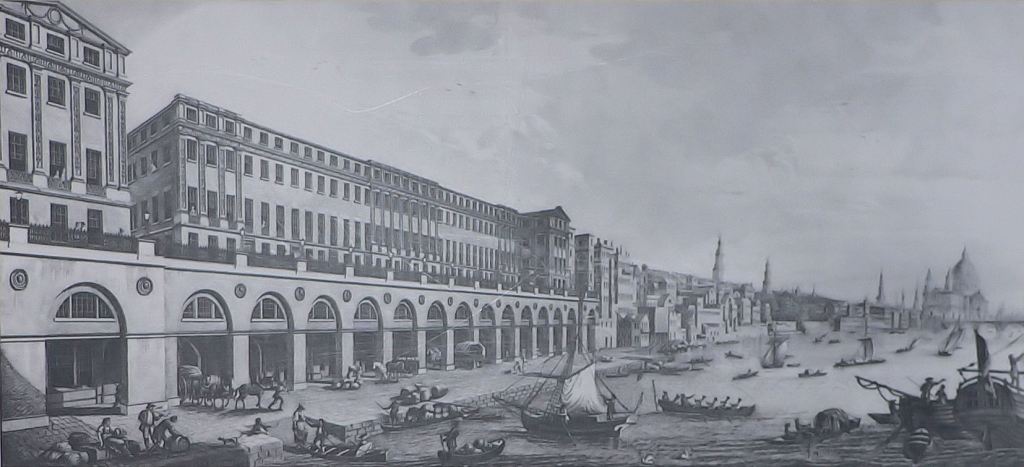
Where to start? Part of the Adelphi building, behind what was the Adelphi wharf is still standing! It is across the river from where we are staying, about a 20-minute walk away, and just up the road, maybe 5 minutes’ walk is the Windmill, so that old London pub will be for another day!
To assist us in this adventure, I found a small booklet called “London’s Hidden Walks Volume 2” at the Charles Dickens Museum. Many of the Lovesey’s lived, worked and died in and around the Strand, from Charing Cross to Drury Lane which was where Dickens also lived, worked, wrote and died. As Dickens books testify, this part of London was nothing short of a slum, conditions abysmal for a population trying to come to terms with a changed world created by the Industrial Revolution.
The Adelphi buildings comprised 24 neoclassical terrace houses furnished to the highest standards of the time and were built between 1768-72. “Adelphi” is Greek for brothers and they were Scottish born designers & developers. John, Robert, James and William ADAM were responsible for designing a number of London’s finest buildings in the 18th century.
But by 1827 a massive new landmark has been erected: The Waterloo Bridge, built to commemorate England’s great victory over Napoleon. Interestingly, the laird of Tregavethan, Richard Hussey Vivian, led the decisive cavalry charge on the fields of Waterloo: I wonder if Thomas Lovesey and William Hambly spoke of this, (and their brush with the law when caught stealing chickens in Truro in 1816) whilst enjoying a quiet ale in Samuel Lovesey’s old pub, The Fox Under the Hill, after a day of coal heaving on the Adelphi wharves?
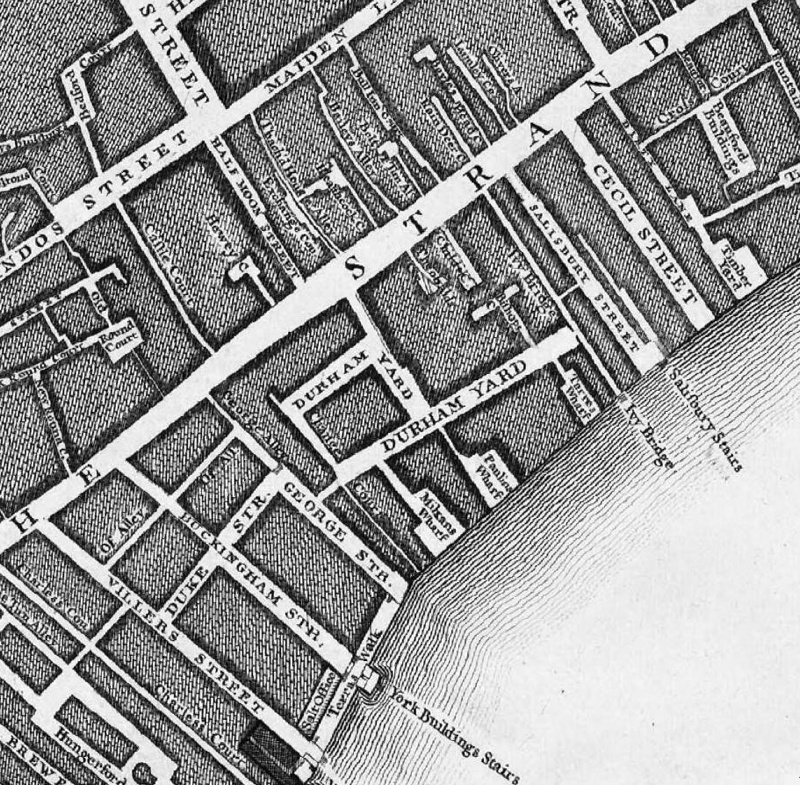
By 1897 the Thames looked a lot different. Between 1865 and 1870 a northern embankment and sewer was built between Westminster Bridge and Blackfriars Bridge. In 1874 a series of gardens were created on the reclaimed land on the inward side of the roadway. The section between Waterloo Bridge and Hungerford Bridge was called the Adelphi Gardens (now known as the Main Gardens). The Hungerford Bridge was built in 1864 to link the new rail line between the two sides of the Thames. Charing Cross Station was built on the site of the Hungerford Markets. One landmark remains: the Buckingham Stairs, (York Stairs) now called Yorkgate sits in the gardens, in its original position but now 137 metres from the Thames. Cleopatra’s Needle was installed in October 1877.
As I was looking for drawings & pictures of Adelphi and the Fox under the Hill I came across a blog called “The Grammar of Matter” and noticed an entry made in June 2014:
“concerning a long-lost London pub off The Strand, situated at the end of Ivy Bridge Lane, ‘a narrow and precipitous passage which was formerly the approach to the halfpenny boats’ (Allbut 1899: 6). Nowadays, Ivy Bridge Lane survives as the service road of Shell Mex House. For a time, the pub was run by Samuel Lovesey, a great-great-etc. uncle of mine 150-or-so years ago, and it was called The Fox-Under-the-Hill : Once the haunt of coal-heavers working at Adelphi Wharf (including a four-times-great grandfather of mine who lived, worked and died there), the site of this vanished Thameside pub is now under Victoria Embankment Gardens, very close to the re-erected Egyptian obelisk known as Cleopatra’s Needle”
And it was quite a surprise to find that the author of the blog was Chris Crook, Rosemary’s son!
I found one more interesting reference to The Fox under the Hill, though I can’t recommend rushing out to get the book.
Loretta Chase is a New York best-selling author: here are “Some historical notes, part of my illustrated guide to The Last Hellion. The characters appear in a number of London eating and drinking establishments, most of which I discovered in the works of Charles Dickens. One interesting place is the Fox Under the Hill. This tavern (not to be confused by others of the same name) was at No. 75 in the Strand and vanished when the Victoria Embankment was built.”
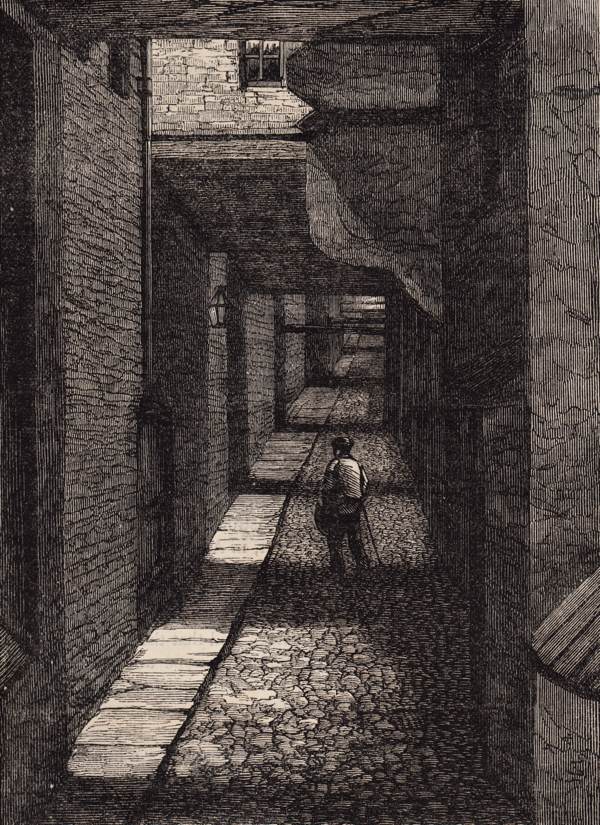
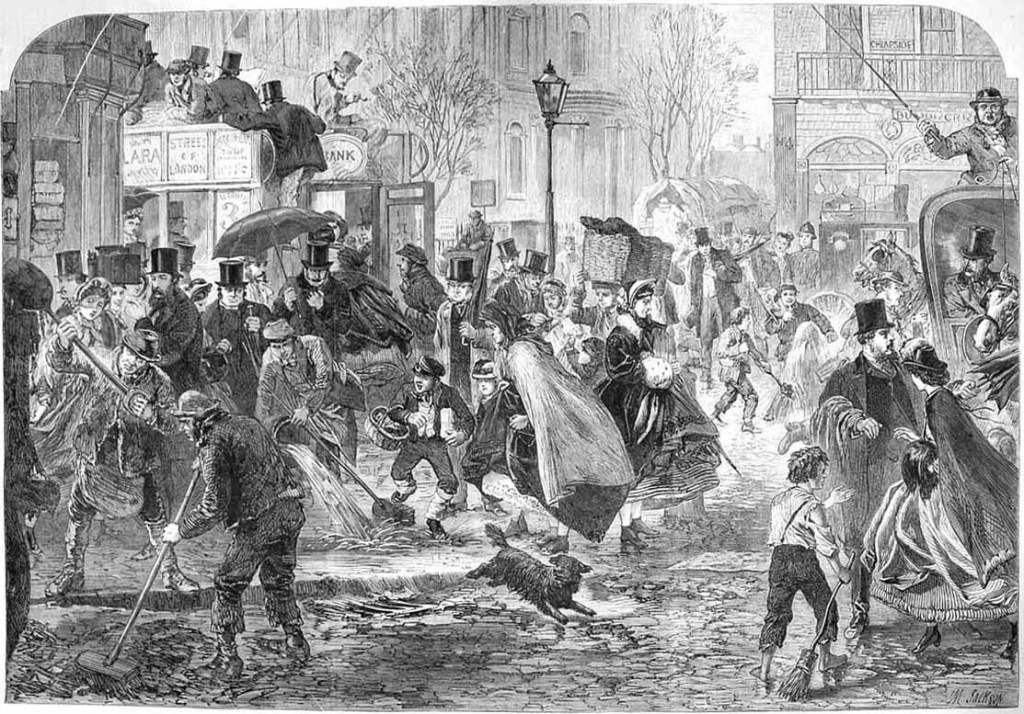
Percy Hetherington Fitzgerald, Bozland: Dickens’ Places and People (1895)
 miles of irvings
Leave a comment