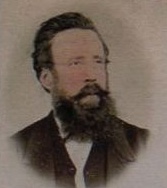
William Samuel Rawling Hambly: born on 31st March 1823 in Kenwyn, just outside Truro in Cornwall; died 1stDecember in Ballarat, Victoria. “WSR” is Roger’s 2nd Great Grandfather.

WSR the 2nd child of John Hambly and Mary Ann Rawling Trudgeon, born in Kenwyn, just outside Truro was like the most of his family a truly remarkable man who lived in remarkable times. His father who I have dubbed “The Don” was a clever mining captain and business opportunist who raised his family on an estate called Tregavethan which was owned by a famous member of the landed gentry, Sir Vivian Hussey, famous for leading the final and decisive cavalry charge against Napoleon’s forces at Waterloo. WSR was initially educated at Trevarth School in Gwenap Parish, looked after by his paternal grandmother as his father had taken a mining captains position in Brazil at the Gongo Socco gold mines. His parents took the eldest, David with them to Brazil leaving WSR and his sister Dee at Tregavethan for five years. Another sister, Mary Ann, and another brother, Josiah were both born in Brazil.
At the age of 14 WSR began his mining and metallurgy education, working with his father in the local mining industry. After three years working in the hard rock mines in the area, he was apprenticed to a drapery, culminating in a year’s employment in Buckinghamshire, probably selling suits and shirts to the gentlemen of London. The family moved from Tregavethan to a small village called Calstock on the southern edge of the Tamar River when his father accepted a position as Mine Captain at the recently funded Devon Great Consols mine on the other side of the Tamar. WSR worked with his father for 12 months then decided to follow his older brother, David to the Americas. David had trained as a metallurgist, dabbled briefly in local Cornish politics, married and was in Dubuque, Wisconsin, working for an English company extracting lead from the area near the Great Lakes.
WSR sailed from Plymouth to Quebec, Canada in 1846 and initially prospected for lead before settling in Dubuque for 5 years, demonstrating the family business acumen by starting a beer and cider outlet. Around this time, his brother, Josiah, also left England and joined WSR and David in Dubuque.
David Hambly was approached by a small group of men who gave him a sample of gold bearing ore that had come from the ranges beyond San Francisco in California. Leaving WSR and Josiah to look after his family and business, David, with a few companions rode overland to California on horseback to see first-hand the land and the possibilities that was to become the Californian Gold Rush. Satisfied that there was plenty of ore and business potential, David quickly returned to Dubuque, packed up his family, sold his property and led a wagon train from Wisconsin to California. WSR was left to finalise the family’s business with the plan that he follow them by sailing from New York to Nicaragua, crossing Nicaragua by land and boat, then taking another ship up the west coast to San Francisco. However, tragedy and bad luck struck the Hambly family: Josiah died of cholera on the wagon train trip to California; and WSR was shipwrecked south of Acapulco on the Mexican coast. Unhurt and anxious to join his brothers in California, WSR couldn’t immediately find passage on another boat – the Gold Rush ensured that all boats were fully booked and at outrageous cost. WSR tried stowing away but was discovered and thrown overboard. He finally reached San Francisco, found his brother David, learnt about Josiah’s death and as well as helping David start his claim, he began selling beer and cider in San Francisco.
WSR stayed in California for the next 18 months as David’s mine grew with continual success, but he received word from his father John, back in Calstock, Cornwall telling him to leave everything in California and get down to Victoria, Bendigo specifically, where huge gold finds had been made. So, in early 1853 he found passage on a small Italian boat, the “Destruzione” which sailed into Sydney via Tahiti in August 1853. From Sydney he went to rural Victoria, around the Bendigo region and participated in the rushes at Creswick and Fiery Creek, apparently doing very well for himself.
A month before WSR landed in Sydney a twice widowed Devon woman, Lucy Upcott Rundell arrived in Melbourne on the “Euphemus” with her four young daughters and one son, aged from 3 to 13. It wasn’t just John Hambly talking up rural Victoria; the whole world knew about huge amounts of gold being found in Victoria and people were sailing from England and Europe aboard any ship possible to get in on the action. Lucy’s probable intention was to have a better life than the military dockyards of Devonport offered and to find suitable husbands for her daughters. This wasn’t an isolated move as three of her brothers and one sister also migrated to Victoria over a five-year span between 1849 and 1854. And yes, a spoiler, WSR will meet and marry one of the young women from Devonport.
But a month before Lucy Upcott Rundell landed in Melbourne, another key player in WSR’s future was making his way from Devon to the Australian Gold Fields, specifically Ballarat. In June 1853 a ship, the “Earl of Charlemont” was wrecked on the southwestern heads of Port Phillip Bay as it tried to enter the bay at night in a storm; on board was a young man named Samuel Squires Gimblett, an ambitious and entrepreneurial shoemaker, or cordwainer as they were called back then. Luckily, everyone survived the shipwreck, because Samuel Squires Gimblett, from the small village of Gunnislake, only two miles from Calstock was recently married to a Mine Captain’s daughter, Dee Hambly, WSR’s younger sister. Dee and Samuel Squires were hurriedly married in Bristol in December 1851, a few months before the birth of their daughter, named Mary Ann, presumably after Dee’s mother and her younger sister, however Mary Ann was also the name of Samuel Squires Gimblett’s first wife who died in late 1850 leaving him to cope with three small daughters. We assume that John Hambly had kept his sons’ abreast of family news over the years that they had been in America – Dee’s marriage, her child; and the marriage of the sister, Mary Ann, also in 1850 whose husband Captain Richards, was also a mining man.
In June 1853, Samuel Squires Gimblett arrives in Victoria on his own and makes his way to Ballarat after disentangling himself from the shipwreck. Not digging for gold but buying a block of land in the booming township of Ballarat, very near the famous Montezuma Hotel, which was later to host the world-famous Lola Montez. SS Gimblett did not stay long in Ballarat and went back to England, but we have no record of his return trip. We do know that he started a boot manufacturing business on the main street in Crediton, Devon, which is about 65 kilometres from Calstock, Gunnislake and Devonport.
Sometime in 1854, when WSR was squiring one of Lucy Upcott’s teenage daughters, Susannah, another family sailed into the Victorian Colony and make their way to Ballarat. We have no record of their ship or exact arrival date; but by early 1855 James Taprell Gimblett, had constructed and opened a shop on Samuel Squires Gimblett’s block of land near the Montezuma Hotel. The shop was selling English made boots for miners, and shoes for ladies. James Taprell Gimblett was a builder and a cousin of Samuel Squires Gimblett who had been employed by John Hambly in Calstock as that town experienced rapid growth in the 1840’s with the development of the Great Consuls Mine across the river in Devon. John Hambly was very busy working the mine, keeping in touch with the Gold Rushes in California and Victoria, expanding a real-estate portfolio, building a hotel in Calstock and seemed to have his fingers in many pies. He put his son, WSR and James Taprell Gimblett in touch with each other; the footwear manufacturing that Samuel Squires Gimblett set up in Crediton was expanding, WSR was looking for a business opportunity as he’d got all serious and clucky with Susannah Netherton and was ready to settle down to the family and business life in Ballarat which was now recognised as a real boom town. WSR felt that by late 1854 the gold that was on the surface had been mostly found and that hard quartz crushing was the next phase; something that he didn’t want to be part of. In short, he felt that chasing gold was a mug’s game. But selling quality boots to miners could become a gold mine! Susannah and William Samuel Rawling Hambly were married in November 1855 in Collingwood, Melbourne; WSR was 32, Susannah was probably 17.
In 1856 the boot and shoe shop in Ballarat became a formal business partnership between James Taprell Gimblett and WSR Hambly, supplied by SS Gimblett through his company The Economic Shoe Works on High Street Crediton, Devon. The partnership “Gimblett and Hambly”, did very well for all concerned with James Taprell Gimblett being bought out by WSR six years later and retiring to live on a property at Beechworth, another gold rush town where he would farm and raise cattle. The shoe business was reported as having one of the first glass fronted shops in Ballarat and also the first fireproof strong room in Ballarat. Despite flooding and fire, they were very successful. The establishment was initially on Main Street, two doors up from the Montezuma Hotel and across the street from Scraggs Brewery. James Taprell Gimblett had died a couple of years earlier, but his two sons were still on the land. And Ned Kelly was also running amok in the region – he served 6 months in Beechworth Gaol in 1870. In 1879 WSR moved the business to a building near the Adelphi Hotel. In 1889 he moved the business to 86 Sturt Street which was a very desirable location at the time. In 1891 he took his one of his sons, David into the business with him. Dee Hambly died in 1873, but she had been involved in her husband’s business, opening retail outlets in Exeter, Devon and Bath, Gloucester. Samuel Squires Gimblett lived until 1908, married again, and again (4 wives in all!) and his business in Crediton was a mainstay of commerce in that town.
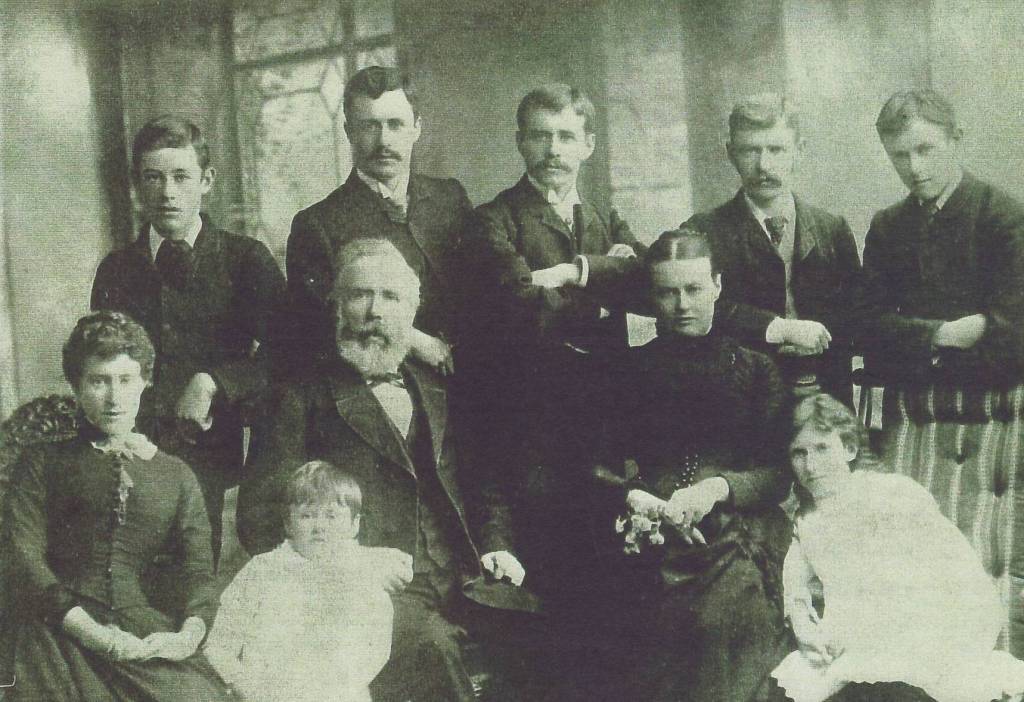
WSR and Susannah had 10 children, with 5 sons and 3 daughters surviving beyond infancy. WSR made a trip back to California in 1876, travelling by boat, train, stagecoach and horseback to visit with his brother David, his sister Mary Ann and another younger brother, Frank who had also become involved in mining and farming in both California and Utah. He sent three detailed letters back to Susannah on that trip, which we have made into a self-contained story – perhaps I’ll put it up here one day!
The eldest son, John, who was my great grandfather, became an accountant and had a seat on the Ballarat Gold Exchange before marrying in Wollongong and then taking a position in Fiji. He returned to Australia and settled in Sydney where my grandmother and mother were born.
Some years ago, Vicki and I met some Hambly cousins in Ballarat and lifelong friendships ensued. In particular, two Ryan sisters, Marion Brennan and Anne Pinches, descendants of WSR’s youngest daughter, Marion May Hambly, have provided energy, perspective and knowledge about the Hambly family for more than ten years and must be acknowledged for their input, insight and unwavering support.
And finally, an obituary from the Ballarat Star (Vic. : 1865 – 1924), Monday 5 December 1898, page 4
THE LATE MR HAMBLY.
BY SILVERPEN.
Mr W. Hambly, boot merchant, one of our oldest business men of Ballarat East, passed away peacefully on Friday morning. Mr Hambly was one of the most honest, conscientious residents in Ballarat East. For many years he carried on a successful business opposite the Exhibition Mart. He then removed to Sturt street, and a year or two ago he retired. In the very early days few men were better known, and his private life was unblemishable. Many years ago he visited America. Before leaving, a testimonial was presented to him by the old residents of Ballarat, the late Jonas Summeracales and Mr Henry Glenny, J.P., taking the matter in hand. It is a good thing, as the Rev. Lewis said at the grave on Friday afternoon, to find a man leaving a splendid character for up rightness and honesty to his children, and no man could claim these good qualities better than their deceased friend. Mr Hambly was at one time a member of St. John’s Lodge of Freemasons, and for many years a staunch member and supporter of the Congregational Church. A widow and a large family of sons and daughters are left to mourn the loss of a good husband and father, a kind friend and a genuine honest business man.
 miles of irvings
Leave a comment