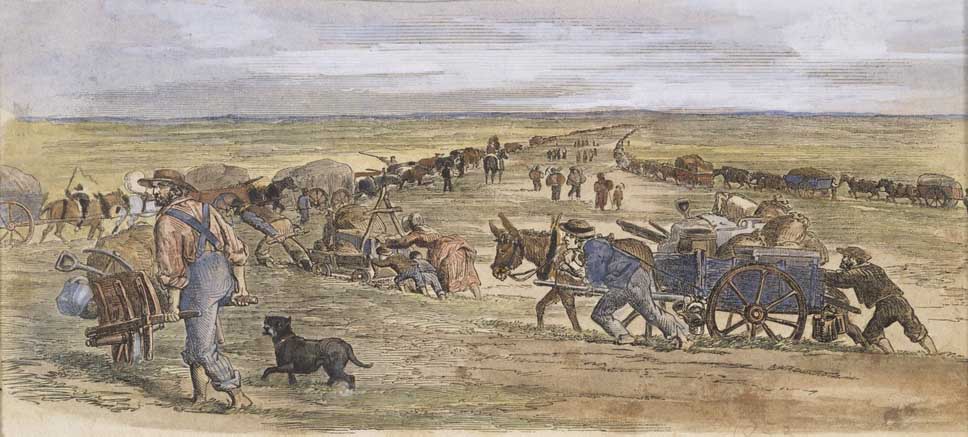
How did a mining captain’s son from Cornwall end up on the Ballarat gold fields of the 1850’s before importing boots from his brother-in-law’s factory in Devon?
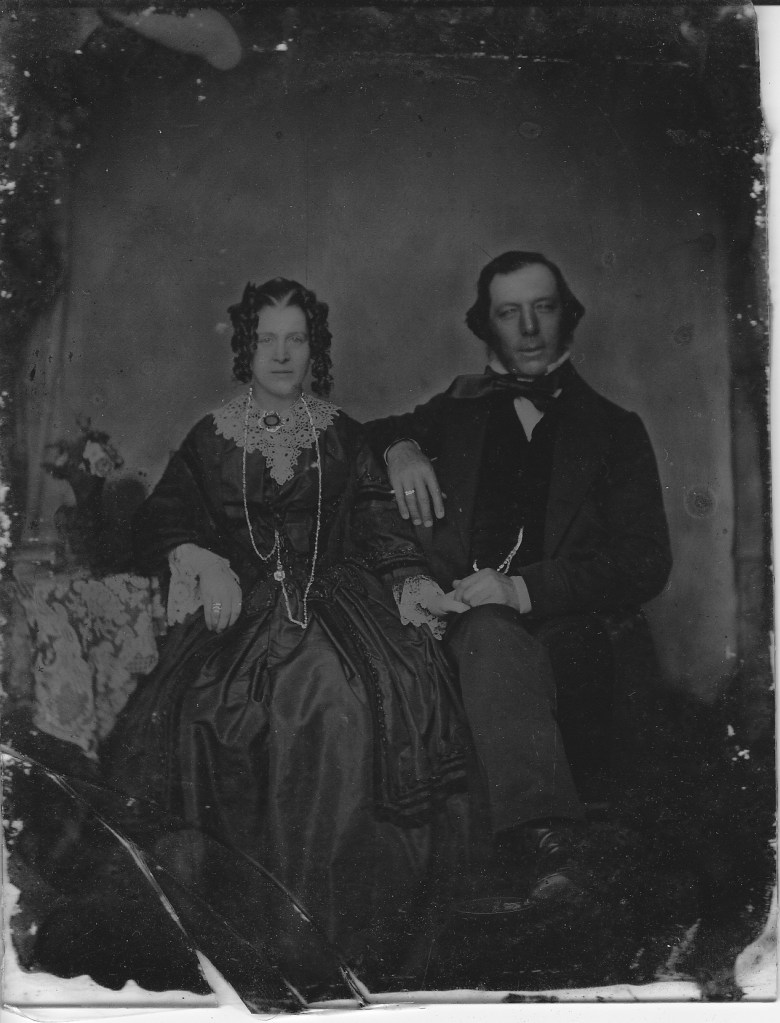
Thomas Edward Miles, born in 1809 was a Welsh blacksmith from Upper Merthyr Tydfil, Glamorgan, Wales; he married Ann Jones, born in 1814 in Merthyr Tydfil in 1835 and they had 8 children, 4 boys and 4 girls. These Welsh Miles folk were not related to Grandma Vicki Miles – her family of Miles’s came from the small farming villages of Englishcombe, Priston and Narwell just south of Bath in Somerset, England. In 1862 Thomas Edward Miles emigrated to Australia, sailing from Liverpool to Melbourne on the “Shalimar” with his wife, the 4 daughters and the youngest son – Edward Thomas Miles – who was 19 years old. The journey took about 3 months and the family would never see the oldest Miles boys again! Thomas Edward Miles the blacksmith settled his family in Sebastopol, a small township just next to Ballarat in the heart of the Victorian Gold Fields, probably plying his trade, making and mending tools for the miners. Thomas & Ann did not move from that place for the rest of their lives.
The son, Edward Thomas Miles, (we’ll call him the Reverend Miles), became a Congregational Minister in his twenties and on 22nd January 1872 he married a young woman, Ellen Rundell Marshall who was the daughter of your 5th great grandmother, Lucy Upcott Rundell. They were married in the Ballarat home of Ellen’s older half-sister, Susannah Netherton, and her husband, William Samuel Rawling Hambly.
Your 5th great grandmother, Lucy Upcott Rundell came to Australia in July 1853 after being widowed twice. The first husband was a letter carrier, William Blewett Netherton who died in Chelsea, London in 1843, most probably from cholera. She moved back to the Plymouth/Devonport region of Devon at the mouth of the Tamar River, where she had grown up (her father was a naval ship builder) and married James Marshall, a gunner with the Royal Navy. He died in December 1852 and six months later Lucy made the voyage to Victoria and onto the Goldfields of Ballarat and Bendigo on the “Euphemus” with her four young daughters and one son, aged from 3 to 13. The whole world knew about huge amounts of gold being found in Victoria and people were sailing from England and Europe aboard any ship possible to get in on the action. Lucy’s probable intention was to have a better life and to find suitable husbands for her daughters, although three of her brothers and one sister had migrated to Victoria over a five-year span between 1849 and 1854.
Also making his way to Ballarat in 1853 was a young man named Samuel Squires Gimblett, (and we’ll call him SS), a shoemaker, or cordwainer as they were called back then, from the small township of Gunnislake in Cornwall. The ship SS was sailing on, the “Earl of Charlemont” was wrecked on the south western heads of Port Phillip Bay as it tried to enter the bay at night in a storm in June 1853, a month before Lucy Upcott Rundell and her children arrived. Luckily, everyone survived the shipwreck.
SS was recently married to a Mine Captain’s daughter from Calstock, Cornwall, on the opposite side of the Tamar River from Plymouth/Devonport and only two miles from Gunnislake. His first wife had died very young, and he was raising 3 young daughters with the assistance of his parents and parents-in-law while trying to build up his shoe making business. Two of his young daughters went to a school in Calstock run by the schoolteacher, Dee Hambly who was the Mine Captain’s daughter. Dee and SS were married in Bristol, 130 miles from Calstock in the middle of winter 1851; this was a marriage not necessarily initially blessed by her father, John Hambly (we’ll call him The Don), but because young Dee was pregnant and their first child was born four months after the marriage in Bristol. The Don, who had grown up in Truro, a Cornish town about 90 kilometres south of the Tamar River, was a businessman expanding an inn in Calstock as it was going through a boom period with the Great Consuls Mine being opened on the Devon side of the Tamar River. The Don was quite the entrepreneur who was also operating as a mine captain at Great Consuls and taking advantage of Calstock’s boom with real estate development. One of his primary builder/partners was an older cousin of SS, a very capable operator named James Taprell Gimblett who after spending time in London, now lived in Calstock with his wife and children.
So in June 1853 SS arrives in Victoria on his own and makes his way to Ballarat after disentangling himself from the shipwreck. Not digging for gold but buying a block of land in the booming township of Ballarat, across the road from the famous Montezuma Hotel. SS did not stay long in Ballarat and went back to England, but we have no record of the return trip. We do know that he started a boot manufacturing business in Crediton, Devon, which is about 65 kilometres from Calstock, Gunnislake and Plymouth.
The Don, originally from a farm just outside Truro in southern Cornwall, had 6 sons and 3 daughters and had spent some years as a mining captain in a place called Gongo Socco, in Brazil in the 1830’s. Two of his children were left in Truro with their grandmother, two went to Brazil with the Don and two more children were born in Gongo Socco. The oldest boy, David was a schoolmate of the son of the Emperor of Brazil. The Don had encouraged his sons to study metallurgy & retail business and in the 1840’s three of them, David, William Samuel Rawling and Josiah travelled to America; to Wisconsin at the edge of the Great Lakes and began mining for lead at a town called Dubuque. The eldest son, David Hambly, who was married and had his own children, was shown some gold bearing ore in 1850 from California, so he and four friends travelled across America on horseback to see first-hand what opportunities might exist for them. Satisfied that the ore was of high grade and that this was going to be a Gold Rush, they returned to Wisconsin, sold everything and arranged a wagon train to make the long trek back across America to California. The youngest of The Don’s sons, Josiah, died on the trek, probably from cholera, at the young age of 19.
The second son, William Samuel Rawlings Hambly (we’ll call him WSR), went ahead of the wagon train by boat, sailing down the east coast of America to Nicaragua, crossing by land and lake to the west coast and sailing up past Mexico to San Francisco where he was to meet up with his brothers and their wagon train. Unfortunately, the ship he was on sank off Acapulco and it took him months to find passage on another ship. He was found as a stowaway on one occasion and thrown overboard. When he eventually got to San Francisco he started selling beer until his brothers arrived. Together they worked the claims that David had made in Plumas County but WSR then received a message from The Don that Ballarat, Victoria was the “next big thing”, and he should leave David to establish himself in California and get down to Australia as quickly as possible. WSR found and boarded a small Italian sailing ship, the “Destruzione” which was travelling to Sydney via Tahiti. WSR landed in Sydney in August 1853 and headed straight for the Victorian Gold Fields, participating in gold finds at places called Creswick and Fiery Point. WSR felt that by 1854 the gold that was on the surface had been mostly found and that hard quartz crushing was the next phase; something that he didn’t want to be part of. In short, he felt that chasing gold was a mug’s game.
1854 saw another family land in the Victorian Colony and make their way to Ballarat. We have no record of their ship or exact arrival date; but by early 1855 James Taprell Gimblett, the builder from Calstock was in Ballarat and had constructed and opened a shop, opposite the Montezuma Hotel, selling English made boots for miners. The Don put WSR and James Taprell Gimblett in touch with each other; the footwear manufacturing that SS set up in Crediton was expanding, WSR was looking for a business opportunity as he’d met by this stage, one of Lucy’s daughters – 16-year-old Susannah Netherton and was ready to settle down to the family and business life in Ballarat which was now recognised as a real boom town. They were married in November 1855 in Collingwood, Melbourne. And yes, as we saw at the beginning of this story, theirs was the house that the Welsh Reverend married Susannah’s younger sister Ellen!
In 1856 the boot and shoe shop in Ballarat became a formal business partnership between James Taprell Gimblett and WSR Hambly, supplied by SS Gimblett through his company The Economic Shoe Works on High Street Crediton. The partnership “Gimblett and Hambly”, did very well for all concerned with James Taprell Gimblett being bought out by WSR in 1862 and retiring to live on property at Beechworth, another gold rush town where he would farm and raise cattle.
WSR and Susannah had 10 children, with 5 sons and 3 daughters surviving beyond infancy. The eldest son, John, who was your 3rd great grandfather, was 12 years old when his aunt, Ellen Rundell Marshall married the Welsh Reverend Miles at WSR & Susannah’s house in Grant Street Ballarat. The Welsh Reverend was 29 and Ellen 22 when they married and soon moved to the small township of Eldorado, just outside Beechworth. James Taprell Gimblett had died a couple of years earlier but his two sons were still on the land. And Ned Kelly was also running amok in the region – he served 6 months in Beechworth Gaol in 1870.
The Welsh Reverend & Ellen Miles had two children in Eldorado; they then moved to Melbourne, had a few more children and then in 1889 moved to Wollongong as the Congregational Minister for the district, and had one more son.
Almost 24 years after seeing his aunt Ellen marry the Welsh Reverend Miles in Ballarat, John Hambly, your 3rd Great Grandfather married Selina Bernice Parker on 5th February 1896 in Wollongong at the Congregational Church manse, officiated by none other than the Welsh Reverend Miles, his uncle by marriage.
WSR was listed as a witness on the Marriage Certificate; taking the family from Ballarat to Wollongong would have taken a few days, probably by train, but still not a bad effort for an old fella – WSR died two years later!
Both Bernice Parker and John Hambly are listed on the Marriage Certificate as living in Darlinghurst Sydney. Where and how they met is unknown. John is listed as a Clerk with no details about his father; and Bernice has no occupation listed, however her father is noted as John Parker, a Contractor. Soon after their marriage they went to live in Fiji where John was employed as an accountant on a plantation of some kind, perhaps sugar. Sometime before 30th April 1905 they returned to Sydney as your 2nd great Grandmother, who we used to call Granan, was born there on that date. They later moved to Melbourne – the Elsternwick, St. Kilda area – where Granan first went to school. They were back in Sydney, living in Northbridge in the early 1920’s, where Granan married the boy who lived over the fence, Caleb Hutton Vacchini in January 1926. Their oldest child, your Great Grandmother, Juli, or Oma, was born in July 1927.
The Reverend Miles, the Welsh blacksmith’s son, retired to Chatswood in Sydney and died in 1907. Today the Church in Wollongong is still being used as a church; and the Manse is Heritage listed as Wollongong’s oldest house. The Welsh Reverend’s mother, Ann, died in 1886 in Sebastopol and his father, Thomas Miles, the Welsh blacksmith, died in Sebastopol in 1887 at the grand age of 78.

 miles of irvings
Leave a comment